
(Yeah, well, you title it, then.)
Our presentations yesterday in class featured my brave and wonderful fellow students Jamie Forrest and Angela Byrnes talking about professional development, and mentors Tania Sterling and Lyn Hilt talking about social media for teaching and administration.
I took two different kinds of notes. For Jamie and Angela’s presentation, I wanted to pick up tips for the Program for Online Teaching, my volunteer professional development group. I appreciated the shared survey especially. I should survey our faculty more often, but when I do I often discover they want things we can’t deliver, like other faculty teaching them to click here and click there. I’m hoping the idea of how-to sheets, which Jamie and Angela proposed, could make that sort of thing easier. (At our college, we have one faculty “trainer”, and her only real specialty is Blackboard, though she also knows Elluminate and Camtasia. We don’t have anyone among our computer people who likes Web 2.0 or knows that much, or if anyone does they aren’t in a position to help. I was inspired to share more tools at department and committee meetings, if I can figure out how to “sneak it in”.)
Both Tania’s and Lyn’s presentation helped me with teaching, and during Tania’s presentation I went off on a trail in my head. As they say on Monk, here’s what happened:
Tania mentioned students tweeting during a lecture. It occurred to me I haven’t done that – not that I don’t allow it, but that my students tend to only bring their laptops on lab days, except for the two or three who take notes on theirs. When I have had the chat open for lab days, they say silly things, and I see them on the screen. Once they did discuss something about the class, which was great.
Tania put this in the context of assessment and instant feedback. That made me think of Cross and Angelo’s simple and quick Classroom Assessment Techniques, which I used to use all the time but have lost track of. Then I remembered David Merrill‘s keynote at ED-MEDIA in 2009, where I watched the Twitter feed behind him on a big screen as he spoke. Quite a dispute went on there, and I thought it got kind of rude a few times, but the idea was interesting. What if I lectured and students tweeted? Behind me? That seems worse than turning your back on the class to write whole paragraphs on the board….
But…I do sometimes lecture, as often as I’ve said I wouldn’t. And I usually prepare a few visuals, Zen slides, to illustrate my points. Usually the slides are visual primary sources: examples of art, architecture, etc. But on lab day, students find their own sources and combine them for their own quick presentations, posting their visuals on the WordPress site I use for the class.
It hit me while listening to Tania. Why should I go find the visuals for my lecture? Why can’t my students do that, on the fly? During the session, someone in the chat mentioned Wallwisher. I’d never heard of it so I went to look. Oooh, a board where you don’t need to log in but can add a picture, video, or 160 characters of text! They could use that! I could lecture and they could illustrate what I was saying by adding, say, Gothic cathedral pictures, and I could then see what they had posted immediately and talk about it and we could discuss and….
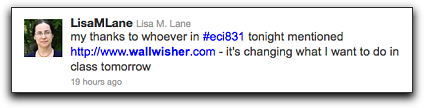
Today was a lab day. So I made a wallwisher wall, despite warnings in Twitter that it might be a little dicey as a web app and Lyn Hilt herself recommending stixy.com:

(I did try stixy, but they made you upload images, and I wanted them linked since students would be quickly finding and posting).
I told students they could try the Wallwisher wall or just do their usual work on the WP blog. They started working, then Wallwisher went down during class, not once, but twice.
So my enthusiasm has dimmed since last night. But you know, it’s about the teaching, not the tools. The students easily switched back to the WP blog, even though it wasn’t as cool. No one minded trying something and having it fail. I’ll find a better tool, and I’ll use it for lecturing someday. I love the idea that they could illustrate my lecture — I have a really strong feeling that will be cool on so many levels: less work for me, more interactivity for them, and that possibility of things going in unplanned directions (which is what I love about teaching live).
It may not have been a good thing today, but it will be a good thing.


Doesn’t that always seem to happen? You are so excited about a new tech tool and you pass your enthusiasm onto your students and then it doesn’t work… but you’re right, it’s about the teaching and not the tools.
I was also inspired by both Tania and Lynn. I had never thought of using technology to provide instant feedback to students and I am looking forward to trying it with my students. I’ve been reading the work of Anne Davis and I am finding it very inspiring. She also talks of instant feedback and involving students in their own learning. I can see using tools such as Wallwisher and even Twitter to do this.
Less work for us… wouldn’t that be nice Thanks for your post!
**On a side note, how did you capture the Twitter feed to insert it into your blog?
Thanks, Angela, for commenting!
I have Snapz Pro, which I bought years ago, but I could capture with Grab (I’m on a Mac) or any screenshot program — that’s all I’m oding.
I think I’ve learned, as you did, more from things that didn’t work well, than from things that were easy to make happen. Wallwisher IS a cool tool, but it doesn’t always perform when you need it most. But the students knew what you were up to, and learned anyway. They got the point and you have made another forward step into engaging their minds to think beyond the lecture.
I really enjoy reading your posts- they are authentic and full of humour and honesty, and strike a chord each time. They prove that learning in an open environment is inherently risky, but very rewarding. Keep writing!