Openness and professionalism

Why is it so scary to blog and share what we do, as faculty?

Because our job is usually private.

This may sound odd, because we teach in classrooms full of people. But usually it isn’t full of colleagues watching us teach in our disciplines. That tends to happen only during faculty evaluation, and that makes many of us totally nervous. I hate having other faculty “sit in” on my class. What if something goes wrong? That’s the only chance, that one hour, and then they will make their judgement, and that could affect my job, and thus my whole life.

Part of the problem is exactly that — it’s the only chance. If these colleagues were there every day, it wouldn’t be so bad. They’d see the body of my work, the good days and the bad days.

But college teaching is also private for a reason. I am supposed to have academic freedom, the right to teach the subject the way I want to, using my own methods. That’s why I became a college instructor instead of a high school teacher. It is hard to develop innovative teaching methods with narrow-minded people watching my every move and breathing down my neck. I want to try things, experiment, have me and the students working together.

And when I am evaluated, even that’s in private. Yesterday I received a copy of  my evaluation packet from last year. It was sealed in an inter-campus envelope with a “Confidential” label stamped across it. My evaluation meeting was conducted in a small room with four other people: my dean, my department chair, one historian, and one faculty colleague of my choice.  I did a little show for them, took them through my packet, then I left the room. They talked, in private. They wrote my evaluation, privately. It is so private it is kept in a locked file and I had to go over to the Instruction Office to sign my evaluation. Email isn’t private enough.

Now, I consider myself a public servant, since I work at a public community college. But would I want my evaluation to be public? Perhaps the public wouldn’t understand. There is a pretty anti-intellectual movement going on right now in the public. They think I don’t earn my pay, which is the highest of all the community colleges in the state. They think I take summers off and loaf, talk for a living, produce nothing of importance, and don’t do my job when students don’t get high scores and a degree they can translate into a six figure income. Couple that with administrators whose main purpose seems to be to catch me out not doing my job, not following the rules. Why on earth should I share anything I do?

Here’s why.

I’m a professional. Professionals work in peer communities. Doctors, lawyers, accountants, and scientists engage in ongoing education in a discipline controlled by their peer network. Their work is published and peer-reviewed. It is public, but not necessarily evaluated in its worth by the public, and there is an understanding that the profession advances society over time, regardless of the vagaries of public fashion. If I leave the evaluation of my work to my students and my bosses, I am not acting like a professional.

And thus I am not treated as one. Adjunct instructors are treated like migrant labor at many places, disposable and expendable. Corporations and publishers are trying to take over the teaching of our subjects through canned online classes and for-profit “colleges” that can hire anyone to “teach” (or, rather, manage the grading of) our classes. This is not OK with me.

As with any other profession, some practitioners put their heart into what they do, and some don’t. Some want the glory of publication and don’t care about twisting the scientific method or their own morals. Some just want to cash the paycheck and have a beer. Some want to teach online so they can ignore their students, run a canned course someone else wrote because it’s easier, get away with not doing a good job. And as the system gets tweaked to try to prevent these abuses, it gets more closed, more private, more restrictive, and less professional.

If I keep my work in private, with private evaluations subject to the whims of student surveys, hour-long cursory class visits, and administrative traditionalism, my work as a teacher may stay safe and protected, but it can’t grow. Over time I will be unable to articulate the goals of my methods, or develop new ones.

BUT if I put it all out there, I can communicate better with my peers than in a closed system. I can see what others are doing and share my ideas. I can engage in my profession, not just in my discipline (other historians are of somewhat limited help when it comes to teaching issues) but in my calling as a teacher.

We have a right to be treated like professionals, with our approaches and methods respected, debated and analyzed by our peers. I have been teaching as a professor for 23 years. A few years ago, I started to open everything up, until now I put my evaluations online (that “Confidential” seal was truly silly in my case) and publish as much of my work as possible on the web. I am creating a body of work, which my peers can evaluate and comment on. Rising above the private system has enable me not only to grow as a professional, but to insist I be treated as one.

Freaking out? a story of baking bread

See this? It’s bread, just good home-baked bread.

So what’s the big deal? It’s that I made it.

You may not know me well, but if you did, you’d know I’m no Dora Domestic. In fact, I used to be somewhat famous for not knowing my way around a kitchen.

But I decided I wanted to make bread. Might have something to do with medieval technology, or just wanting to do something self-sufficient.

It took awhile. I made some doorstops. At first I thought I couldn’t make bread, that I had no talent for it. Other people didn’t help much — they told me to keep at it, because bread was hard to make. Oh no, I thought, it’s too hard. I stopped for awhile.

I kept looking for a good recipe, better yeast, how to get the water exactly 115 degrees. I found a simpler recipe, just water, flour, yeast, salt, sugar, oil. It came out good. I started to tinker with it. The bread got better each time. Now I make it a lot. And it’s easy. I don’t use measuring spoons. It’s peaceful to make it now, instead of stressful.

It wasn’t hard. It was new. That made it seem hard. But I kept doing it, looking for ways to make it better and easier.

Are blogs, web pages, and teaching online new to you? Keep doing it. You don’t need talent, a feel for it, or strong hands. Just keep making the bread. Soon it will be good.


Data-driven attacks on profs signal cultural revolution?

“Public policy reformer” Rick O’Donnell, fired from the UT system, recently published a paper called Higher Education’s Faculty Productivity Gap: The Cost to Students, Parents & Taxpayers. This followed the public release of faculty data by the UT system, which in itself caused plenty of controversy, and a study called Faculty Productivity and Costs at the University of Texas at Austin, which claimed that an increase in professorial productivity of UT professors would save tons of money (published by the Center for College Affordability & Productivity). There’s a summary here at the Texas Tribune from July 20. O’Donnell’s report goes so far as to label professors as “coasters” or “dodgers”, depending on how many students they teach (note, not how well, but how many) and how much grant-funded research they do.

NPR reported on this debate, which is how I found out about it. And after thinking about it for awhile, and remembering my years as a hard-working Teaching Assistant at university and knowing how large my student load is now, I nevertheless have come to the conclusion that this sustained attack isn’t just about money or “productivity” (a bizarre concept for intellectual work), but about culture.

We are becoming a culture that thinks of “knowledge” as a commodity, and the college systems provide a wonderful locus for attack on intellectualism in general. Although we are not yet at extremes, it hearkens back to the Cultural Revolution in China, where the 7 May Cadre Schools were created to “re-educate” professors and intellectuals by having them perform manual labor on farms. These professors weren’t just a “capitalist elite”. They were seen as not doing “real work” — they were not productive. They too were “dodgers” and “coasters”, producing no identifiable product and rather representing the archaic system the communists wanted to tear down.

“Going to live and work in a production team to wage revolution, 1969” from Chineseposters.net

Yes, I realize that comparing a conservative-backed attack on liberal education might not seem to correspond to a communist attack on elitism, but the motives seem to be the same. Instead of moral jeremiads, physical violence and relocation, we have a simple “release of data” and “reform institutes” releasing “studies”. So the attacks are positivist rather than metaphysical, to use Comte’s epistomology. That doesn’t make them less hostile to intellectual values.

I am not saying that data has no place in higher education, or that workloads shouldn’t be examined. In fact, the issue revealed by the data to me is more one of workload than anything else — adjunct and younger professors may be carrying far more weight than is just or right, even if you only consider a college as a workplace. The cultural aspects that lead to such formulas (dodgers and coasters are obviously derogatory) could lead to some issues that ought to be examined beyond that of cost and productivity.

It may be starting in Texas, but in today’s climate of accountability, “data-driven” decision making, attacks on unions, criticism of school systems, the high cost of college, and questioning of the value of a college education, this is going to spread.

Diderot, come help your Encylopedia

A couple of weeks ago, I needed to link to something defining a MOOC (Massive Open Online Course) for a professional development thang (and for my last post!), so naturally I went to Wikipedia. But the page for “Massive open online course” had very little on it, just a basic definition and a list of years and some courses.

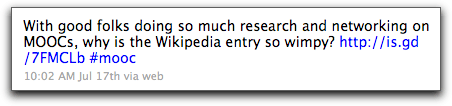
So I tweeted, of course:
And Dave Cormier answered:


Now, I’m not a MOOC expert at all. No research, no articles. I’ve participated fully in three of them, as a student. I taught one in History, and failed. I am teaching another one in fall, POT’s Online Certificate Class. But I started editing, though I’d never edited a Wikipedia article before that I recall. I put in a few names, like George Siemens and Stephen Downes. Then I figured I’d get back to it later.

Then it got more urgent. I regret to say that I have not been able to participate much this summer in the eduMOOC: Online Learning Today…and Tomorrow course. However, I subscribe to the feed from the Google Group. I began seeing a thread called “Please help edit the Wikipedia article on MOOCs (before it disappears)“. Perhaps my actions triggered something, but the MOOC page was set for deletion.

So I and a couple of folks from the eduMOOC class have been working on it. I’ve added links to research, and some text with references, and links from other pages (like Connectivism, and George Siemens) because it was an “orphan” page.

But really, I’m thinking some of the Big Players might want to work on this too? The topic itself is about openness and collaboration, and while blogging and writing journal articles and conducting courses is great, Wikipedia is where most people get their information. In an area that emphasizes open education, shouldn’t the Wikipedia entry be pretty important?

I wonder — did Diderot and d’Alembert outsource the Encyclopedia to their students?

The Wild West and Mobile Learning

I’m immersing myself in Bernie Dodge’s EDTEC700 seminar  in Mobile Learning, and going through materials from EDUCAUSE’s Mobile Computing 5-Day Sprint from April, but my thoughts are out on the range with the cowboys.

I am always wary of EDUCAUSE because of its central IT/administrative focus and corporate sponsors, but the people in the discussions supported the opportunities and concerns that are forming in my own mind about the taming of the wilderness.

Not so long ago, the internet was the Wild West. Those of us teaching on it when it was new, long before technology plans and wireless hotspots, may not have had a lot of spiffy technologies but we had pretty much total freedom. Over the years, the wild horses have been corralled and tamed by Learning Management Systems, the swift emergence of central IT, and the even swifter development of graduate degrees in educational technology and distance learning.

In the first part of the EDUCAUSE Now podcast #38, Bryan Alexander, Terri-Lynn Thayer, George Claffey Jr, Joanna Young, and Gardner Campbell discuss how movile devices are affecting higher ed:

EDUCAUSE Now #38

I am hearing here an echo of the early web-based teaching concerns: how can we keep the freedom? Mobile devices permit all the affordances of the internet (massive amounts of information, social contact, and fun distractions) to be carried around. This provides opportunities to teach in new ways.

Just as some profs didn’t want (and still don’t want) the internet impacting their teaching and their classrooms, some don’t want mobile devices in the classroom (the Turn Off All Mobile Devices in Class syndrome). But, as Gardner Campbell says in the podcast:

“Rather than raise a generation of students who will be waiting until the bell rings so they can go outside and consult their mobile devices, we can and must incorporate the riches these mobile devices present to us into teaching and learning.”

At the same time, out of conferences like this come directives, often along the lines of :

“From a planning perspective, CIOs should assume that the entire user community wil require support for one or more mobile devices.”

“…those institutions with with a well-defined strategy for exploiting mobile technologies will discover significant advantages.”

(These are also from EDUCAUSE, the recent Review).

Last time, the internet cowboys were on the open range. This time, the mobile learning cowboys are already outnumbered by the bank managers, sheriffs, back room accountants in green visors, and federal marshals. There are concerns about central IT and others taking control. I sense these “stable” forces working hard to figure out how to promote the advantages of mobile learning while “organizing” it into “plans” and “strategies”. To me, that means an inevitable restriction of the range by fences.

True, the very mobility of mobile learning should mean it will be more like fencing in birds than cows, but technological and commercial limitations take care of the rest. Apple’s success has already shown that people care more about style and snaz than independence and creativity. (I am currently being “encouraged” to buy a new iPod since Apple refuses to create software so I can update my “old” one, even though nothing is really different inside except a camera the software could ignore.) “Apps” now dominate, and many are proprietary, even when they operate on systems that are open source (like Android). Even QR codes are patented by Denso Wave, though they choose not to exercise rights .

Arcade Saloon, Eldora, Colorado 1898, Denver Public Library

So the railroad investors and moguls will make sure whatever range isn’t limited by managers will be limited by their products.

My hope is that the mobile cowboys will do as much as they can now, making models of independence and creativity, before we enter the next age (which should be, what, a year from now, at the outside?).  Those who exercised insane creativity on the last frontier seem to be the only forces holding the web itself as an open space, against the enclosures of property-owners like Facebook.

So let’s do some jailbreaks and fight in the saloons before things get really civilized (and dull) around here.

Jury Skills and the New Pedagogy

This morning I watched the judge instructing the jury in the Casey Anthony trial, and it occurred to me that the skills needed to be a good juror (and thus a responsible citizen in our society) include the ability to:

  • follow a sustained argument over a period of hours, days or weeks
  • juxtapose two sets of sustained arguments
  • connect witness testimony to the sustained argument in terms of the strength of support
  • listen attentively for long periods without any opportunity to interact with the source of information
  • comprehend high school or college-level vocabulary, such as “abiding”, “negligence”, “bodily”, “deception”, “objective” and “knowingly” within a prescribed context
  • take notes that will be useful later in the recall of both facts and interpretation
  • interpret bias on the part of both the defense and the prosecution
  • determine when the defense or prosecution are attempting to evoke an emotional response designed to sway the juror in examining the facts
  • evaluate witness testimony for bias, consistency, and truthfulness
  • retain an extensive collection of facts in mind for an extended period of time
  • retain the judge’s instructions and fine points of law in mind during deliberation
  • operate according to a list of rules one may not agree with nor fully understand
Image: Christian Science Monitor

Most of these are practiced in the traditional classroom, rather than in a constructivist or connectivist pedagogical model. (In my class, the development of historical theses practices the process of such skills, albeit with far more choice of evidence.)

Is it possible that the new and exciting modes of teaching we examine would undermine the ability of people to be good citizens?

Digital literacy in general would, of course, help greatly in understanding evidence from social networks, computer databases, etc., so I have no argument there. But what about following ones own interests, learning through networks, aggregating information independently, and constructing ones own knowledge? I can’t help but think that habits of mind which discourage sustained attention and argument would make being a juror, and thus a good citizen, more difficult.

Note: After the judge’s instructions, it was realized that some of the jurors had left their notebooks on their chairs when they went to the deliberation room. Did those jurors not take notes? not need them? are they that skilled in factual retention after, what is it, 19 days of trial? I really don’t think so….

Academic Freedom vs Course Quality

Perhaps academic freedom and course quality issues come into conflict all the time, but it is usually hard to see.

From the instructor’s point of view, academic freedom extends to many areas, including how a subject is taught, what work is expected of students, and what readings are assigned.

From an administrator’s point of view (and we can count here department chairs in places where those people have control over evaluating faculty), course quality may be a concern but is difficult to assess.

In many colleges, there are two assurances of course quality. One is at the college-wide, course-level certification. Here the curriculum committee examines state and federal standards, and assures that courses approved to be offered at the college fulfill these standards. The second assurance is faculty evaluation. Faculty whose class offerings are not up to the standard of the college are weeded out, corrected, or reassured during faculty evaluation.

For some administrators, this is not enough. They want to be able to walk into a class at any time, sit down, and see what’s happening. In some places, they do. In others, this is seen as an intrusion that not only makes an instructor nervous, but suggests distrust that is then communicated to students.

Online teaching takes care of this problem, at least from the administrator’s side.

It is now technologically possible for an administrator to enter the college’s course management system and “sit in” on any class. At some colleges they do this with permission, at others they just do it. At some colleges, this is transparent and expected, at others it is not. I just heard a respected administrator say at a conference last week that they sometimes ask permission, sometimes notify the instructor, and if there’s any refusal or “problem”, they just do it. After all, it’s their job.

In California, Title V says that “regular effective contact” must occur between instructor and students. Since often an administrator’s first concern is about how often the instructor is “attending” their own class, this provides an excellent justification for entering a class online to “see what’s up”. In online classes, students feel free to email unedited complaints, often to not very web-savvy administrators, that their instructor didn’t answer their email (it’s been all of 6 hours) or failed to notify them of a deadline (which has been posted in three places on the class website for weeks).

Does this kind of thing violate academic freedom?

Not if academic freedom means only the right to teach a class using the materials and approaches the instructor wants to use, and the administrator’s visits don’t seem to affect that.

But if you consider the tradition of academic freedom, we should also look at what it means, not just what it does. Academic freedom is based on respect for the individual instructor. It is the idea that political differences should not be a cause for restricting the content or method an instructor uses, not only because politics are malleable, but because the professor is considered an expert in the field. S/he is respected as more of an expert than the administrator when it comes to the discipline.

Coming in and sitting down in a professor’s class to “see how things are going” violates that respect, whether it’s on-site or online.

Now, I realize that many departments restrict the academic freedom of their own colleagues, dictating which textbooks they must use and which method they should use. The claim (always) is that it’s easier for students or “ensures” that all students in the same section of the class “get” the same thing. As far as I’m concerned, if we’re thinking like this, we are also showing lack of respect for instructors, and we might as well just all do computer tutorials of the same content the same way.

Such incursions on academic freedom are rarely questioned, and they aren’t questioned at all at for-profit institutions, where not only textbooks but entire courses are designed by someone other than the instructor, who just guides discussion and gives grades. This model provides “consistency”, they say, and value for money, as these instructors are paid less than those at public institutions.

Online education is new enough that people can make up rules as they go along. When I began teaching online in 1998, it would have been absurd to consider that the “rules” were different for online — the challenges, yes, but not the traditions of academic respect. Over the years, this has radically changed, until we are accepting of a system that lauds methods which value standardization over creativity, and administrative interference over academic freedom.

The system has become so oppressive that it is almost impossible for instructors to take back their right to teach the way they want, using the resources they choose. Given the fast-paced changes occurring in our “classroom” (the internet), we are reneging our responsibilities if we don’t examine the options for learning, take advantage of the affordances of the web, and experiment openly with new methods and resources. It is very difficult to do this with administrators hanging out in online classes, adopting Course Quality rubrics based on decade-old models, and telling us we all need to use Blackboard because of FERPA (not so) or college liability (also not so).

But, they say, what about the online prof who doesn’t show up for committee meetings, only logs into their own class every two weeks, doesn’t answer student emails for a month, and just uploads handouts into their classes without offering any form of student interaction?

That’s what faculty evaluation is for (remember that? scroll up). If an on-site faculty member didn’t come to class, read aloud for hours out of the textbook, lectured in long boring tirades, we’d see it on student evaluations and class visits that are part of evaluation. Course quality can be improved for all classes through better faculty evaluations, especially those which include instructional innovation, originality and creativity as evaluative factors.

Course quality and academic freedom meet here, where all elements of a class and its teaching are discussed. We shouldn’t let the ease of accessing online classes (and of standardizing instead of innovating) set a different standard for online, just because we can. In doing so, we’re losing valuable elements, academic freedom being the most crucial.

Historians hoard

We got notice a couple of weeks ago that our offices are going to be carpeted and painted starting June 6, and that we have to pack up and label everything ourselves.

I have been in this office for over 15 years, and I’m a historian. Historians hoard. You never know when something might be useful! Here’s before packing (well, as I was starting – I don’t normally keep a roll of paper towels on my desk):

And here’s (almost, not quite) all packed up:

Exhausting

Two classes, same stuff, vast difference

Every semester I teach two sections of the same class, using the same content and method, just so I can marvel at the differences.

This semester I had the best U.S. history section ever – best grades, most social activity, best learning. Why?

It’s the students. They form their own dynamic, they come in with decent skills, they get into working online, and the whole class takes off.

We don’t like to talk about this. We prefer to think it’s our teaching that leads to students success. Well, up to a point. But I’ve watched this class as I’ve taught it for years, and the main variable is the students themselves, what they do and how they do it.

cc flickr Top Koaysomboon

I can tell by the very first posts. If they’re answering each other’s introductions on their own, we’re good. If I require that, it means nothing. If they just start responding to the prompt, it tends to stick.

And the pattern depends on who posts first. If the first posters stick to a standard intro (name, grade, future plans, work), the tendency is for everyone to follow suit, and they standardize their responses for the rest of the class, regardless of what I model, say, encourage, etc.

If the first posters are original and creative, everyone reaches a higher level.

I wonder if there’s a way to ‘seed’ this. My comments and feedback mean very little, which is how it should be. It’s good that they heed each other. I’m not sure enough research is being done about students setting the tone of a class, but after this class, I think it’s crucial.

Steampunk and historical mashups

I am trying to figure out why some historical mashups bother me less than others. Here’s an example of one that bothers me:

http://media.mtvnservices.com/mgid:uma:video:mtv.com:275121
When I comment on the bad costuming (in this case, he’s in pseudo-19th century garb, and she’s in pseudo-18th century) I have a friend who says, “This is why no one will watch movies with you”.

But this kind of mashup doesn’t annoy me at all — in fact, I think it’s creative.

[youtube=http://www.youtube.com/watch?v=iMuirCKzYEU&w=640&h=390]

I’m thinking it’s particular to steam punk, like my joy in receiving this flash drive. Steampunk combines the contemporary with Victorian sensibilities particularly, or, as in Terry Gilliam’s piece, with Victorian technology, setting, and sensibility.

During the Victorian age, there was a tremendous interest in new technologies, and in a sense mashing things up by combining the symbols of modern progress with those of the traditional past. Take for example this Victorian room:

The Victorian middle class put new technologies (photographs, telephone, gaslight, electric light, phonograph) next to old technologies (paintings, fireplaces, clocks) and enjoyed both equally. So I suspect that the Victorian spirit is much more present in today’s mashup culture than that of any other era one might be stealing from. At least, that’s my theory.

Image source: http://www.flickr.com/groups/victorianhouselovers/pool/ via http://www.ourfixerupper.com

Seven things I’d want to know as a new online teacher

This started as a “things I wish I knew” list, but these are the biggies I’ve learned in 12 years of teaching online:

1. Save everything on your own hard drive.
Course management systems, and access to them, come and go. I now create all quizzes, discussion prompts and extensive directions (the things I plug into a CMS) in plain text files, then use copy-and-paste to put them into whatever system.

2. Serve yourself.
Serve your creations from a server where you rent space rather than the college’s server — link to or embed everything. You never know who’ll decide they own your stuff, or when resources won’t be available. And that “Web 2.0” company (think Ning) could go premium or be gone entirely tomorrow.

3. Trying to reduce workload can lead to better creativity.
Most online classes at public institutions contain too many students. Learning techniques of grouping students, clustering assignments, and using templates for activities is invaluable.

4. Online teaching is its own discipline, and we need to study it.
It’s not just a “method of delivery” or a “format” — it’s its own field, with a whole community of practitioners in K-12, college, training and consulting. It pays to be in touch with people who know the latest trends. Entire careers are being built by people who know nothing about teaching, but get advanced degrees researching it so they can get jobs and tell you what to do. Not knowing the jargon or the research, and being able to critique it, could mean less autonomy in your own work.

5. Knowing HTML will be a boon more times than you can count.
Entering (or copying and pasting — see #1) text into WYSIWYG editors inside various systems does not give you enough control. When something goes wrong (the text looks bad, the paragraph doesn’t indent correctly, the bulleting is mixed up) , clicking on < > and fixing it saves loads of time. Also, knowing just a bit of code means you can use other people’s cool ideas and plug them in yourself.

6. Sharing is important.
Current trends show that the “wild west” nature of the open web is moving toward more closed applications (think Facebook). Large media companies now dominate the web, but so far, access is low-threshold. This means we can share our work with each other just by putting it on the open web. Innovation, help, ideas, and reflection result from doing this.

7. Content isn’t a course.
More and more universities (Harvard, MIT, Berkeley) are offering their lectures freely and openly. But content isn’t a course — just plugging in someone else’s material doesn’t make it a class, much less your class. This is also true of publisher-created content. Student’s highest priority remains learning from the teacher, whether directly or through the pedagogy designed by the instructor. If you’re not creating the content pathway and facilitating the learning at every step, you’re not the teacher.

The loneliness of the open autonomous learner

People like to be recognized for their contribution. In a large social network, a big class or a community, folks who work hard contributing a lot don’t necessarily do it for the recognition — they do it to share and help. But anonymity can be lonely, like being alone in a crowd or doing a good job at work and having nobody notice.

Students in large classes often feel like this. When I attended UCLA for two strange quarters many years ago, I sat in lecture halls with hundreds of other students. I was completely anonymous. The brilliant professor on stage couldn’t have seen my hand even if I’d felt encouraged to raise it, which I wasn’t. The discussion section was where I could talk and ask questions. My teaching assistant got to know me, not my prof. She gave me feedback, so I knew that I was contributing appropriately.

Entering a large online class, social network, or online professional community feels like that large lecture hall, except there’s no stage. Instead, it’s like an ancient Greek agora, the big open space where Athenian citizens gathered to make political decisions. With so many people, only those with the best speaking skills got the attention and were able to make their point (thus the high profits for Sophists, much to the disgust of Socrates). The others could only listen, and weren’t necessarily encouraged to raise their hand.

Independent learning, even with the affordances offered by online communities and classes, can feel the same way. Autonomy is great. It enables learners to create their own Personal Learning Environments and be self-directed. Many people have the desire for autonomy — some studies have correlated it with happiness and as a preventative for depression. But does that mean they want to be alone and unrecognized?

If the drive toward social online connections tells us anything, it tells us that people want to be both autonomous and recognized. We want our own profiles, our own apps, but to be part of a network of friends or colleagues. Contributions must be more than acknowledged; they must be appreciated. It is very lonely to post hundreds of tweets or updates, and have no one respond. In online classes, one may post the required number of times in a forum, but have no one reply while others are engaged in conversation.

I heard Leigh Blackhall referenced yesterday in a presentation by Gardner Campbell, assigned for DS106 Digital Storytelling by Jim Groom, then hours later read Leigh’s What Am I Doing? post. I had been following Leigh because of his un-PhD idea (I am also a frustrated non-PhD person), but he sees lack of response on his education posts.

Leigh didn’t know I was there. And perhaps it’s like teaching, and I don’t know who I’m influencing with my work. And maybe all the people who learn autonomously and in the open also feel a bit lonely, because they can’t know the impact they’re having, and one would think that with ones work available all over the world, there’d be more than a comment or two. Is there thus an inherent loneliness that goes along with autonomous learning, even (or especially) when it’s open?

Photo by Padraic Woods

Mysteries of annotation

Perhaps it’s my fascination with medieval manuscripts, and the image of those translators in Spain working on the Arabic texts which annotated and expanded the Greek scientific classics. Or perhaps it’s all those scholars who created works like the Talmud, its commentary on the commentaries, but I find annotation very intriguing.

I trust a number of the medieval scholars, but annotation by people I don’t know is disconcerting. If I read someone’s work for awhile, on their blog or articles or books, I will come to trust their interpretation. But sometimes the source is mysterious.

boonotesmed

This is a copy of Steven Johnson’s book, Emergence. It’s not an old book (2002), and yet by the time I checked it out of the library, someone had already marked it up extensively.

It affected my reading, and eventually I had to take the book back unfinished. I’ll have to read a clean copy. I kept getting the message of the anonymous annotator, rather than my own interpretation of what Johnson was writing.

I’ve mentioned elsewhere my difficulty with an interpretation already superimposed upon a work. Annotations, even if they’re just notes and highlighting, constitute their own work.

Thus even annotating bookmarks, for example, in Diigo, could be seen as a creative act. I could easily see doing only that for ones online scholarly experience, marking up the work of others. I could also see creating an entire class that did only that, applying knowledge of a discipline to writings in that or related disciplines, at any adult level of schooling.

Because so many authors seem intent on presenting only their own interpretation, particularly in the various books on current inquiries into knowledge via the web, the annotations are left to the amateurs (like myself). Commentary on events is taken seriously (think political pundits), but commentary on writings is not, outside of scientific journals and highly specialized fields.

The format of blogs does not encourage annotation or commentary either. Blog comments are attached to posts, which gradually scroll away. Blogs thus don’t provide a middle ground between the primary work and open social discussion. Annotation fills this need, for focused and extended critical analysis. Rashi spent much of his adult life writing Chumash and Talmud commentary, and how could anyone study law without it? But on blogs, most people who would be commenting and critiquing extensively in the days before the web prefer to post their own ideas and have others comment instead. And too much of the critiquing becomes both personal and dogmatic, which is not helpful in furthering knowledge.

A genuine commentary culture could thus help mitigate the speed of information (and disinformation) on the web. Knowledgeable annotators could provide a useful filter and a mechanism for perspective, before rumors become cultural facts. This has been a primary role of the press for the last century — respected annotators could share this role with more traditional journalists and editors.

An emphasis on annotation and commentary in learning would fill an intellectual gap and foster both criticism and new ideas. I’d like to see it come back into fashion (though not, perhaps, in my library books).

Three Projects Done

I have just finished three major projects, which combined with others have kept me from posting much on this, my one true blog. But I have been posting — oh my, yes!

   
cc jayneandd at Flickr

The first collection of my last four months of posts are at my blog for the EC&I 831: Social Media and Open Education class, which I just completed. This was the incredible class I audited a couple of years ago, taught by Alec Couros at the University of Regina. This time I took it for graduate credit. Although it was a lot of work, we were allowed substantial independence in our topics, so I was able to explore ideas about techno-utopian thinking and hype as well as the subject of open education. I have returned even more dedicated to open education as a concept and a mission of my own, and somewhat more cynical about social media.

Emblem7BwtextThe other collection of posts was a continuation of my work for the certificate at the Program for Online Teaching. Although I was in the crew that created our online teaching certificate and its requirements, I had not completed the process to actually earn one of my own until today. Our Pedagogy First! blog requires two semesters, the first exploring pedagogy and tools, and the second engaging in application and helping others.

I saw a kind of community emerge at the PF blog, and I’d like to see it continue. I’m still not sure whether a multi-user blog was the way to do this, although it certainly seemed more open and interesting than a forum in a CMS or a Ning. I hope to explore multi-user WordPress options with AIS.

My third project was my faculty evaluation, which we do every four years (or two, if they want). Influenced by my new dedication toward open education, I put my full evaluation portfolio online. While I would not necessarily want this to be a model for all, or even a few, faculty, most of my work is online teaching so it just made sense to me.

Feels like coming home to be blogging here again!

Attribution Matters

As I noted in today’s blog post for EC&I831 class, I’ve been reading Jaron Lanier. And doing that makes me think about attribution. At the very least, I would like to attribute as much of the stuff I find on the web as possible, particularly stuff that is created “from scratch”, both textual and visual.

So today I followed a link from Rodd Lucier in Twitter: http://twitpic.com/31l7sc. It’s the image you see on the left. I noticed that Rodd wrote a query at the bottom for Badd_moon, the person who posted the image, about whether the images were licensed for sharing. With Lanier on the brain, I tried to track it down. On Badd_moon’s Twitpic page, karohemd said:

This led me here so I tweeted that the artist was Scott Beale (laughingsquid in Twitter) and his FAQ said the images were licensed for Creative Commons, so I tweeted that. But then I scrolled down the page and found the real attribution:

Sao Paulo ad agency Moma Propaganda created a wondeful series of retro future ads for Facebook, YouTube and Skype as part of the “Everything Ages Fast” ad campaign for Maximidia Seminars.

and the update saying high-res images could be downloaded from Maximidia.

This seemed like a lot of work to find out who made an image, but I was glad I did it (and not just because Rodd mentioned me on his blog). I somehow felt better knowing that whoever made these (I still don’t have an artist’s name) was paid for his work. By someone. Somewhere in Brazil. I think.

Should teachers be web-savvy or web-aware?

A fascinating discussion is taking place at Scott McLeod’s Dangerously Irrelevant blog. Titled We can’t let educators off the hook, it actually starts with a quotation from Steve Dembo that I really, really understand:

In fact, the majority of the voices in the EdTech Community are so far ahead of the curve that it doesn’t even seem like their on the same road anymore. Most educators have never listened to a podcast, much less created one. They’ve never edited a wiki, much less started one of their own. So how on earth could they be expected to have a rational conversation about the impact new technologies are having on the skill sets our students need? Simply put, they can’t.

Arguments range from “force it down their throat” to “don’t worry about it”.

I’m not actually concerned on a larger scale, except in a sociological sense. I don’t believe that elementary and junior high teachers need to be web-savvy, just web-aware. High school teachers need to be even more web-aware, because some students won’t go to college. The web should be studied for its effects on economy, society, communications, technology. Yet many high schools don’t require the social sciences that would examine this, such as sociology or anthropology.

College is a bit different. For college instructors in any discipline to not be able to use the web for their own research is appalling. For them not to use Facebook is not. If they’re teaching in a discipline where the web is part of the subject matter, they should know enough to teach that. But while much of that may benefit from immersion in the web environment, I don’t believe they need to be immersed if they understand the immersion. I don’t have to live in the Middle Ages to teach it.

Now for professional development of teachers and professors, however, especially any who want to work in the online environment for or with their classes, web-savviness is crucial. I am very concerned about the professors who say “I want to (or worse, I’m going to) teach online” and “I’m not much of a tech person” at the same time. That disconnect has to be worked on. You can’t work online without being web-savvy, and please please don’t do it with real live students. I think it’s criminal to upload Word documents into Blackboard, post a few factual questions on the discussion board, and say you’re “teaching online”.

To me, it’s more significant that we’ve got teachers who are teaching online but don’t understand the web, than that we have pre-college teachers not “getting it”. Let’s start with the people who are modeling the skills that we want the future educators to know.

Open but Counted: A Model for Open Classes

There has been a debate for some time, likely since even before the Connectivism Massively Open Online Course (CCK08) offered by George Siemens and Stephen Downes in 2008, about the “worth” of open online classes. The current analysis by Dave Cormier, who has also co-taught such classes, is valuable in setting up some of these issues, which he did in response to a critic named Ken (whom, if I recall correctly, was also part of CCK08).

The issue of how to rate the value of an open online class is, it is acknowledged, ultimately up to the individual participant. I participated fully in CCK08, and I did it for graduate course credit. That credit was important to me. A number of open learners like to brag that they are just in it for their own learning, not in order to move ahead in their careers or get a degree. But professional development in a career (particularly a career like mine) is too often neglected and should be heartily appreciated by employers, be them public or private educational institutions. Course credit, particularly graduate credit, is the currency in that transaction, just as a degree is the currency for getting a job.

open sign
CC Flicker by loonyhiker

Yes, I do learn for learning’s sake, and I do it all over the web. But a class is seen by most people as more than a collection of resources with a social network attached. Most people want it to somehow be led by experts. If we are using that model anyway, and such experts are connected to institutions of higher education, why should learners not be able to get official credit? CCK08 combined a small group of officially enrolled students with hundreds of looky-loos, learning-for-learning’s-sake learners, trend spotters, and other interested people. The brunt of the conversation was carried by the instructors, the officially enrolled learners and a small group of strong open participants. The enrolled students had “buy-in” and made a more sustained contribution — hundreds of others might have learned a lot from the class but they didn’t add to it.

In examining why people sign up and then leave such courses, it is a mistake to dismiss the lack of official credit as a reason. There are numerous courses on the web that are fully enrolled because they offer, if nothing else, continuing education credits that people can use in their careers. Some of these classes are lousy. Why take a great class and make it exclusive to those who don’t need credit?

The best model that has emerged thus far is the credit/non-credit open course exhibited in Alec Couros’s graduate classes and CCK08. In both, a small group of students is enrolled officially through a university, with required assignments, assessment and a grade. But the content and social interaction (the heart of the course) is open to all to participate. This provides vast participation without “managing” hundreds of students, and allows many different types of learners to participate.

This type of class is not at all new — optional credit courses have been offered for many years. It is still the best model in the internet age, in fact even more so because the online environment allows the outsiders to be insiders and truly contribute. It makes a better experience for both teachers and students, socially authorizes the activity, and forces the university to participate in new learning methods. Sounds like win-win-win to me.

Don’t attend or participate. Contribute!

Today I went through my grading pages and everywhere changed the word “participation” to “contribution”.

At the half-way point and again at the end of the semester, I ask students to do a self-assessment. Both together are worth 20% of the class grade, and it’s here where I “grade” their discussion forum posts. In these self-assessments, some students admit that they’ve done little to help others, or haven’t posted much in the forum. A few critique my class, saying they shouldn’t have to participate in a forum, they don’t like posting, they don’t think what their colleagues post is helpful, blah blah blah.

Of course, my forums are no longer “discussion” or “reflection”. It isn’t enough anymore to just “participate” — students must add content to the collection, and their own interpretation of a portion of that content in the form of a historical thesis. The expectation that they help each other has been there, but it’s not explicit unless you reference the grading pages.

Studies have shown that this generation of students will need to be able to create things and work in groups, including in an online environment. They need experience at teamwork. But even without this sociological stuff, there’s the old adage that you get out of an experience what you put into it. What they put into my class can’t just be their own private work shared with me. That would be fine if I were a tutor at Oxford, but I’m at a community college with 200 students starting each semester. We must help each other, whether it’s trendy or not. We must create our own norms, feed each others’ minds.

I know some professors who mark a student absent if s/he’s sleeping in class. Aside from the arguments about sleeping in class (sometimes students need to, and I don’t wake them up or take offense), the idea is that if they aren’t awake they can’t listen. Listening isn’t enough.

So, students! What are you bringing to class that will make class better, a more vibrant learning environment? Being a good audience? As a professor, I have tired of planning moving and engaging scenes and acting them out, hoping for a good response. Who am I, Shakespeare? This is education, not a Restoration comedy. Coming to class prepared to watch by reading the play ahead of time is good, but in what way are you taking part?

The “Participation Assessment” is now a “Contribution Assessment”. The grading rubric now says “Contribution to the Class” as the column heading instead of “Participation”. A small change in language, yes, but I hope it will emphasize that I expect my students to contribute to the class rather than merely attend or simply participate.

Steampunk Gift

It’s news to me, but there is a cool cultural thing out there called steampunk, wherein a Victorian sensibility is combined with postmodern technology to create something unique. At least, that’s what it means in terms of design rather than science fiction.

Normally I don’t post at all about my personal life, but my husband got me something very special for our anniversary — a thumb drive:

The handles turn and the guage face lights up when it’s plugged in! It holds 8 GB and is referred to as a Portable Information Cabinet which “extends the powers of analytical engines by maintaining a library of algorithmic and documentary files which may be accessed in an instant”. Even the instructions to not get it wet nor drop it from a great height are written this way.

Ordered from England, it was made by Shipton Bellinger’s Steampunk Engineering. It’s absolutely enchanting. I cannot imagine a more perfect anniversary gift.

Texas and the Goodness of Paleopedagogy

I am still thinking about the Texas State Board of Education decision to rewrite the history textbooks for their schools. The idea is apparently to emphasize white Christianity (including creationism) as a guiding force of the nation. At the time, a lot of people asked me what I thought because I’m a historian. History has always been used to further the ends of politics, and what was interesting to me was that people were actually talking about the issue and being concerned. Debate and inquiry (or even better, the other way around) was happening. I liked that.

Then I began thinking about what effect that sort of right-field history book will have on children, and I’ve decided it won’t have much, because in my experience college students do not remember any of the history they learned in the lower grades anyway.

Thus it can be a good thing that students don’t listen in school. The battle over textbooks may seem to be a war for the minds of children, but children see textbook content as crap to be put on a test. If, however, the educational reformers have their way and the teaching of material becomes more active and collaborative, two things may happen:

1. the active, collaborative, discovery method will make it impossible to ignore alternatives to the textbook’s viewpoint (thank goodness for the internet), or

2. the active method will be resisted by conservatives, and thus children will zone out and not learn the crap.

So a textbook like the one they plan in Texas might not work the way they think it will. This may be the best argument for retaining instructivist pedagogy, rote memorization, and boring educational methods I’ve ever considered.

Robots, Man and the Future of Education

Discover Magazine in May had a wonderful “article” (I use quotation marks because it read much more like an editorial) about robots. “The Body Shop” by Bruno Maddox launched immediately into a discussion of “robo-fear”, how we used to be afraid of “War of the Worlds” and “Terminator” robots, but now we don’t seem so afraid. I thought of one of my favorite bad movies, “Runaway“, where the robots, programmed by a demonic Gene Simmons, killed people as good cop Tom Selleck tried to figure out the mystery.

This is a trail that reaches back at least to Mary Shelley’s “Frankenstein” — I would argue that Shelley’s monster is just the start of a pattern of “manufactured people” continuing into characters from “The Day the Earth Stood Still” (“Klaatu barada nikto“, for goodness sake) to “Westworld” to R2D2.

Maddox claims we aren’t afraid anymore, and I want to have him explain why. Unfortunately, the May issue is not yet on the open web, and even though I subscribe the online version I’m allowed to access won’t let me copy anything. Luckily for me, I don’t keyboard, I type, so we’re good.

I’d argue that the revolution of the last 20 years has quenched our robo-fear, not so much by giving us a taste for change as by taking the gleam off that spark of humanity that we used to be so proud of. What is Man? people used to wonder. Is consciousness divine in origin? Or is it a mere accident of nature that we alone, of all the matter in this Great Universe, adrift upon this marbled speck, have the power to dignify and enoble our condition by understanding it, or at least attempting to?

Then along came the Internet, and now we know what Man is. He enjoys porn and photographs of cats on top of things. He spells definitely with an a, for the most part, and the possessive its with an apostrophe. On questions of great import or questions of scant import, he chooses sides based on what, and whom, choosing that particular side makes him feel like, and he argues passionately for his cause, all the more so after facts emerge to prove him a fool, a liar, and a hypocrite. If a joke or a turn of phrase amuses him, he repeats it, as if he thought of it, to others who then do the same. If something scares him, he acts bored and sarcastic.

That’s pretty much it for Man, it turns out after all the fuss. And so our robo-fear has become a robo-hope. Our dreams for ourselves are pretty much over, having been ended by the recent and vivid reiteration of the news that we really are just grubby and axcitable apes, incapable by our nature of even agreeing on a set of facts, let along working together to tray and change them….It’s already clear that we’re not building robots in our own image. We’re building them in the image of the people we wish we were….

You know I never quote extensively, but this seemed to speak to me. Then it turns out, this week in the Education Futures online MOOC, a free massive online class being led by Dave Cormier and George Siemens, the topic for this week is How Do People Decide? I would no longer answer this with a glib “Badly.”

While I understand the desire to do research and create formulas in order to enlighten us on this issue (see the assigned readings), I’m not sure it’s helpful in predicting the future. This is partly because, as a historian, I know the future is not really predicted anyway. Rather it is dreamed. Parts of the dream become reality as persistent, and often manic or obsessive, individuals, make it happen. Other parts are stored or forgotten (or both).

http://lisahistory.net/media/WestWing5jetpacksm.mov

We do not get the future we expect, and many people have different and competing visions. For education, there is a dream of openness which reminds me of the Progressives pushing for mandatory public education from the 1880s to the 1920s. I thought of John Dewey, of whom I know little. When I looked him up on Wikipedia, I found a quotation of his that seems to be the same argument about pedagogy we have now:

The older type of instruction tended to treat the teacher as a dictatorial ruler. The newer type sometimes treats the teacher as a negligible factor, almost as an evil, though a necessary one. In reality, the teacher is the intellectual leader of a social group, He is a leader, not in virtue of official position, but because of wider and deeper knowledge and matured experience. The supposition that the teacher must abdicate its leadership is merely silly.

Elsewhere, I see the progressives who created public schools that allowed children to learn instead of work in factories referred to as both fascists (with reference to the KKK’s support of mandatory education) and socialists.

All education reformers have a vision of the future. The visions of those who would like to see Greek-style tutoring revived as an ideal form will be in conflict with those wanting free-form internet-based personal learning environments based on connectivist ideas. If history tells us anything, the “result” (assuming perhaps 25-50 years hence) will be neither, but some combination.

The industrial education model, with too many students and too many underpaid teachers and instructivist pedagogy, will likely continue to hold sway regardless. Why? Because we do not always represent, as Lincoln put it, the “better angels of our nature”. We foolishly regard convenience and the acquisition of personal property in the short term more highly than long-term sustainable goals that provide justice and comfort for all people. Perhaps the robots made in our better image of ourselves will create a better future, but as they too are manufactured by the obsessive Dr. Frankensteins of our age (and I mean that in a good way), I doubt they’ll replace our visions of what could be. Instead, the visions will guide small steps, incremental reform, a betterment so slow it may be hard for one generation to see. And that, I think, will have to do.

Transience and permanence

We say it’s about creating something entirely new in an online environment, but we want to save it like it was India ink on parchment. We seek flow, yet end up with geological strata.

We record Elluminate meetings and webcasts. We store our stuff on our hard drives and in repositories. Aside from pretending that these are real places, the urge to stash seems very strong. Evidence the recent outcry against Ning’s decision to charge for its social networking sites. Many large communities have their base in a free Ning. The first thing alternative sites offered to Ning “refugees” was a way to store things, to keep your stuff in perpetuity.

We stash entire classes in an LMS. We worry about transferring all that “content” from one LMS to another. I back up all the classes to my hard drive. I save them. A new version of Moodle comes along. I try to upload my stored classes and it doesn’t work. Oh no!

We want lifelong learning, and protest the closed silos for keeping our classes. Those of us who believe in open education want it all out there. We want our students to keep “blogfolios” for their whole lives, archiving all their stuff to show future employers as they bounce through those 15 careers they’re going to have.

Our pedagogy shifts to student-created content, student connectivist exploration. We focus on storing that learned content in bookmarking sites and RSS readers, to be accessed later. Some of us now spend more time stashing than reading. The Library of Congress has stashed all our tweets.

Perhaps it’s the idea of permanence that is the heart of the old pedagogy. I was in a session where people kept asking, “will the slides be somewhere later so we can look at them? this is all moving so fast!” Yes, it’s moving fast. But in life, will the slides always be stored for you somewhere, so you can come back to them later? Is that how it works?

Perhaps the educational breakthrough we seek is not one of method, determining the balance between content relayed through instructivist methods or learning through constructivism and exploration. Maybe what we need to let go of is saving everything. If the scarcity of information, the storing of knowledge in books and libraries, is what made education so exclusive, let’s stop worrying about hoarding the goods.

The pedagogy could then change from content storage, regardless of method, to content experience. Or just experience. To be in a classroom, or an online session, is an experience. Is it necessary to store an on-site class for more time than it takes for the students who missed that day to access it? Is putting it on Slideshare just creating “content” that others might want to use? Do they store it on their hard drives, or does it help change their minds? If it disappears in two years, could it not be replaced by something better?

Historians love storage, and in the internet era “search” is the new black. You can tag till the cows come home, but real long-term storage is illusory anyway, dependent on shifting technologies and paradigms. What would happen to us if we shifted this paradigm, and began focusing on the in-the-moment educational experience instead of acquisition?

Being an open ed Lurky Loo

cc-attribution-noncommercial-sharealike
Lisa M. Lane

I have a habit of dropping on online conferences to which I wasn’t invited. It’s so easy to do, and it’s fun! So far, no one has asked me to leave….

It used to be because of Twitter. I’ve hung out at professional development workshops for SDSU, because Jim Julius posted a link. I follow Alec Couros around a lot, and the EdTech Posse crew, showing up sometimes if they’re presenting in Ustream or somewhere I can lurk. Now it’s because of Buzz — I’m lurking over at the U of Hawaii open conference now thanks to Greg Walker. Greg, Distance Education Coordinator/ Educational Technology Developer at Leeward Community College in Hawaii, posts on Twitter, too; that’s just not where I found out.

Greg said, “spread the word”. He’s got a 6-week open workshop for U of Hawaii CC faculty running for about one more week with a mini-conference webinar as the culminating activity, and cool guest facilitators like fellow chocoholic Nancy White and Alec Couros. Even the technologies are open. It’s all laid out on a wiki at Google Sites. Greg’s video reflections are at Viddler.com. There are some very cool open resources I hadn’t read (I’m old-fashioned, so I’d better buy more printer ink), including Nancy White’s (cc Full Circle Associates 2002), the Wikiuniversity course Facilitating Online and a collaborative book posted in Scribd called What Matters Now.

Lurk and learn, that’s my new motto.

[Update: as I was posting this, Greg Walker invited me to present at the workshop, which I’ll do next Wednesday…I guess I won’t just be lurking!]

Chef as metaphor

Last year, as part of the huge Connectivism course, we were asked to consider various metaphors for the role of the instructor in this new internet-influenced world of learning by association (and with ones associates).

The metaphor of curator, which George Siemens used, seemed to me the best at portraying the new paradigm. At the time, I suggested the role of Organic Gardener or Wizard to be apt also.

But this week, after preparing Prezis and recordings and providing worksheets for translating lecture material into a handy chart of political shifts during the French Revolution, many students did very poorly on the quiz. The brighter students easily saw that I had prepared them thoroughly for the exam. Others wandered around the essay question, not realizing it reflected what we had done together in class. We had spent an hour with me putting the events of the French Revolution within a framework of conservative/liberal/radical politics, and many essays didn’t use any of these words.

I was not using open, connectivist learning, but rather classic lecture and a classic essay question. Nothing should have been in the least surprising. It occurred to me that I had cooked the meal, laid the table, and some had simply refused to eat. It should have been comfort food, what they were used to, but seemed somehow exotic.

So my new analogy is that of chef. I am a master of the ingredients of history. I can combine them into multiple complex formulas to please the most discriminating palate. I do not like being treated like a mere cook, whose role it is to simply serve up the quick info and then expect quick consumption. Our current model of student as customer has, of course, encouraged the White Castle burger (or In ‘n’ Out if you prefer) approach. The items on the menu are assumed to be limited, and to cater to pedestrian tastes, familiar to all.

I served up a wholesome meal, a chronology of the French Revolution with a pleasing side dish of political philosophy. They picked at it, and would probably have preferred macaroni and cheese.

I suppose if I taught at a university, it would be like being a gourmet chef, the kind that gets his name in the newspapers. People come to that chef’s restaurant to eat what he cooks, because he is an expert. Only those who can afford it, those who at least think they have discriminating taste even if they don’t, would visit. At an open access community college, however, I get a much broader spectrum of clientele. I do not mean this in a socio-economic sense, but rather in an intellectual sense. I have students who are there to get into a good university and already come to me with intellectual skills, ready to hone them into historical skills during my class. They ask what’s fresh today, order on my recommendation, use their napkin, and tip properly. But I also have those who casually made it through high school, and who think this is “high school with ashtrays”, and who are very much enjoying the fact that unlike in the cafeteria of secondary education, where they had to sit at a certain table for 45 minutes, they can now refuse to eat at all. A number are there only to stay on daddy’s health insurance, and will happily take a D. They clean their nails at the table, order too many drinks, and make fun of the French names on the menu. They expect a TV chef, that I’ll juggle knives or get all choked up if the judges don’t like me.

How do I serve them, as society assumes I am supposed to do? Open education means opportunity for all, and everyone deserves a chance to succeed, so all must understand the menu, and be able to digest what I’m offering. At our Adventures in Online Pedagogy session in January, my colleague Jim asked the attendees to move to the corner of the room representing their pedagogical comfort zone: instructivist, constructivist, or connectivist. It was assumed that I would be the only one in the connectivist corner. I really couldn’t go there yet. I’m still part instructivist and part constructivist, as my forum design demonstrates. I still think I need to serve them something, and that I’m the best person to decide what the something is. But the fact is, I was trained as a chef, not a short order cook. I can’t do Adam and Eve on a Raft, wreck ’em. My understanding is that I was hired to make the decisions in the kitchen, yet the pressure seems instead to make sure that everyone eats. If I have a high drop rate, I must be doing something wrong. If too many students get below a C, it’s seen as my fault. They don’t like the food, I must be cooking the wrong things.

What I would like to do is serve a connectivist buffet, and let them make their own plate. But I worry that they will not make good food choices. Some will go for the sugar, having been given their own choice for the first time since high school, selecting sensationalist tidbits from the History Channel. The only ones who will create a nutritious plate will be those in the habit of doing so, or who are bright enough to understand the digestive consequences of an unbalanced meal. These are the A students, the ones who could have cooked a decent meal for themselves anyway.

I just wonder whether the buffet, or connectivist approach, would make this better or worse. Would providing a huge selection of choices lead to real learning? or would they just get too many carbs?

Meanwhile, at POT

My thanks to Glenda Morgan for allowing the Program for Online Teaching to use “Pedagogy First!” (a phrase she coined) as the title for the POT community blog, now required for those earning our certificate.

I blogged there myself for the first time today.

We also have our new website, and I’m uploading our MiniConference workshop videos to our Vimeo channel as quickly as 500 MB a week will allow.

What I find interesting is how quickly the community formed at the blog after my delightful colleague Jim Sullivan set it up and faculty became more aware of our existence, presumably because of our presentation at MiraCosta’s convocation to-do at the start of the semester. While this was a “command performance”, it seems to have made an impression.

We had half a dozen certificate candidates before, but each had their own blog, and they rarely associated. Now with everyone on one blog, the more experienced folks have joined in. I confess I was skeptical, because we hadn’t created real community among our online instructors in an online environment over the last five years. Faculty would gladly show up for in-person workshops, but only those needing help with Moodle participated online. But Jim has done it. It’s really like working together now!

I’m reminded of Rick Schweir’s work “Pursuing the Elusive Metaphor of Community in eLearning Environments” (here are his slides). In some ways we might have created a formal learning environment, since we now require blogging on certain topics. If Rick’s work is right, our community will experience outstanding engagement and then die a sudden death when the semester is over. The difference, though, is that unlike a closed CMS or system, the blog will be there for everyone to reference and participate as they wish.

Clearly we are growing, and that’s such a good thing.