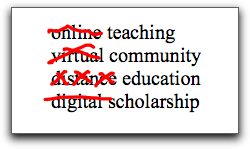
Here’s my new acronym: FLCP. It stands for Faculty-Led Community of Practice.
I am working my way through the implications of Etienne Wenger’s work on communities of practice, mostly trying to decide whether the Program for Online Teaching‘s open, online Certificate Class is one, or should be one, or could be the start of one, or isn’t one at all.
As I did this, I began to consider that what makes our class different is that POT itself, our own group that facilitates the class, is led by faculty. Now, I love educational technologists, instructional designers, and people with masters degrees in the technology-oriented areas of education. But these positions are new compared to college faculty (which go back to the Middle Ages). Both are hired by institutions, to be sure. But there are some major differences that I think justify why communities of practice, particularly those relating to online teaching and the use of internet technologies for education, should be led by faculty.
The first and most important is that faculty-led communities can provide a focus on individual pedagogy instead of institutional goals, procedures, and culture. Often IDs and ed techs answer to the computer department heads, or deans of technology. They must keep institutional goals, enterprise systems, and political issues in mind. This can make individual pedagogy a secondary issue. The emphasis is often on enacting college policies (fulfilling transfer requirements,or student learning outcomes) rather than developing an instructor’s own approach. And often these possible approaches can be trapped due to institutional decisions to limit pedagogy through the support of a particular LMS or campus-developed system. I can’t think of a single educational technologist working at a college who has the power to make decisions about which technologies the institution supports. They, and instructional designers, tend to be caught in between the decisions of higher ups who want to invest in enterprise systems and make everyone use them, and the faculty trying to find their way.
Since centralized IT and educational administrative systems tend to focus on standardized systems, the institutional solution to unprepared faculty tends to be an emphasis on “training”. In this case the word is improperly used to define preparation for teaching online. “Training” is designed to bring everyone in the group to the same place, such as a level of skill for using a piece of software — training everyone to use the features of a learning management system would be a primary example. “Preparation” does not carry that connotation of homogeneity. “Education”, which would be even better, might suggest individual goals as the foundation of the work.
So instead of “best practices” (now often the domain of “experts), we could focus on “our practices”, those that best match the instructor’s strengths with the technological possibilities.
Faculty-led projects can also break down hierarchy. If the core group includes adjunct faculty, then barriers are broken down between full-time and part-time faculty. When it comes to teaching with internet technology (or just teaching in general), both groups have exactly the same issues. Folks connected to administration and technical services have to consider the groups differently (one clearly gets more support than the other), but a faculty group doesn’t.
In addition, if faculty are able to lead such a community, it says something in response to a novice’s concerns about being overwhelmed, having too many students, too much work, too much to do. Working with the technology is what educational technologists, administrators, and instructional designers do all day as their regular job. When they try to lead faculty in making changes, there is a feeling that, sure, those guys can do this stuff all the time, because it’s all they do. If a faculty member (or several of them) have made time for this, it must be crucial somehow to our main job, teaching.
Another benefit is that faculty-led communities of practice can act separately from formal evaluation processes, program reviews, curriculum development, etc. They can also work across the disciplines, apart from discipline-specific and department politics, including turf wars and disputes over standards.
I’ve been reading portions of Palloff’s and Pratt’s The Excellent Online Instructor, and at the end of a section they say that if you don’t have a formal process for getting online faculty together, you can make it yourself by hosting brown-bag lunches or hosting a synchronous meeting online. Although this is true (in some ways that’s how POT began) this puts faculty leadership in a backup position, when it should be the main idea. Faculty groups shouldn’t be playing shortstop to what technologists hit — they should be pitching.
But of course there are a couple of caveats. In George Otte’s article on faculty development and blended learning, he warns against “Shock and Awe”, having highly experienced and competent online faculty held up as a model to emulate. He says people admire such faculty (they are shocked by how much time it must have taken and awed by the result), but they think they are exceptional and don’t copy them. He claims that community-building is primary, and suggests an emphasis on hybrid courses as a good middle ground to encourage faculty to build dedication to teaching online.
Whether it emphasizes the hybrid model or one that’s fully online, a community of practice formed and led by faculty should be the place where new faculty are welcomed into a culture that puts teaching first. In this way, they can develop their own online pedagogy in a supportive environment.
Sources:
Otte, G. (2005). Using blended learning to drive faculty development (and vice versa). In J. Bourne and J. Moore (Ed.), Elements of Quality Online Education, Volume 6 in the Sloan-C Series (pp. 71-83).
Palloff, R., & Pratt, K. (2011). The Excellent Online Instructor: Strategies for Professional Development. Jossey-Bass, An Imprint of Wiley.
Wenger, E. (2006). Communities of practice – a brief introduction. Retrieved from http://www.ewenger.com/theory/communities_of_practice_intro.htm.
 Yesterday these Kony posters appeared in our neighborhood. I knew they would get torn down as soon as people saw them this morning, so I went out early to take some snaps.
 “Then,” I said, “You should know I like this sort of thing.” He smiles and rips the sign down, going back to his car. I drove to another part of the neighborhood to get more snaps before he finished his morning endeavors.
 Of course, an individual song can be taken out of context — bands like Pink Floyd and Radiohead didn’t want their songs to be sold separately in iTunes. Alice Cooper’s Welcome to My Nightmare is meant to be heard in a certain order – so is Queen’s Night at the Opera. Album rock is based on the album, not the individual songs.






 I could use blogs and wikis instead of Moodle, and a central blog and Engrade again for the on-site (now hybrid) classes. I could have them blog and collaborate in documents and work in teams and use WordPress and make videos and … oh my god, 240 students?
 Sense my disgust? To me, these are all canned courses, made to last a long time and be consumable by anyone, but more importantly, taught by anyone. We continue to sojourn, often voluntarily and with enthusiam, into the Land with No Professor, as detailed elegantly by Alex Wright in his


 Is it open and available?