Partnership over romance

I was in Canva today creating some social media ads for my books. In particular, I was working on Murder at an Exhibition. In that novel, my fictional heroine Jo Harris works with the real-life historical figure Dante Gabriel Rossetti, and I was putting them together for an ad.

It got me thinking about the male/female teams in my work.

Jo Harris and Dante Gabriel Rossetti are not a romantic couple. In the first place, Jo is gay, which lady’s man Rossetti is not. But they make a great team.

In Bummer at Luna Beach, Lou has been in love with senior sleuth Rosie for a long time. It may be mutual, but their partnership is what is important. There are no romantic overtones.

Even in my mystery romance, A Heart Purloined, the collaboration of Amanda Goodwin and Jack Strawman is what keeps the plot moving. Yes, it’s a romance, and a rivals-to-lovers trope at that. But their love for each other develops slowly, and is not crucial to the action.

I’m also reading Bird by Bird, by Anne Lamott. She says in her chapter on characters:

You are going to love some of your characters, because they are you or some facet of you, and you are going to hate some of your characters for the same reason.

I had never thought of my characters as being some facet of me. But if they are, then it may be that I’m not a fan of love for getting things done. Certainly not for solving a murder, at any rate.

Am I unromantic in general?

Naw. Maybe I just think of the word “romantic” in its 19th century form, when it implied the supremacy of emotion. The emotion of love can create a bond, but it isn’t that bond itself. Elizabeth Taylor and Richard Burton come to mind. A couple may have strong feelings toward each other, but the relationship may not be workable, or only workable for certain things.

Readers know that I’m not a huge fan of the solo detective in my novels. Yes, Cuthbert Slaughter is my main detective for the Victorian mysteries, but even he doesn’t work alone. All my characters who solve murders work within a pair or, as in Murder on the Pneumatic Railway, as part of a team that supports each other. Even Poirot, Holmes, and Marple needed their foils.

Of course, I write alone. Yet alliance, relationship, and collaboration are of importance to my characters. If Lamott is right, these values are part of me. Just perhaps not when I’m trying to get something specific accomplished!

I write literary fiction. I think.

The first book I published, Before the Time Machine, was unapologetically literary fiction. It was dual timeline, completely character-focused, had no threaded plot, and featured serious themes.

Before the Time Machine old cover

But then I began to write historical mysteries, the Tommy Jones series, set in Victorian England. And immediately there was a problem.

The meta information for a book (needed for publishing, Library of Congress information, and marketing) requires the author to state a genre. Are Murder at Old St. Thomas’s, Murder at an Exhibition, Murder on the Pneumatic Railway, and my upcoming Murder at the Gasworks historical fiction? You bet. Are they in the mystery (also known as crime) camp? Also yes.

Once in the mystery category, there are subcategories. Are they cozies? A cozy doesn’t have graphic violence or sex. Check. It is usually discrete, one crime solved per book. Check. It has some light elements or humor. Check.

But historicals aren’t cozies, typically. So when I wrote a more typical light cozy mystery, Bummer at Luna Beach, I stopped referring to the historical mysteries as cozies. Instead, they are historical fiction, and traditional mysteries.

It got even more complicated when I published A Heart Purloined, a historical romance that was also a mystery. And possibly a cozy. But certainly a romance, with a rivals-to-lovers trope. The meta list was getting longer and more confusing.

Since my books have been available for a few years, I’ve had the opportunity to receive feedback from readers. I do not have a lot of readers. Historical fiction is not a popular genre at the moment, and people buy far more thrillers than traditional mysteries.

Historical romance is nowhere near as popular as it was when I was reading them avidly in the 1980s and 90s. And historical romance mystery? Not even on most readers’ radar. My best-selling book is the actual cozy with no genre waffling, Bummer at Luna Beach.

What I keep hearing is that my books, particularly the Tommy Jones Victorian mysteries, are differently written than most in the genre. They are more serious, less trauma-based, and better researched than many books that are written quickly and sell a lot. They have deeper themes and more developed characters. The typical mystery elements are there, and they are whodunnits (not why-dunnits), but they come off more like — dare I use the word? —  literature.

That’s because my models were people like Anne Perry and P.D. James. At the time, they were considered mystery genre writers. But now, as I re-read their work, I believe their books would be reclassified as literary fiction, like Patricia Highsmith or Georges Simenon.

Why? I believe that in the last twenty years or so, what we call genre fiction (mysteries, thrillers, romances, etc.) has become increasingly lightweight in terms of literary expression. Perhaps because attention spans are shorter, people want a fast read. It doesn’t have to be short, just easy to read quickly. They want their emotions hit through trauma, rather than character depth. Trauma is a faster route to caring what happens to a character. When they love a book, they want more like it rather than something new. (As a reader, I got into this tangle myself reading authors like Kate Morton, who use recurrent themes in similar settings.) Also, many readers today demand a “twist”, and are unhappy if they don’t get one. My twists are more ribbon than braid.

In short (yes, I know it wasn’t), I’m considering thinking of my historical mysteries as literary fiction, at the other end of the table from cozy mysteries. If you’ve read my work, let me know whether you agree?

Destroying history by post

This set of four 78 records was released in 1946. It survived McCarthyism, Elvis, the Vietnam War, the Reagan years, grunge, 9/11, and the election of a complete moron to the presidency, but it could not survive an eBay shop not knowing how to pack records properly for shipping.

Historical service announcement: Don’t ship antique objects without proper padding and boxing. Assume the postal service will toss it on the porch–they’re underpaid and shouldn’t have to care about your stuff. If you don’t know whether something is an antique, that means it was made a long time ago. Look it up.

1927 review in 1926 book

One of the delightful things about buying used or second-hand books is that sometimes there are things inside. People tuck notes into books. They press flowers. They leave bookmarks. And in this book, The World of William Clissold by H.G. Wells (1926), the gentleman who owned the book (I know it was a man because he signed the flyleaf and put the date) left a clipping from a newspaper:

You can see the way the acids from the newspaper have stained the page of the book a darker color. Our reader dated the clipping: Mar 11, ’27. It’s a review of Sinclair Lewis’s Elmer Gantry. Now at the time, there would have been no way to know that this would be a book that someone in 2022 would have heard of, that it would stand the test of time. It has, so I know the story, and was interested to read the review. The reviewer didn’t care for it at all, which I find rather funny.

So we have a bit of history inside a bit of history. Lovely.

The strange feminism of Colonel March

I confess, I watch a lot of British television. In fact, I almost exclusively watch British television these days, given the choice: Inspector Morse, Miss Marple, Poirot, Scott and Bailey, Hinterland, Jonathan Creek, etc etc etc.

I usually don’t find older programs, but I came upon Colonel March of Scotland Yard with Boris Karloff, made in 1955-6, and have been watching its one season of 26 episodes.

It was made in the early days of ITV, when the new station was trying to promote itself, and has been roundly criticized for having very little intellectual content. It is based on the John Dickson Carr book The Department of Queer Complaints, which I would love to read but which costs a ridiculous amount of money when one searches for a copy.

I’m terrible at figuring out whodunnit. I always have been, which makes mysteries wonderful for me. I also forget whodunnit immediately afterwards, making it possible for me to see The Mousetrap in London four times before I could remember. I have solved only one Midsomer Murder out of 21 seasons of the show, though I have done two of Death in Paradise.

Which means that Colonel March is excellent entertainment for me. I don’t need to follow it closely, and March always wraps things up quickly at the end. But I’ve noticed something odd, something I didn’t expect.

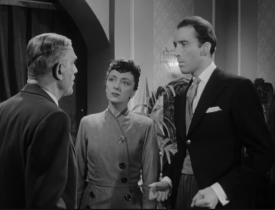
Frances Rowe in At Night All Cats are Grey (yes, that’s Christopher Lee)

The women. Despite an occasional “because she’s female” line, the female characters seem pretty equal to the male in terms of agency, career, ambition, intelligence, and cunning. They are business owners, scientists, research assistants, intrepid explorers. They don’t usually commit the crime, and sometimes there is jealousy between men over a woman, but they aren’t in the background either. Their motives and actions are as complex as the male characters.

It’s a decade after the war, so I would assume that women in public roles was fairly common, but if one watches The Bletchley Circle, one would get the impression that the problem with the “Back to Home” women was the same in Britain as in America. Perhaps it was, but even “mindless” television may have been comfortable with the idea that not all women belonged at home, cooking and having babies.

         Elspet Gray in Murder is Permanent

In “Murder is Permanent”, Elspet Gray plays the daughter-in-law of the woman who owns a beauty salon, and is into shady dealings. In “The Abominable Snowman” a somewhat ridiculous premise is saved by Doris Nolan as Mary Grey, a mountain climber who isn’t allowed to be in the Himalayan Mountaineers’ club because she’s female (which Colonel March finds absurd). She led a major climb and it’s the film she made on that adventure that helps solve the mystery. Of course at the end she’s in the club, and will clearly be leading it.

So one has to be careful. Any number of 1950s films and television, on both sides of the pond, have surprised me by either confronting the very issues that supposedly restricted them, or by portraying certain types of people with a different sensibility than I was led to expect. I’ve seen so many now that I’m wondering whether the exceptions to the rule are so numerous that the rule is the exception. . . .

Is this Wells’s dad?

I’ve been doing some research on Joseph Wells, H. G. Wells’s father. Why? For a single slide.

My upcoming lecture on Wells for the Victorian Britain group needs slides, and I had little to put on the slide for his father except stuff from his extraordinary cricket career. Well, it wasn’t that extraordinary, but he did bowl for Kent against Sussex in 1862, where he bowled 4 wickets in 4 balls. This was an extraordinary achievement (although I have had a cricket enthusiast explain it to me, I’m afraid I still don’t know why).

So I went looking for the estate where Joseph Wells worked before he came to Uppark, where he would meet Sarah Neal, who would be H. G. Wells’s mother.

According to H.G.’s autobiography, this would be Redleaf. Redleaf was an estate in Penshurst, Kent, where Wells was the gardener. He was born into this, because his father (also Joseph Wells) had been a gardener. And here it gets confusing, because the owner of the estate was also named Joseph Wells, although he was no relation.

This is the place in 1838, under William Wells. I’m sure it wasn’t any easier to garden in the 1860s. Young Joseph used to leave work and go play cricket nearby.

Now there aren’t many pictures I’ve been able to find online of Joseph Wells. In fact, this is the only one that’s reliable:

So looking back at his son’s autobiography, I also find this:

Old Wells was interested in art, and one of his friends and a frequent visitor at Redleaf was Sir Edwin Landseer, the “animal painter,” who could put human souls into almost every sort of animal and who did those grave impassive lions at the base of the Nelson monument in Trafalgar Square. My father served as artist’s model on several occasions, and for many years he was to be seen in the National Gallery, peeping at a milkmaid in a picture called The Maid and the Magpie. Behind him in the sunshine was Penshurst Church. But afterwards the Landseers were all sent to the Tate Gallery at Millbank and there a sudden flood damaged or destroyed most of them and washed away that record of my father altogether.

Googling The Maid and the Magpie, I find a number of items, most an engraving by Samuel Cousins which was based on the original painting. It may have been “Edwin Landseer’s last great work”, but I wouldn’t know that unless I get access to the paywalled British Newspaper Archive (Google only showed me a bit of a teaser).

Is that him, peeking in? Could be. But the church. Wells said it’s Penshurst Church. But Penshurst Church (of St. John the Baptist) doesn’t have a spire, but rather a tower with little corner pinnacles.

Did it ever have a spire? I could find nothing saying it did, except this:

The Topographical Dictionary (of 1848, but close) is available at British History Online. So I looked, but although the church is mentioned, the spire steeple isn’t. And unfortunately, Getty has etchings of the church from 1840, with no steeple. Maybe Landseer took artistic license. A spire balances the picture better.

So is that Joseph Wells?


Lecture: recorded, zoomed, or what?

The word “lecture” conjures an idealized image of students listening attentively as a professor relays knowledge. Almost all of the lectures I enjoyed at university were in this format, and when I began teaching I lectured this way too.

With this year’s quick and unexpected transition to online teaching, many professors assumed that online lecture meant reproducing what they do in class. Zoom.com was grateful for this assumption, even as they struggled to accommodate the massive numbers holding live lectures. Almost immediately, however, there were complaints and problems.

Professors whined that students weren’t paying attention, or didn’t want to turn on their cameras. They couldn’t see the facial expressions and body language indicating comprehension (or lack thereof). Students complained about boring, wandering lectures, and they felt exposed. You can’t sit at the back in an online classroom, and they didn’t want thirty strangers to see the trailer they lived in. Many decided they would watch the recording instead.

The problem? Zoom provided the platform, but the pedagogy was still based in the classroom. This worked better for some professors than others. At our college, they let us choose before this fall whether we wanted our classes scheduled and in Zoom, or “online only” (meaning asynchronous, with no live meetings), or a mix. Many professors regretted their choice.  Those in Zoom wished they hadn’t, and those who chose asynchronous were sorry they’d done that.

For two decades, I’ve been pushing the idea that the technology should follow the pedagogy. Your preferred teaching method should dominate. In the rush, there had been no connection between a professor’s pedagogy and their choice of format.

So, assuming you lecture, what kind of lecturer are you?

Interactive lecturers count on student participation. They ask questions during lecture, or survey the mood, or set tasks for students during the lecture.

Interactive lecturers should consider live (synchronous) lecturing in Zoom or another webconferencing program. The live approach online, however, works best for the simple lecture, on one topic. Shortening lecture time by about 2/3 is also a good idea for live session lectures, but they can be immediately followed by breakout room activity.

Traditional lecturers are those who lecture to an audience, and don’t expect, need, or want the lecture to be interactive. They relay a lot of information, framed by their own interpretation from their professional experience.

Traditional lecturers should record these lectures, and students can view them in an asynchronous way. Students particularly appreciate recorded lectures when the topic is complex, so they can go back and review without being on the spot.

Online lecturers, long ago, were all using dial-up modems and there wasn’t much bandwidth. A lecture quickly became a typed out version of ones lecture notes. As bandwidth expanded, these written lectures could be enhanced with images, then audio, then video. Written lectures can be more like reading, or they can be multi-media experiences, but they’re based on the web page or blog. They may include recorded mini-lectures. Like traditional lectures, they tend to be asynchronous.

So, planning to offer a 90-minute lecture on the historiography of the fall of ancient Rome? Go ahead, but considering recording it with images or video clips rather than doing it live. Want to lecture on solving a quadratic equation, using a whiteboard and asking students to help as you go? Consider a live lecture. Already wrote a great article that covers everything that would be in this week’s lecture? Record your voice reading it, and add some pictures or video clips.

But we don’t all have a choice. Have you been told you have to fill 75 minutes of scheduled class time? Consider creating interactive lectures and activities that require working together. Or have students view a recorded lecture, then come to the synchronous class to work out problems or just do their homework together. I would consider this a flipped online classroom, a model that understands that absorbing information may be best done on ones own but applying it should be done together.

So as we approach spring, let’s consider.

Two Characters in Search of their Teaching Author

“Excuse me,” said Jo, from inside the computer. “Lisa? I’m sorry to bother you, but I’m afraid we need some attention here.”

“I know, I’m sorry,” I said. “But I have a lot of grading to do.”

“You always do,” said Jo. “And we understand. But you’ve left us hanging around here in Chapter 3 for almost six weeks.”

“Yes, yes,” I said, trying not to sound exasperated. “But we are in a pandemic, you know, and I’ve had a death in the family, and I’m behind on my teaching work.”

“But we’re losing the thread here,” said Jo, “and I’m afraid Rossetti is getting impatient.”

“Hmmm,” I said, trying to grade just one more set of student lecture notes.

“Lisa?” This was Rossetti now. “Trouble is, I’m an actual historical character.”

“Unlike me,” added Jo.

“Unlike Jo,” agreed Rossetti, “And I’m known for my impetuous nature.”

“And your charm,” said Jo.

“And my charm,” conceded Rossetti, “And my brilliance and talent and vivacity. You can’t leave us sitting here in the chapter like this. We must shine.”

“We need to know where things are going,” said Jo.

“Well,” I said, “You know where things are going. There’s the outline.”

Jo laughed. “You said you weren’t going to use the outline. Right after you took that Mystery Writing class. I can’t do all this planning, you said, and bought a book about writing in the dark, or something about the seat of your pants.”

“Yes, I know,” I said, “But you can use the outline to know what’s going to happen.”

“But I don’t know,” said Jo. “We’ve only just discovered the body of Mr Pratchett. I’m supposed to be the lady detective this time, aren’t I?”

“Yes, you are. The Inspector did all the work in the first mystery, but this time it’s you.”

“I cannot detect without having something to detect with. A plot or a clue or something. If I don’t have it, I can’t share it with Rossetti.”

“And we’re becoming such good friends,” added Rossetti.

“Yes, we’re becoming such good friends,” said Jo.

“Which you hadn’t planned,” added Rossetti.

“Which I hadn’t planned,” I said, “because Rossetti was a rather famous lover of women, and you, Jo, are a lesbian.”

“She’s a lesbian?” asked Rossetti.

“Yes,” said Jo, “Didn’t you know about my lover Nan, the one who died?”

“No,” said Rossetti quietly.

“She was in the first book.”

“I didn’t read the first book,” said Rossetti, “I wasn’t in the first book. Why would I read a book I’m not in?”

“Oh,” said Jo.

“Look, you two,” I said, “Maybe you’ll become close friends because there’s no sexual tension. Or maybe you’ll both just get excited about the case and enjoy joining forces. You’ve already joined forces really. You’ve already taken Jo to see the wombats.”

“I did,” said Rossetti proudly, “and she’s to be my very dear friend. If you write it that way.” There was a pause. “Are you going to write it that way?”

“I think so,” I said, “But it’s been awhile. I was having trouble with the plot.”

“Well,” said Jo, “you need to write us more, give us more things to do. We can’t just sit here waiting for you to finish your grading. It’ll be all term. We won’t move till winter break at this rate. And all the time, the killer is getting away.”

“How can he be getting away, if I haven’t written about him either?” I asked, reasonably.

“Maybe he’s planning another murder. Maybe the head of the National Gallery is involved. Maybe he’ll start killing artists!” She sounded afraid.

“Or Bridget,” said Rossetti, “He might kill Bridget. Bridget is Mr Pratchett’s assistant, isn’t she?”

“And a very dear friend of mine,” said Jo.

“And a very dear friend of yours. What if she’s in danger? How would we know?”

“She’s already been locked in the darkroom once. And somewhere back here,” Jo paused. She must be searching the previous chapters, I thought. “Somewhere back here there’s a Millicent somebody, who comes to the photographer’s studio.”

“I didn’t know that,” said Rossetti.

“I haven’t been written to tell you yet,” said Jo, “but maybe she’s involved? She’s in the same philanthropy group as I am.”

I shook my head, “I’m not sure what to do with her yet. I thought someone could blackmail her about her hair color. Or a forgery of a painting she owns.”

“Yes! Forgery!” said Jo, “You were going to do something with forgery. And that character, the Italian who knows all about art. He could identify the forger.”

“Besides,” said Rossetti, grumbling, “You’re leaving us here in 1863, while you sit comfortably in 2020.”

“I’m not comfortable,” I said, “Did you hear what I said about a pandemic?”

“More time to write,” said Rossetti. “The fact is, a story about me should be an inspiration, should override all need for mundane work. I want to inspire you! I want to be your muse!”

“It’s not a story about you,” I said, “I am fascinated by you, of course. Who wouldn’t be? But the story is about Jo solving the murder. You’re a side character. You’re her foil.”

“Oh,” said Rossetti, quiet again. “I thought you cared. At one point you had a scene with all of us, with Christina and mother. And Mr Dodgson.”

“I did have,” I said, “I wasn’t sure what to do with it.”

“And now it’s in a file marked ‘not used’,” said Rossetti, sadly. “My family. Not used.”

“Really, Rossetti,” said Jo, “You’re being too sensitive.”

“Am I?” cried Rossetti, “Am I? What if she starts slaughtering the Pre-Raphaelites? What if I’m the next victim? What if poor Lizzie didn’t kill herself, if this murderer gave her an overdose of laudanum? We need this thing written. I deserve to know where I stand!” He was getting very upset.

“Please don’t worry,” I said. “I won’t kill off the Pre-Raphaelites, and you and Jo won’t be harmed.”

“Bridget?” said Jo nervously, “You won’t kill off Bridget?”

“I hadn’t planned to,” I said. “But I really don’t have time to get back to this right now.”

“Hah! You always say that time is made, not found,” said Jo. “So make some time for us and get us to where we can find the forgery and do some detecting.”

“Yes, dear,” I said, and sighed. “I honestly had no idea you characters were so demanding.”

“I’m sorry,” said Jo.

“I am too,” said Rossetti, “but please don’t abandon us.”

“I won’t,” I said. “But do let me grade another set of lecture notes.”


It Never Goes Back the Way it Was Before

I hear people say things like “when things go back to normal” or “after the pandemic” or just “afterwards”.

That might have worked for something that lasted a few weeks. Or for a hurricane or fire that destroys your home, then you have to rebuild. We can’t do that yet — this is the classic slow-motion train wreck. And anyone who’s rebuilt, had tragedy strike, knows that nothing is ever the same again.

Because we cannot go backward. Trust me on this — I’m a historian. I know backward. We only go forward.

The articles talking about the way in which the pandemic is changing business, or is changing the way we do things, are closer to the mark than the ones talking about going back to the way things were before. Will we have a time when we shake hands again, and hug our grandchildren? Very likely. Will we ever shake hands the same way again, not thinking anything of it? No.

Even when we’re not actively afraid anymore, we will be more aware. More aware of how quickly things can change, how people can treat each other differently, suddenly. How protestors can take to the streets even when they might get infected. How people can lose their jobs, lots and lots of jobs. How government support can happen, and how it can disappear. How the economy is based on the spending of extra cash. How people can be treated like disposable commodities. How those without money are exposed to danger. How science cannot stand against unreasoned anger.

We already watch old movies, or at least I do, and think, “they’re not wearing masks”. It will still jar us later. We’ll tell our grandchildren, we learned to smile differently then. With our eyes. We waved more with our hands. We learned to speak more clearly.

The international embarrassment will take years to fade. Luckily, Americans have dealt with this before. A number of our military operations have been embarrassing, for example. But the usual admiration for our brashness and our money won’t hold up as well this time. American brashness is killing people, a lot of people. Our money has failed to provide even a minimum number of virus testing kits for us, much less the world.

So let’s not make assumptions about the After Times yet. Let’s focus on now a bit more. What are we gaining now, and what are we losing? How can we help others? How can we support people in trouble? Shouldn’t people with a lot be providing for those with less?

This summer the best web browser ever, Cliqz, closed down. The German designers made it as a model for open source browsers that protect privacy and operate quickly. They intended European countries to adopt it with public support. But the pandemic, they said, had left no room to even talk about a browser for the people. Everyone is focusing on Covid.

Well if that’s the case, if that’s what we’re doing, perhaps we could do a better job of it. Fight the fires, but also do some introspection. And some planning. And some spending. Heal some rifts. And start getting it right. Because there really is no going back.

A story published

I’ve had my first short story published, in The Secret Attic. Entries were competitive, so it’s real, but I’ve had to pay £7.99 plus shipping to America to see it in print. They didn’t tell me my story got in — I had to return to the website to see if I won the contest or got published or neither. An interesting process, publishing, but I’m grateful for the opportunity.

I read the submission rules, and copyright is mine with right to publish elsewhere. No one else will publish it, of course, but it does mean I can publish it here. Enjoy.

The Online Death of Gerald Thorne
by Lisa M. Lane

Just Be Kind

I’ve been attending the Humanizing Challenge offered by Michelle Pacansky-Brock at @ONE here in California. For years, Michelle has been encouraging faculty to put themselves into their courses, continuing a tradition begun by Pat James.

The tone has shifted to humanizing online instruction through equity and empathy. Unlike many programs using the word “equity”, here it is in its fullest sense of caring for everyone and treating differences with understanding. During the pandemic, I have tried hard to push back against approaches that simply ignore the situation. It is deeply unfair and inhumane to continue as if nothing is happening.

The response of some professors, unfortunately, has been to double-down on enforcing their own rules and regulations. Psychologically, this provides a feeling of control. New instructors do this a lot. I recall when I was a new professor being very concerned that I have authority in the classroom. I was 25 and anxious that students wouldn’t respect me or do what I needed them to do. When they didn’t come on time, I locked the door.

Over the first year or two I relaxed, established the minimal authority necessary for classroom functioning in my tone and personality. I changed, students changed. I put more responsibility for learning on them, and removed elements that caused me the stress of adjudication and enforcement.

The many profs new to teaching online are reacting like I did when I was 25. They have been thrown into an environment they cannot control, and they are as frightened as I was. Training has not been helpful, emphasizing regulations and technology: FERPA, how to upload things into the LMS, how to use Zoom. “We are here 24/7 to help you” does nothing when you don’t know what to ask. It’s as useless as “Hope you are doing well in this challenging time.”

The approach of the Humanizing Challenge reverses this to acknowledge the affective domain of teaching online, to put kindness toward ourselves and our students at the top of the agenda, not an afterthought at the bottom. Because basically it all comes down to Just Be Kind.

We should always have been kind. Students have always faced challenges, not just of the financial kind. They have always had a husband dying of leukemia in the next room, a severely autistic child, an environment too dangerous to learn in. They have had these individually, and we should never have responded with “it’s due Sunday or else”.

Yes, there will be a conflict between academic standards and kindness. The Humanizing Challenge has focused on empathy and teaching from a place of love, and asks faculty to reveal their vulnerability. I have seen this go too far (I know a faculty member who teaches drunk, and one who overshares about her life, burdening the students). While I do not agree with the current article in the Chronicle of Higher Education (they say a Zoom background is necessary to be professional), we do need to be models of how to handle adversity while learning.

I recall 1991, when I was teaching during the Kuwait war. My classroom filled with military wives who desperately needed to be somewhere at a particular time. I was teaching US History, but the subject didn’t matter. They told me they needed the class time to focus on something else, to not think about their husbands deployed overseas. When I missed a day, they were distressed because that day they had nowhere to be. It is our job to provide stability in a crisis, a chance to focus on something else.

But while being professional, there are so many ways to be kind. Deadlines are the perfect example. Why are your deadlines important? Mind are important for establishing rhythm. I have lots of small-stakes assignments. A student who misses a deadline knows they’re off the rhythm. If I individually say it’s ok, let’s try to get this in a few days late, no penalty, it’s just basic kindness. It doesn’t mess up my life to the extent it’s worth harming theirs. For first responders, students working in health care or working extra shifts, deadlines are removed as soon as they contact me.  The only real deadline is the end of the class. Will they get as good an education doing things late? My answer used to be equivocal. Now its “We’re in a plague, people!”

It’s taken a pandemic for more people to realize the extent of human suffering. You don’t lock the door — you open it wider. It’s a shame that it takes a program like the Humanizing Challenge to give such a basic message: Just Be Kind. But with hundreds of faculty attending the sessions, I’m very glad it’s there.

The Awakening What?

In doing some research for a possible next mystery novel, I am looking into the Pre-Raphaelites, one of the few sets of people that still has the power to surprise me. I came upon this article: Edouard Rod, “The English Pre-Raphaelites“, The Connoisseur (June 1888).

It references several paintings I have seen. In discussing Holman Hunt’s Christianity, Rod mentions his painting, The Awakening Conscience (1853). He notes:

According to the explanatory catalogue, “The Awakening of Conscience” represents a young woman led into evil by a shallow and frivolous man, and installed by him in a little English cottage; her conscience is awakened by the refrain of an old song, “Oft in the Stilly Night,” played by her lover upon the piano, and which recalls to her the time before her fall. If you look at the picture without reference to the catalogue, and endeavor to seize the moral, you will notice that painful thought is indicated by the tension of the features; the young woman is depicted as leaning back in a hopeless attitude against the easy-chair in which she is seated; you will also infer from the indifferent and smiling air of the man, whose fingers are wandering over the keys, that her disturbed feeling is not produced by the simple music; you will still further see that the man is thoroughly commonplace, while the woman is of finer fibre, but nothing more.

That’s funny, I didn’t remember her being seated, but rather him being seated and her rising. And when I saw it in person I questioned the whole idea of her entering some stage of repentance anyway. So I thought I’d have another look:

OK, so maybe he had been playing the piano, but he certainly isn’t now, and she is not lounging hopelessly in the easy chair — he is, like I remembered, and she seems to be rising from sitting on his lap. And is that a cottage? It looks like an urban flat to me, but what do I know? Anyway, his fingers are not wandering over the keys, but resting on them.

Sometimes, this sort of incongruity happens because there were different versions of the painting. But I looked and there doesn’t seem to be another one. Had Rod really not seen the work? Or did he see a different scene than was painted? The rest of the article was good, but marred for me by this inaccuracy.

One does hope, of course, that one can at least trust the facts in a secondary source, if not the interpretation. If I lived in pre-internet times, I wouldn’t have been able to look and check the work itself without going to a library. But here I go blithely sending students to J-STOR, telling them to do their research. Better check our facts, even in 1888.

What the Dickens

Funny the things that happen when you’re a historian just trying to read a book, and the ways in which being a historian can get in the way of a good read.

I recently joined the Victorians! forum on Goodreads. People there read Victorian-era books. I’ve read some of those myself, including a few by Charles Dickens. I’ve read The Old Curiosity Shop (which someone spoiled for me, thinking everyone knows the ending), A Christmas Carol (of course), and Hard Times (ok, so I listened to the audiobook). The rest await me, eight or so volumes on the shelf. I figured Oliver Twist would be next.

Then I saw that the Victorian group would be reading Nicholas Nickleby. I’m not much of a joiner, but I thought it might be fun. I’ve never read with a group, never been in a book group or anything. The closest I get is reading the “book group questions” at the back of  novels.

But I didn’t have a copy of Nicholas Nickleby. I could have downloaded it from Internet Archive, but I don’t like reading things on a screen. Ironic, isn’t it? Backlit screens are for work, but reading for pleasure is different. I want a book in my hand, turning its pages, absorbing its history.

My ultimate site for second-hand books is abebooks.com. But I’m very choosy, because to me books are historical objects. My first preference is for a book published during the author’s lifetime, so “publication date ascending” is my go-to sort. Ending 1870, when he died. Whoa! the prices! How could Dickens be fetching such prices? OK, maybe not 1870. . . But even with an edition from 1920, we’re talking some money.

I knew Mr. Dickens was not getting a cut from my purchase, but I’m not a huge fan of him as a person, despite Simon Callow’s brilliant portrayal in Dr Who. As a historian, I try very hard to separate the creator from his creation. Where would I be with Rousseau if I cared about how he gave up his own children to foundling hospitals? Or if I ignored the brilliance of Thomas Jefferson because I was busy judging how he lived? People are not their ideas. We are all flawed. Good ideas survive long past the person’s lifetime.

Dickens is somewhat different because I went to his house. Not while he was there, of course, but several years ago. It’s a shrine to him.  I found this bizarre, because it was really her house. His wife, Catherine. She raised his ten (!) children. She wrote the best-selling menu book What Shall We Have for Dinner? Since 2016, the museum has made a huge effort to include her in the house’s story. The problem is that Mr. Dickens, who was having an affair with young actress Ellen Ternan, didn’t want his wife anymore. After she discovered the affair in 1858, he turned the situation on her, separated from her, and dissed her all over London. He even tried to get her committed to an asylum. (I’ve begun reading Lillian Nayder’s 2011 biography rehabilitating her reputation. I feel I must.)

I’ve learned that you cannot be a Victorianist without enjoying, or even reveling in, Charles Dickens. Certainly I admire his detailed portrayal of the era, the wonderful characterizations, the turns of phrase that make you chuckle aloud. He wrote so fast, and so much, that I know I haven’t even scratched the surface of his talent. But the hagiographic approach to him annoys me anyway.

So I clicked past the volume of Nicholas Nickleby that said “Works by Charles Dickens” on the spine, because it was part of a collection. I scrolled beyond the $1,000 matched sets of his work. I searched for the small 8vo versions I prefer, but there aren’t any because the novel is too long. I finally found one I liked and ordered it.

I do not hold it against Dickens that I spent so much time looking for a book I hadn’t wanted to read, by an author I personally dislike, just to join a discussion with a group I do not know. It’s just another case of a historian making things more complicated than they need to be.

Writing novels

I read a great quotation today: “You must stay drunk on writing so reality cannot destroy you.” It’s by Ray Bradbury, so of course I had to find out from which book and order it.

Way back in November, which feels like a lifetime ago now, I was feeling stuck in my research. I had applied for a grant for my collection of H. G. Wells’ writings, so it felt like I had no reason to work on it until I knew whether I got it (I didn’t, third time running). The other book on Wells was in the process of being written through a series of scholarly papers presented at conferences, but since I teach full-time plus, and can only present once a year, this was going slowly. I tried reworking the papers into publishable articles, but they didn’t seem to fit what journals were looking for.

So although I was still fascinated by my topic, output was lagging. Nothing felt completable. So on a gloomy November day, I haphazardly began writing a novel based on a character like me, in the process of doing research on H. G. Wells. Over the next four months, I wrote every night between midnight and 1 a.m., until it was done. The writing flowed. I downloaded Scrivener to have a place to write it, and ultimately paid for that program (and I rarely pay for anything). The book seemed to write itself. I edited as I went along, going back to the previous chapters nightly, rearranging and fixing. It was a strange process, since I have long thought of myself as having no imagination. But what came out was pretty good.

I wanted to get it published, so I began reading up on how to do that. I have a former student who’s now an author and writing coach, and subscribed to her advice. I thought I should join writing groups on Facebook, so I found a few and followed them. I searched out information on writing and writers conferences, novel construction, how to make a good plot. I discovered that I’m a “pantser” (writing by the seat of my pants, with no plan) rather than a plotter.

This conclusion annoyed me. I have for many years prided myself on my organization and planning skills. I had read that it is a good idea to start work on a second novel, while waiting for the zillion rejections on the first. The first book was in the genre “literary fiction”, I discovered, but I had been wanting for some time to write a Victorian mystery, so I started that. My many blog posts on the year 1862 attest to the fun I’ve been having doing it. The pundits said no, you should write in the same genre for several books. Oh well.

Unlike the first book, this one should have been planned out rather than “pantsed”. Mysteries are complex, and my memory is not good (few historians have good memories). I tried mind-mapping, and ended up with Scapple, from the same people as Scrivener, to map the plot. This didn’t work well. I tried to plan, but ended up putting things that I had already written on the map instead, a reverse process of tracking rather than planning.

And I kept looking for groups to join, because I’m entering a new world so I felt I should. Writers, they say, should hang out with writers, as a community, for support. I am not a joiner. I don’t like groups. And I’ve become annoyed with the process of looking for an agent, which everyone says takes huge amounts of time and lots of rejections. I expected rejections from publishers, but agents? The whole publishing thing has been frustrating and mystifying. The advice, the formulas, the sample letters, the filling out of forms that each have their own format, just to get someone to represent you whose fee will ultimately be paid through book sales. I have decided on one plan, anyway: write agents some, send directly to publishers if I can’t find an agent, and self-publish if I can’t get an agent or a publisher.

I do not, like some authors, seek fame or fortune. But I would like some people to read and enjoy my work. If the writing itself adds joy to my life, the seeking of agents and publishers seems to suck it back out. My book(s) are good, I think, but I have learned rather quickly that quality doesn’t matter that much in the publishing world. I’ve learned why Dan Brown and John Grisham sell, and beautfully written works do not.

The pandemic now has millions of would-be novelists putting fingers to keyboards. I have been joined by mobs. Am I novelist, without a published novel, just because I’m up at night writing novels? Does this graphomania have anything to do with my job? Why am I doing this?

And yet I continue to do it all wrong. I have read that my protagonist must have a horrible flaw, an Achilles heel that causes conflict. Mine merely has a penchant for buying too many books and taking his time thinking things out. The action is supposed to rise, with a status quo brutally disturbed, truths revealed, and a startling conclusion. Mine has likeable characters that mosey along finding things out. There are supposed to be twists, where I’ve led my reader to think one thing and then — shock! — it’s something else. I have some pinkish herrings, but I don’t think I have a single twist. It’s more like a churro than a pretzel. Is it a cozy? Apparently not, because there’s some plot-based sexuality and the person solving the mystery is a professional. But it seems like a cozy to me.

And now, I’m a bit stuck, with most of the mystery written, and no idea how it’s going to end. But when I allow the characters to just mosey along, talking and discovering and living their lives, the world of today utterly disappears. I am in 1862, caught up in the pushing and shoving of the audience at the Surrey Theatre, sensing the activity of overcrowded London, wondering whether it’s worth the trip to travel to the Exhibition in Kensington when the omnibus doesn’t go all the way there. When I let the characters take over, the plot just goes along fine, so I’ve decided to leave it to them. They know what they’re doing. They’ll figure it out.

Maybe when ones characters become so real they write the story, one really is a novelist. So I’ll stay drunk on writing.

Underpants, cats, and the classroom

I just don’t know about teaching in a classroom.

I know we have to do it, and I am aware that we have no choice. It’s because of the emergency. In seven months, for some of us less, we’ll have to be prepared to teach in the classroom.

Most teachers know that this will be difficult. At times it seems impossible. How can we possibly teach in such a space? Some of us don’t have the training for it. Sure, we’ve hung out in classrooms to meet friends or socialize, but that’s not the same as learning there.

Realistically, how can we get to know our students when they aren’t Zooming from their living rooms, utility rooms, and bedrooms? We can discern so much from the pictures they have on the wall, what items hang in their broom closet, and what space they can (or can’t) claim for themselves.

It will be hard to wrap my head around the learning challenges they face when I can’t see that they’re taking class from their car in a parking lot, or that their parents don’t understand they’re in class and come wandering in wearing only underpants. That’s just not going to happen in the classroom. I won’t be able to hear the noise they’re subjected to when they try to do homework, or see that they enjoy using a different Transformers coffee cup every day.

I won’t have the privilege of meeting their children. No happy waves to the camera, or tugs at the sleeve for a cup of juice. Kids and siblings really give me an idea of who my students are. And pets! They won’t allow pets in a classroom, and you can tell so much about a student from their pet, seeing how they interact with it. We’ll have to abandon that whole Golden Compass thing, with each person having their own familiar. I’m proud that so many cats have learned history from me.

Let’s face it, a physical classroom is a sterile, artificial environment. It smooths away the individuality of our students, with its identical desks and whiteboards. What cool visuals are there in a college classroom? A few maps featuring a divided Germany, a flyer for an event that was over a month ago, some learning cards ordered from a set in 1992. When students are in their own learning spaces, or wherever they can find, we come to know their individuality, and in many cases their creativity.

I’ll miss watching the rearrangement of the cell phone so it leans properly on the bowl of oatmeal, the face turned away from me to yell at someone who’s come in the door, the earnest expression as a student speaks but has forgotten to turn his microphone on. These are all teaching moments.

But I know it can’t last. There’s an enthusiasm for the physical classroom, I realize. And there are people who, in the last few decades, have become real experts in teaching there. I’m of two minds about learning from these utopians. They’re just so enthusiastic about that environment. It’s intimidating. They really believe that learning can happen there, when everyone knows it’s an open question as to whether a physical classroom can ever approximate the online experience of learning.

The pressure on students to answer a question right away, the forbidding of food and drink, the hours spent away from ones dog. The cognitive load involved in seeing everyone’s lower half. I’m just not sure anyone’s ready for it. But if we must, we must. Teachers are nothing if not resilient.

Thoughts on art and windows

Some of the best things happening at the moment are related to art.

Not being an Instagram aficionado, I read in 1843 magazine that Instagram is the place for art and artists. So I signed on and followed my favorite museums: The Metropolitan Museum of Art in New York, the Uffizi, the Getty, the Ashmolean, the Fitzwilliam, the Victoria and Albert, the National Gallery in London, the National Portrait Gallery, and the Bodleian Library (yes, I know it’s not an art museum).

Each are posting an artwork a day, and most are responding to questions. It’s a delight.

Most of these works, like most of my recent blog posts, are not directly about the current situation. And yet they touch upon the values, knowledge, and sympathies that inform our response to it. So for example, Antonella da Massina’s “St Jerome in His Study” (c. 1474-75), from the National Gallery:


This has been one of my favorite works since I first saw it. I can see myself there at the desk, reading and writing. (This is despite the fact that Jerome would not have liked me at all, and that if you look at it realistically the place would be awfully drafty.)

On Instagram, people replied to this post asking about the birds in front and the lion in the back hall, and National Gallery staff explained about peacocks and wisdom and the story of Jerome and the lion’s thorn. It had over 23,000 views in 13 hours. It’s learning, without a class, but with guidance and expertise, in an interactive environment, with object-based instruction and student-based inquiry. A perfect lesson.

When I first saw the work of Vanessa Bell, it was in an exhibit where the curator, Laura Smith, pointed out how views out of windows relate to women’s experiences. An example is “Interior with a Table” (1921 © Tate):

Some would say that women’s domestic lives are often more isolated than men’s, that over time many have seen the world from behind a window. Given a choice, I often prefer life through a window, but that’s because nature and I have an enigmatic relationship. I want her protected, unpolluted by my footprints. I prefer the idea of wilderness to the idea of conserving nature for human use. But I’ve also been teased, having been camping only twice and told that my idea of “roughing it” is a hotel without room service. Looking out a window, one has the illusion that one is in control of what is behind it. The wildness and beauty of nature is beyond, seen through glass. It can do its own thing, while inside I do mine. A Room of Ones Own must be a Room with a View.

Nowadays many people are supposed to be inside for awhile. There have even been art jokes about this self-isolating, and the tongue-in-cheek adapting of artworks. A copywriter named Peter Breuer in Germany posted this in Twitter:

Art can show, articulate, or contrast reality. A person can be put inside, or the outside can be swept of people. The work of Jose Manuel Ballester, which removes the people from art masterpieces, has a new resonance these days. For example, the Hieronymus Bosch’s “Garden of Earthly Delights” becomes “El jardín deshabitado” (2007).

I do miss the guy with the flowers.

Art appreciation can also be personal and timely — the Getty has people recreating art masterpieces all over the world. The idea of people using things they already have, to recreate great works, and create new things, shows the best of humanity. And yes, some people are working extra hours in dangerous conditions, while others are unemployed and too worried to create, but it is often at the busiest and worst times that art provides some comfort.

One of my Honors students just finished her final paper for this term. At the beginning, in January, she wanted to write about the history of social media. I assigned her Tom Standage’s Writing on the Wall. As the term progressed, her topic gradually changed. Her paper is titled “Art and Technology as a Mechanism for the Reduction of Isolation”. And it’s quite wonderful.

It is said that the pandemic has proven the necessity of the arts and humanities. It’s true, and not just for the comfort they provide, but for the reminders. How to take the familiar and make it intriguing. How to hold an object in your hand so people see it and ask questions. How to change your perspective by changing your window. How to teach by showing instead of telling.

With the arts and humanities, we are part of a larger experience. We can be inside looking out, instead of outside looking in.

Armchair historian does London Bridge

Historians sometimes reinvent themselves. Or maybe it’s better to say that historians who are very famous, or not famous at all, sometimes reinvent themselves. If you’re very famous (like Simon Schama) you can do whatever you like. If  you’re basically unknown (like me) you can also do whatever you like. But if you’re an acknowledged expert about One Big Thing, I suspect you can’t do anything else.

I’ve been working for a few years on making Victorian England my new specialty, and I’m also writing a novel that takes place in 1862. To find good resources and just enjoy the era, I’ve joined some Victorian-focused Facebook groups. People post old photos:

These are London Bridge in 1890, the top one facing north, the other facing south. And oh, the traffic! I’ve read that the bridges were often jammed in the 1860s, and it looks like by 1890 they weren’t any better. Can’t you just imagine yourself trying to cross the street?

Then someone on Facebook asked whether the stairway was still there:


Let’s go look! (And get a load of all the “temporarily closed” on Google. Might want to take some screenshots — this will all be history too, remember).


So I “drop down” my little G droid* and go look.


Hmmm… looks like maybe the top of a stairway? I’d better drop down by the river bank for closer inspection.


A ramp! Much nicer than stairs for lots of people. Plus you don’t have to go out past the church and turn left to get onto the bridge.

The ease of doing this sort of thing amazes me. An armchair traveler in the 19th century could sit at home and read books to go to wonderful places all over the world. I can drop down my G droid anywhere and walk around (well, click around).

I can’t go to England this year, but I can do this. The Google Map images are relatively recent. I can walk down streets. I can look up old maps and then go see what’s different (I do that all the time for research). I can even go to webcams like this one and see places in real time. I can start up Google Earth and see buildings in three dimensions.

All of which beats relying on H. Rider Haggard for my view of the world. But I would like a wingback chair, please.


___
*I know the droid is called “Pegman”, but why should it be a man? I’m a lot of things, but I’m not a man.

Is it better to be a milkmaid?

In the early 18th century, Lady Mary Wortley Montagu would discover the inoculation process for smallpox while she was living in Turkey. She had lost a brother to the disease, and barely survived it herself. Smallpox in the 18th century was particularly virulent; the CDC says it had an average a 30% death rate for those who got it. The inoculation was done using actual scabs from people who had smallpox, inserting it under the skin through a cut. Lady Montagu had her son inoculated while in Turkey, and her daughter in England when she returned in 1721. She then campaigned to popularize the method in Europe.

But Edward Jenner gets all the glory, even today, because he developed a vaccine to replace the inoculation. Inoculation is an old idea — you take some likely material from a living victim of the disease, and put it in a person who hasn’t had it (similar to the convalescent plasma being tried today). But there is always a danger of actually giving the healthy person the disease. A vaccine uses a more benign substance to achieve the same immunity.

I was taught in college that the discovery of the smallpox vaccine came out of the realization that milkmaids didn’t get smallpox. This was apparently because in leaning their cheek on the cow while milking, they acquired cowpox, a very mild disease. The cowpox antibodies protected them from smallpox.

There is a wonderful mythology around Edward Jenner and his 1796 vaccine. It’s based on the story of a milkmaid he met when he was a boy, bragging about her lovely skin that would never be scarred by the pox.  Rather like the story of George Washington and the cherry tree, it was created by a later biographer. The real story is more ordinary. Nevertheless, milkmaids didn’t get smallpox.

I learned today that an old vaccine for tuberculosis may have some value in helping with the current virus. The New York Times article says:

The B.C.G. vaccine has an unusual history. It was inspired in the 1800s by the observation that milkmaids did not develop tuberculosis.

The active ingredient of the Bacillus Calmette-Guerin vaccine is Mycobacterium bovis, which was isolated from a cow in 1908. It was made into a proven vaccine by 1911, and is today used in areas with high tuberculosis danger.

Unlike the Jenner/smallpox tale, the story of BCG inspiration and milkmaids is harder to track down. I can find nothing in a verifiable source, other than popular/journalistic websites copying each other’s phrasing, to confirm the background of the discovery.  Closest I could get was a 2008 Russian article saying that milkmaids and others close to cattle could carry a latent infection that gives a false positive for a tuberculin skin test. I couldn’t find anything even saying that milkmaids didn’t get tuberculosis. Is this a case of people just mistaking one apocryphal tale for another?

But we know that Mycobacterium bovis is to Mycobacterium tuberculosis as cowpox is to smallpox — a similar, less deadly disease that protects against a more virulent one. The Lancet warns that it might not be effective against the current virus, and there might not be enough available, but it has helped people with similar respiratory diseases recover faster.

I’d still like to think that milkmaids would be safer.


Fake Fitzgerald or Real Telegram from 1918

The last couple of weeks this has been going around. Like a lot of people, I was hoping it was real.

I thought it was real not because I know Fitzgerald, but because I know Hemingway. But it wasn’t real. It was from McSweeney’s.

According to Esquire, we all wanted this to be real because we’re all looking for reassurance that we can survive this crisis. I’m a historian, so in addition to being embarrassed because I was tricked, I wanted to then find real documents that could accomplish the same thing.

Here’s what I found:

Western Union Telegram signed [Hon.] Edward Rainey, [San Francisco Mayor’s Office], to Hon. Harvey Neilson, Santa Barbara, California Mayor’s Office.

1918 October 31.

“If you have not already taken such steps strongly urge universal wearing of masks to prevent or check influenza epidemic. Cases here rose steadily from two hundred per day October Six to over two thousand October Twenty-fifth. On Twentieth, some our people wore masks, on Twenty-first on recommendation Health Board, Mayor [James] Rolph issued proclamation calling for everybody wearing masks. Nearly whole population complied. Red Cross backed with advertising and two days later supervisors passed ordinance requiring wearing by all persons. Practically whole population in masks. By Twenty-third, five days after first masks appeared or three days after use became general new cases dropped approximately fifty percent. Deaths at peak 194, yesterday only 103, many of these having been sick for some days. New cases decreasing daily. Health authorities say San Francisco probably get through with far less distress and death than Eastern cities which started with about our figures but keep on going up while ours went down. All agree masks largely responsible. Sending this for your information because I have seen the whole terrible effect of epidemic here, because masks have saved untold suffering and many deaths, and because Santa Barbara my old home city. Portland, Seattle following San Francisco lead.”

Source: Online Archive of California, UCLA Special Collections
Collection of personal narratives, manuscripts and ephemera about the 1918-1919 influenza pandemic, 1917-1923
https://oac.cdlib.org/findaid/ark:/13030/kt2t1nf4s5/entire_text/


So. Wear your masks, Californians, and know that it will end.

Going online the 19th-20th century way

Given current discussions about moving on-site classes into an online environment as an emergency response, I’m going to go out on a limb and say: don’t worry about pedagogy.

Current Learning Management Systems have simplified online instruction to an extreme degree. Despite decades of research and experience in various active learning online techniques, our current systems still encourage the basic triumvirate: reading/information, discussion, and assessment.

An on-site class already has assigned reading, so these can be moved online if necessary. Discussion that took place in class can be placed on a discussion board if desired, or one can easily just answer questions through messaging or email. And assessment can be moved online using the built-in quizzes. The fact is that most on-site teachers moving online will focus on these three things. They will need to learn how to upload their readings, set up a discussion board, and retype their assessments into the system if they don’t know how to use a tool like Respondus (or are on a Mac). The fourth big task will be learning to use the gradebook, which is more difficult than handing back a piece of paper with a grade and comments.

These preparations will take far more time than classroom teaching, and will already cause massive workload issues. These concerns will be added to student confusion on assignments and grades, basic worry about managing ones professional tasks in isolation, and trying to ensure enough income and food to keep ones family comfortable.

In other words, pedagogy, universal design, student equity, and other considerations will become instantly irrelevant.

Synchronous lectures, especially at a college without teaching assistants, may be well beyond instructors’ capabilities, and if not, the stress of doing it may be overwhelming. Even discussion boards, which require design of some sort, may be beyond the abilities of many instructors while everything else is going on. That would leave us with: read the textbook, take the test.

This might sound terrible, but it isn’t. It’s the way distance learning was done in its earliest incarnations, through the mail and televised courses. It is the way the earliest online classes were conducted, over email. In other words, read/inform and test was considered adequate for education for many years, particularly for subjects not requiring laboratory work. And it’s the pattern for every publisher’s course cartridge I’ve ever seen.

Certainly it’s ironic that after so many decades of active learning, student-centered techniques, just-in-time education, constructivism, and inquiry-based models, a single emergency would mean a return to the old style.

If this emergency goes on for a long time, several things could happen. The following could well drop out of college: students who only have their phone for a computer, students who cannot motivate themselves and stay on task, students who require personal contact with others in order to learn, students who require that teachers take a deep personal interest in their lives, students who can only learn in groups of other students, and students who are unprepared for college work. While all of these problems can be dealt with effectively in the online environment, there will be no time to work on the methods for doing so. This is particularly the case for faculty who’ve never taught online, or posted more than a minimum of resources in an LMS.

The remaining students, those who can do well under these read-and-test conditions, will be more similar to students of the 19th and 20th centuries. During these years, educational reformers were striving to make sure there were spots available for students who were capable but financially disadvantaged. The ability to read and test, and ask good questions, was essential to student success. It might prove interesting if it were that way again.


Rigor or workload?

It appears as though next summer, our 8-week classes will all be offered in a 6-week format. I am in favor of this. At first this seems like a good idea: students finish faster, faculty are done sooner (avoiding the problem of immediately starting fall afterword). Until one thinks about rigor.

Rigor is a word frequently argued about in academia but rarely defined. It has something to do with the academic integrity of a course. If, for example, it is a college class but one assigned a third-grade textbook, there would be a problem with rigor. Our course approval process requires a list of possible textbooks and possible assignments, ostensibly to ensure appropriate rigor.

Years ago, our historians were asked to offer 4-week intersession classes in winter, and we said no. Our senior historian at the time went in with the dean to argue that rigor could not be maintained. Our classes, as approved for transfer to university, were 16 weeks long. We could not maintain standards, particularly with students rushing through reading and writing at 4 times the speed. It’s a community college. Some students had trouble reading college-level work. Forcing them to do it faster would be disastrous for their success and our teaching. We won the argument, because at the time there seemed to be a general understanding that History requires extensive reading and writing, and by extension considerable thought. This requires more time.

As time has passed, however, the expectations for the level of student achievement have changed. The emphasis on “student success” has led not only to a natural and predictable inflation of grades, but a much broader acceptance of less rigor. The available textbooks for a college course are written at a much lower level, and have many needlessly large illustrative images and lots of white space. Courses are approved for General Education transfer that are more “fun” and have significantly lower expectations of learning ability. The push for what is called “equity” has led to an utter rejection of everything from the Western canon to any novel written by a white male, with the result that many longer works with universal themes are no longer considered appropriate for assignment.

So in a sense all rigor, in the sense of expectations of the level of the work completed, has declined. But rigor is not necessarily workload. When I was at university, lower-division courses required a full textbook, and several ancillary texts. When I was a teaching assistant at the University of California, Santa Barbara, only one ancillary text was required, but it was an extensive secondary book. Students chose the shortest one, of course. All the same, the workload (number of pages to read, number of papers to write, length of those papers) was significantly higher.

If rigor is being decreased, but achievement in the discipline continues to be expected, then workload should increase. If the level of what one is being given, and is expected to perform, is lower, then increased quantity would provide more opportunities for practice. Increasing workload thus implies a dedication to higher rigor, even if the standard is not obtained.

But we must also consider the contemporary dedication to the affective well-being of the student. This dovetails with the culture at large. It is accepted that people who are distressed cannot study well. Mental illness, overloaded schedules, job and family demands are seen as reasonable justifications for being unable to perform what could have been considered university-level work a generation ago. Before, they would have been encouraged to leave university and find a job for which they were suitable. Now they are held onto like precious gems, who without university have no chance in life. It’s our fault, not theirs, if they don’t succeed.

The university transfer approval process requires that community college rigor matches that of university. This has not been a major issue. University rigor has also declined. No one checks very carefully, anyway. But approval also requires that the same rigor and workload approved at the course level apply to every class section that is offered. So if I offer a 16-week class that normally required a full textbook, five primary source readings each week, and two assignments per week, the expectation is that this will be compressed but identical in shorter-term formats.

While this may seem to be a way to maintain rigor while increasing workload in the short term, it doesn’t actually work that way. I have adapted several of my classes to the 8-week (double-speed) format already for summer classes, and to provide a “back-to-back” single semester option to complete a two-course sequence. Enrollment in these is excellent — students do indeed appreciate completing the course faster, and they drop less often. I have long felt that 16 weeks is too long anyway. But I do not demand exactly the same number of assignments for my 16-week students. The primary source boards dropped from 16 to 8 to keep their focus on the weekly unit. Everything else, however, I simply doubled up: textbook readings are two chapters a week, primary sources are ten instead of five.

Six weeks presents a slightly different challenge. I cannot simply eliminate the Age of Discovery, or the American Empire. These are required to be “covered” to be approved for university transfer. Thus the workload must increase. I suspect that the transition from eight weeks to six may be a tipping point for rigor and workload.

What happens when one increases the workload beyond the expectations and desires of the students? First, they just don’t do it. They simply won’t be exposed to the facts, interpretations or ideas. They’ll skip the Age of Discovery. Second, they will not enroll in the first place, or drop the class in favor of classes with lighter workloads. Our History department has seen a consistent slide in enrollments over the last few years. While we know that this is partly because the national reputation for disciplines like History is on the decline (as it is for intellectualism in general), there is also a greater dedication to rigor in our discipline, a dedication often misinterpreted as “white” and elitist. (In truth, historiography has been foregrounded the agency and obstacles for people challenged by mainstream culture since the 1940s.) The college now offers far easier course in “culture” that count for the same requirement, and thus compete directly for enrollment.

Simply compressing my 8-week classes into 6 weeks, I fear, won’t work. The workload will be well beyond the expectations of students, and they will leave, drop or fail. While failing used to be acceptable, we are now expected to prevent this at all costs. So some tasks need to be removed. It cannot be topics or “coverage”, so it must be reading, assessment, and writing. I am leaning toward removing the textbook reading, because it could be considered “boring”, they have more difficulty reading, and the facts are not as important as them “doing history” (my lectures may have all the facts they need). Removing textbook reading also reduces the number of quiz questions, or perhaps eliminates the quizzes themselves. The writing assignments should be given a few days without anything else due, so they focus on them — those I am unwilling to change, but I want to provide them with space and time.

The grading weights would change accordingly, so that each of the remaining tasks would be worth substantially more. That is unfortunate, because my usual method is to have many little assignments, so that no one assignment is worth a lot. That way students can learn, practice, improve. So in addition to impacting rigor and workload, my pedagogy will also be affected. I do not, however, see another way.

Musings on equity and pedagogy

I am considering the implications of mapping student learning challenges and solutions like this:

Universality in education implies open opportunity and access. It also has cultural implications, that certain philosophies, methods, and subjects are worth exploring because they lead to knowledge in a larger sense.

Communality in education implies that the people being educated, and the educators, belong to particular groups or communities. These may include professional or personal groupings, but they may also include other groups favored by social scientists: socio-economic, racial, religious, etc.

Individuality in education implies that learning in basically an individual activity, and that the effectiveness of pedagogy depends on the individual. It also implies that teaching must take into account individual talents, proclivities, abilities. It underpins ideas of individualization and personalization of learning materials and methods.

At many institutions, those who privilege communality are increasing awareness of the influence of groupings on the lives of students. Some of this has taken the form of movements for student equity. In its most useful form, communality makes teachers more aware of the challenges students may face because of their identification within a particular social group. In its extreme form, communality mandates particular forms of speech, opposes ideas that are seen to represent the dominant culture, and publicly shames individuals who don’t engage in groupthink.

Within this construct, universality is seen as tainted. Access is not enough, because those who are disadvantaged by their group membership cannot benefit equally from that access. In its most useful form, this can cause the culture to acknowledge those deficiencies and seek to remedy them, through awareness and policy designed to offset limitations. In its most toxic form, it denies the universality of ideas, and engages in cultural relativism.

Individuality is similarly tainted, because it does not consider the pressures resulting from group membership. Individuals must acknowledge, and in many cases are expected to represent, the group. A person who seeks to overcome the limitations of their group is seen as a traitor to the group. This may occur even when the group is defined externally, and the individual does not identify as a member.

The image above centers the individual within the group, and wraps both individuals and communal groups into the universality of humanity. There are similarities to the philosophy of stoicism. Using stoic concepts of individual and universal, the diagram might look like this:

Creative Commons licensed A-NC-ND John Danaher

In stoicism, the goal is to connect the individual at the center with the universal ideas that supersede the social context. The social world is an intermediate place where it is hard to tell noise from signal. Although humans are automatically attuned to the social world, they must overcome its noise to find a deeper connection with the universal. Communality is highly changeable, redefining itself frequently. Today’s communality is the not the same as yesterday’s.

In education, a central goal is to connect the individual to larger schemes of human knowledge. Pedagogy’s purpose is to assist the individual in using information, creating knowledge, and ultimately gaining wisdom. To achieve only typical attainment may attach the individual to the communal in a way that can prevent higher knowledge.

Sustained argument

The Economist‘s column Johnson recently wrote about the extent to which artificial intelligence can compose prose, and claimed we need not fear the “Writernator”.

The reason? Because during an experiment:

Each sentence was fine on its own; remarkably, three or four back to back could stay on topic, apparently cohering. But machines are aeons away from being able to recreate rhetorical and argumentative flow across paragraphs and pages.

Well, most of my students can’t do that either.

So while the article was trying to reassure writers that they need not fear losing their jobs to a computer, I saw quite another angle, a trail of thought that goes something like this:

Computers cannot create sustained arguments. Neither can most of my students. And only the best journalism seems to bother. Educated people can both follow and create sustained arguments. But to whom are they writing? We have many voters and public figures who are anti-intellectual, and only interested in the realms of fear, emotional expression, and personal identity. They have no interest in sustained argument. The media reflect this, with the emphasis on factoids. Articles have gotten shorter, even in journals like The Atlantic. Computers can’t do it, and computer programming is a reflection of ourselves. Perhaps the very idea of sustained argument needs to be defended. But how can one defend it except with sustained argument, and a reliance on the very intellectualism being increasingly rejected?

If I had read the article 20 years ago, I might have nodded along, not because computers weren’t writing then, but because I felt that sustained argument was a norm. It’s perfectly obvious to me why it needs to be preserved, as obvious as the preservation of free speech, democracy, respect for the opinions of others. These things aren’t obvious anymore.

Today on BBC4’s PM program, Evan Davis reported on Jacob Rees-Mogg’s insensitive statement that he would have got out of the Grenfell fire by ignoring the orders of the fire authority to stay in the burning building. He interviewed Andrew Bridgen, Conservative MP of North West Leicestershire:

Davis: Do you think he meant to say that he thought he would not have stayed put?

Bridgen: That’s what he meant to say…

Davis: And that in a way is exactly what people object to, which is he’s in effect saying, I wouldn’t have died, because I would be cleverer than the people who took the fire brigade’s advice?

Bridgen (Sigh.) But we want very clever people running the country, don’t we, Evan?

Well, I’m not sure people do. In fact, I’m pretty sure many people don’t see why having educated people run things is a good idea. They think that educated people run things to the detriment of uneducated people, and sometimes that is true.

People, Bridgen noted, tend to defer to authority, as they did in the case of the fire.

When people trust these authorities and the authorities fail, there is popular anger. At some point people will ask from whence does this authority derive? And one can say “from your votes”, but they feel that isn’t completely true. The response is to elect uneducated populists.

Intellectualism, and education itself, may have a much tougher advertising campaign to run than we suppose. The old norms are suspect, and assumed ideas need a cogent (or, better, non-intellectual) defense. I don’t think saving writers from computer-generated text is quite going to do that.


The internet’s not for learning?

I confess to being depressed by a summer article in The Economist, “The second half of humanity is joining the internet” (June 6). In the spirit of Thorstein Veblen’s critique, poorer parts of the world are getting on the internet*, mostly though mobile phones. And even fewer people there than in the developed world are using this online time to learn things.

The Economist article did not specifically count online courses, only “education information/services”, but the use is pretty low. And it likely includes looking up something on Wikipedia so you can win a game, or checking the weather.

People everywhere do the same thing: use the internet mostly for “timepass” – passing the time by communicating with friends and family, playing games, and watching videos. I’m not saying these things don’t cause learning. They do. But the purpose is entertainment and emotional satisfaction, not becoming an educated citizen.

It just serves to remind me how truly wide the gulf is between those who value education for its long-term benefits, and those who just want to pass the time. Are the people who get satisfaction from intellectual challenges rare? If so, will the smartphones make them even more rare?

Because that’s the crux of the issue. When all this internet-y, web-by stuff began, we educators were all excited. Vast libraries of information! Massive open online classes! Anyone can learn anything from anywhere!

I’m not anti-entertainment. I’m a huge classic movie fan, and I watch a lot of TV programs where one character calls another “Inspector”. I read modern novels just for fun, or to get to sleep. I’m not always working, always teaching, or always learning.

But I am again reminded of the old Zits cartoon:


The internet relies on huge servers, and uses tons of resources. It only seems “clean”. The mobile phones contain rare earths, the servers are so hot they need to be in the Arctic, the power plants chug away so we can have long power strips full of our charging device plugs. It’s odd to make that sacrifice just so that people can play Fortnite from anywhere.

Perhaps our goals were too utopian. The article points out that our vision of the subsistence farmer checking weather on his phone to save his crop doesn’t really happen. But why shouldn’t everyone use the internet for whatever they like? And can’t we learn wonderful things on our own? Some little boy somewhere is watching a Zeffirelli clip on YouTube and is inspired to become a great set designer. Some little girl is watching the US women’s soccer team and will be a great player. Is formal education a more important use of technology?

After two decades online, however, I am saddened that there hasn’t been a little more educational uptake and a little less “Whasup?”.


* I used to be very careful to distinguish the web from the internet — the internet is the entire online structure, while the web is the world wide web accessed through a browser. The recent dominance of the “app” and sites requiring log-in is closing the web, and has become the most-used aspect of the internet other than email.

Wells and the moon shot

On the 50th anniversary of the moon landing, I picked up my copy of H.G. Wells’ The First Men in the Moon (1901), and found these paragraphs:

. . . Then with a click the window flew open. I fell clumsily upon hands and face, and saw for a moment between my black extended fingers our mother earth—a planet in a downward sky.
   We were still very near—Cavor told me the distance was perhaps eight hundred miles and the huge terrestrial disc filled all heaven. But already it was plain to see that the world was a globe. The land below us was in twilight and vague, but westward the fast gray stretches of the Atlantic shone like molten silver under the receding day. I think I recognised the cloud-dimmed coast-lines of France and Spain and the south of England, and then, with a click, the shutter closed again, and I found myself in a state of extraordinary confusion sliding slowly over the smooth glass.
   When at last things settled themselves in my mind again, it seemed quite beyond question that the moon was “down” and under my feet, and that the earth was somewhere away on the level of the horizon—the earth that had been “down” to me and my kindred since the beginning of things.