The dangers of segregating the digital sphere

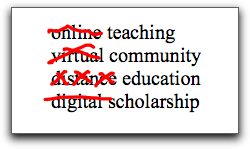
I have begun to think it is dangerous to consider the digital, the online, the technological, as separate from the whole.

Partly this thought is a result of attending Martin Weller’s presentation this morning for the Change MOOC, where he presented a wonderful discussion of Digital Scholarship. But my question was whether the attention given to digital scholarship as its own issue doesn’t undermine the effort to have it become mainstream.

This goes beyond the “no significant difference” argument that comes up periodically for online teaching, although for me it started there. At our college, online teaching came about as a “modality” or “mode of delivery”, because it was 1998 and we were trying to offer it as an option for students. We taught ourselves how to teach online, all before learning management systems, best practices, or student learning outcomes. And most of us involved said it was just teaching, doing what we do but adapting it for a different “classroom”. I’m not sure I ever saw the difference between “online education” and “education”, or my “online U.S. history class” and my “U.S. history class”.

It’s not that I don’t acknowledge differences between the relationships, work tasks, and communication we engage in online and those we engage in face-to-face. But I also acknowledge differences between relationships, work tasks, and communication in various face-to-face settings, and it has always been that way. If we say “online community” instead of just “community”, we imply a separate reality that may or may not be the case. Rick Schwier’s presentation in Alec Couros’ EC&I831 last night noted that there are many ways that communities form in online environments, and of course there are many ways that communities form in-person also. Schwier noted that some of us use multiple online personalities, reflecting the in-person reality that you don’t talk the same way to your priest as you do to your coach as you do to your mom as you do to your college president.

A class is a class to me, whether it’s taught under a tree, or in a circle, or over the internet, or by hand-written snail mail.

I’m going to argue for completely ignoring the fact that things are “digital” or “online”. In terms of scholarship (it’s own heavily-laden word), continuing to fight for the acceptance of “digital scholarship” perpetuates the idea that it is somehow different from “regular scholarship”, that is is not as real. We shouldn’t focus only on the vetting of articles, the false scarcity of  information and the tyranny of for-profit journals, but on behaving as if it’s just scholarship. The same standards (peer review, for example) should apply if  you’re going to say it’s real, or scientific, or important, but whether it’s online for free or in a bound pay-walled journal  is irrelevant in terms of its value. It’s either good research and useful to me, or it’s crappy research regardless of format.

This is why I am against the idea of having a “dean of online”, a “coordinator of online education”, or anything else that segregates the digital aspects of education into their own sphere. If we do that, we continue to emphasize its differences. While this may be an advantage up to a point (getting funding for online projects, justifying masters programs in educational technology, paying government employees to create standards and rules for accessibility), it also provides ammunition for those who are resistant to technology and resistant to change. It packages the “technology-enhanced” and the “online” and the “distance ed” into something that is easier to dismiss and de-fund. Such packaging can also discourage innovation by making “online education” a specialization beyond the understanding of ordinary faculty, something that requires strict management by administrators. And that packaging can be literally packaged, by selling “online courses” created by “teams” at for-profit institutions, or “course cartridges” in Blackboard, available for those too controlled or too timid to create their own classes.

The distinction thus gets in the way of professional development, when good faculty feel they are entering a new and scary world instead of just extending something they already do skillfully — teach.

So I’m declaring myself against “digital scholarship”, “online community”, “distance education”, and anything else that applies a special adjective to something wonderful we do as humans but happen to do using a computer.

And no, that doesn’t mean my Facebook “friends” are my “real friends”.

A funny thing happened on the way to the…

We don’t have a forum at our POT Certificate Class SMOOC (Small-to-Medium Open Online Class). Nor a Google Group (though that’s been suggested and may appear), nor a Moodle forum, nor a Ning.

When I took EC&I 831 from Alec Couros last fall, I felt we needed a forum, and he and I looked for one we liked, but nothing we found had the particular combination we wanted (no ads, free, nested comments and the ability to post multimedia), so we gave it up. On his current page for this semester, he’s listed many types of communication, but not a forum.

And now I notice that the Change MOOC, co-hosted by George Siemens, Stephen Downes, and Dave Cormier, has a forum, but it’s kinda awkward. Not like a full-featured thing at all. On the main page, there are three Participating links for blogs, two for the newsletter, one for the backchannel, and one for threads. The class starts tomorrow and there are three posts for a class of hundreds.

And yet, all my college history classes feature forums as the heart of the action. I couldn’t do without them.

So why no forums for these classes? I think because the idea of distributed communication has become something we’re all taking seriously.

If we’re going to focus on the wonders of learning on the web as our topic, it makes sense that our participants should be communicating there rather than in a central location. We not only want them communicating via blogs, wikis and Facebook, but we also want them creating their own places and spaces (which is why the potcert11 class may yet have a Google Group, because the participants may be creating it — and they’re starting the Twitter thing, not me).

chart
From Rick Schwier’s Pursuing the elusive metaphor
of community in e-learning environments

I also think there’s more staying power to a distributed community. If you have one space, as we all know from using learning management systems, the course seems finite. Even if the space is available after the class is over, the feeling is still that the class is over. But if the conversation is distributed (our class has a very active Facebook group, which surprised the heck out me), there’s a feeling of perpetuity. The river continues and you step in and out when you wish.

As Rick Schwier has noted, informal communities have higher levels of engagement over time. I wonder whether de-emphasizing a formal location for conversation makes these classes lean more toward informal learning, even though they are organized as classes, with set timeframes.

So come on, hit me with the research. Do distributed communities last longer? Are we right to “force” them instead of offering a rich place for a single discussion?

Freaking out? a story of baking bread

See this? It’s bread, just good home-baked bread.

So what’s the big deal? It’s that I made it.

You may not know me well, but if you did, you’d know I’m no Dora Domestic. In fact, I used to be somewhat famous for not knowing my way around a kitchen.

But I decided I wanted to make bread. Might have something to do with medieval technology, or just wanting to do something self-sufficient.

It took awhile. I made some doorstops. At first I thought I couldn’t make bread, that I had no talent for it. Other people didn’t help much — they told me to keep at it, because bread was hard to make. Oh no, I thought, it’s too hard. I stopped for awhile.

I kept looking for a good recipe, better yeast, how to get the water exactly 115 degrees. I found a simpler recipe, just water, flour, yeast, salt, sugar, oil. It came out good. I started to tinker with it. The bread got better each time. Now I make it a lot. And it’s easy. I don’t use measuring spoons. It’s peaceful to make it now, instead of stressful.

It wasn’t hard. It was new. That made it seem hard. But I kept doing it, looking for ways to make it better and easier.

Are blogs, web pages, and teaching online new to you? Keep doing it. You don’t need talent, a feel for it, or strong hands. Just keep making the bread. Soon it will be good.


SMOOC update (or the joys of being a WP admin)

The not-quite-a-MOOC (but rather Small to Medium-Sized Open Online Class) POT Certificate Class is underway at the new Pedagogy First! Blog. What follows are notes about technology realizing my pedagogy for this class.

What I wanted

I wanted something like Jim Groom and Martha Burtis do for DS106, a central WordPress blog that pulled in posts for the separate blogs of people participating in the class.

I wanted to adopt a mentoring system like the one Alec Couros used for EC&I831, where more experienced people could help the newbies.

I wanted it open, as Jim and Martha and Alec did, and as George Siemens and Stephen Downes and Dave Cormier do for their MOOCs (yes, that link is the unfinished Wikipedia entry, but I haven’t had time to work on it).

I wanted participants to be able to add their own blogs to the big blog.

I wanted sticky posts at the top that had the week’s instructions, since we are not using a strictly connectivist pedagogy (if there is such a thing) for the people earning a certificate. Certificate folks have weekly readings and tasks, including a blog post showing what they’ve reflected upon and created on the web.

I wanted each week to have a moderator, who would create some introductory media for that week and then follow the big conversation, just for that one week.

The content was set up as a simple syllabus page. That’s actually been the easiest part of the whole thing. It’s just a syllabus. We all know how to do that!

I wanted it not to be an administrative nightmare. (Well, as they say, ROFLMAO!)

The technology

It’s turned out to be much more difficult than I anticipated. Here are the challenges:

1. Sticky posts (Solved)
Feedwordpress at first could not do a Sticky Post properly, causing me to try other plugins designed to pull in feeds, none of which were what I wanted. This was resolved with a bug fix in the updated version of Feedwordpress that came out in July. In Atahualpa theme, it was easy to change the background color of these posts, and even add a little POT logo, so they look different.

2. Massive database and CPU usage (Partly made kind of OK)
As I set up the blog and people began adding feeds, even with only a few, the CPU usage at my hosting company (Lunarpages) was climbing. I alerted them before they alerted me, but they don’t support the scripts you use, just yell at you to fix it. I did chat support a lot trying to narrow down the problem with my limited knowledge of databases (i.e. none) and php (almost none). I failed and opened a new account at Bluehost using POT’s Excellence reward money, created the domain pedagogyfirst.org (after checking with Glenda Morgan, who first coined the phrase) and imported the WordPress files and database. Since I’m not a fan of using the phpAdmin to repair and optimize the database (I figured out this was helpful to deal with what they call “slow queries”) I’ve had to use an optimizing plug-in that I manually click on if I want it to clean stuff up more than once a day (and I do).

3. Feedwordpress weirdnesses (OK)

Author names come through as usernames rather than a real name. Since people don’t sign their posts, I’ve changed these so long as I can see that they want their real names used (if they mentioned their real name on their blog).

The first post on WP (“Hello World” with no real content) comes through as the first post in syndication, so if they didn’t change it, it posts the default first post. I am removing these manually.

Jim and Martha had to remind me that when you delete syndications (like with spam), it only makes them inactive. You have to then go to the inactive ones and really delete them. Interestingly, Chrome will immediately not show them even though they’re still there, so you think they’re gone when they’re not. Firefox and Safari will show the undeleted feeds.

Also, if using a Cache (recommended) plug in (I used Quick Cache), be sure to clear it when you make changes. Some browsers will continue to show the old post or page.

And strange things happened, but even with manually refreshing all the feeds, they wouldn’t correct themselves for hours.

4. WordPress things (OK).

When using iframe on a page, you must create a template just for that page. I also used Custom Menu, which meant remembering to add the page to the menu also.

The Atahualpa theme is wonderful, but some of its settings get overridden by Feedwordpress, and it’s hard to tell which ones.

I removed the admin account for security purposes. (I learned this while flailing around trying to decrease CPU usage.)

5. People adding their own blogs (sort of OK)

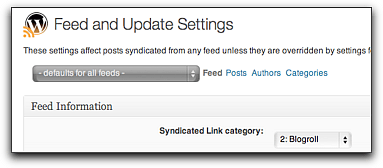
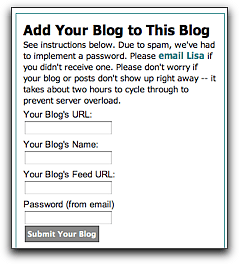
I used the “Add Link” widget plugin, which lets people put their blog onto the Blogroll. Then I set Feedwordpress to syndicate posts from the Blogroll. First, I got some spam blogs, so I had to implement a password. Also, Feedwordpress needs the URL of the blog’s feed, not just the blog’s URL. People put in the wrong feed or a whole other URL. I had to change these manually for each blog. Since most newbies are using Edublogs, the feed URL usually just ends in “feed”.

I also gave instructions for adding only posts that had the class tag (“potcert11”) into the blog URL, but people didn’t always know how to do that. The idea was that if someone already had a blog, instead of adding the feed from the entire thing, they could just add the tag’s feed (for Edublogs or WordPress.com, this is something like http://example.com/?feed=rss2&tag=potcert11. For Blogger, it’s something like http://blogname.blogspot.com/feeds/posts/default/-/potcert11. When folks didn’t understand, I had to try to do this manually to prevent the entire blog filling up with unrelated stuff.

6. The prompts (well, I hope it’s OK now)

The sticky posts, once they were working, appeared to be simple. Just add in the instructions (written by Jim Sullivan, our Blog Meister, who’s wonderfully encouraging). But each post will also have media, and all the  moderators are creating their stuff in different applications — Voicethread, Jing, Camtasia, YouTube. This is what we want, of course! But embed codes didn’t always work. I’d have to add a plug-in, or change the size on a video to prevent it overlapping the sidebars. Lots more work than anticipated.

The Participants

I asked everyone to email me to be “registered”. I kept all their information on a Google Doc spreadsheet. I added their name, where they were from, what they taught or studied, then their blog URL and feed URL, and whether they were interested in Mentoring.

But I also asked them to sign themselves in to a public Doc that appeared on a blog page as an iframe. I used a Google Form for them to enter their info, setting it to show the resulting spreadsheet after they had done so. This way they could know who else was in the class, I could find out how they came to know about the class, etc.

Some people aren’t comfortable being “known” on the internet, so I had a provision for the certificate that they could use a pseudonym. It’s hard to assign a mentor to a pseudonym.

The Moderators and Mentors

Several wonderful people agreed to be moderators and mentors, proof of the old adage that you just have to ask.

Moderators introduce a unit and supervise for a week. I called on POT leaders, certificate holders, and facilitators to take a week and moderate it, making a video tutorial or something to inspire and preview that week (an idea of one of our new people, Eric Robertson). Everyone is doing great work with this, and I look forward to each of them “taking charge” during the week they’ve chosen.

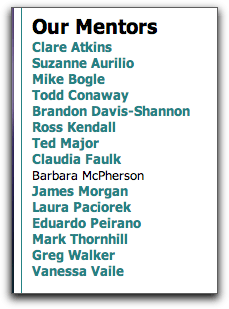
Mentors help individual participants, with a focus on community so no one is sitting there with no comments on the blog. When I saw an obviously accomplished blog post or experienced distance educator add the class, I asked if they’d be a mentor, plus we have people who already earned a certificate last year and are paying it back. As the class registration rose above 50, I decided to follow Alec Couros’ lead and assign mentors to particular participants, so I just added a column to the Doc then gave the mentors edit access to it. Right now each mentor has 4-6 people assigned to him/her.

The Insanity

At one point in my panic, Alec Couros advised me not to abandon my pedagogy. I thank him for that. Others advised me to bail on it and use an LMS (the horror!) or a Google Reader bundle, which is certainly my backup if all this fails and the database crashes or my new host sends me threatening emails. Some people think it’s too open, and they don’t want to blog. Others think this isn’t open enough, and want it to be a connectivist MOOCy thing with internet diffusion and intergalactic social network connections. (If I let this kind of stuff get to me, I’d have given up teaching undergraduates a long time ago!)

It is possible, however, that there is a much easier way to accomplish some of this. I stumbled recently upon a post by Jim Groom, who used WPMU and another plug in to create a Feed to Rule All Feeds by just pulling in any post on the web that had a particular tag. This would be good (no 77 separate feeds, latecomers can play along much more easily) and possibly bad (lots of spam postings, dependence on yet another plug-in to pull them in). I am still trying to decide whether to try it now, but I think it might be better next year. Then we could go even more open and diverse, which would be good.

For now, tracking 77+ people and trying to prevent Pedagogy First! from crashing will be quite enough.

Now what?

The class actually starts tomorrow.

What will we do with those who want to add late? I can allow a few exceptions (I already have, since the registration deadline was August 26). But the way the feeds are done there isn’t much mechanism for just jumping in on the big blog.

People can jump in, though, in a number of places: the POT Facebook group (already very active), a Diigo group, the POT YouTube channel, Twitter (hashtag #potcert11) etc. And we have several mentors already who will be taking the lead in doing synchronous sessions, Google Groups, and goodness knows what other Distributed Activities.

I’m confident that the pedagogical model is sound, and the set-up is sustainable and rich. I mean the people-to-people set-up. We’ll have to see about the technology. 😉
Data-driven attacks on profs signal cultural revolution?

“Public policy reformer” Rick O’Donnell, fired from the UT system, recently published a paper called Higher Education’s Faculty Productivity Gap: The Cost to Students, Parents & Taxpayers. This followed the public release of faculty data by the UT system, which in itself caused plenty of controversy, and a study called Faculty Productivity and Costs at the University of Texas at Austin, which claimed that an increase in professorial productivity of UT professors would save tons of money (published by the Center for College Affordability & Productivity). There’s a summary here at the Texas Tribune from July 20. O’Donnell’s report goes so far as to label professors as “coasters” or “dodgers”, depending on how many students they teach (note, not how well, but how many) and how much grant-funded research they do.

NPR reported on this debate, which is how I found out about it. And after thinking about it for awhile, and remembering my years as a hard-working Teaching Assistant at university and knowing how large my student load is now, I nevertheless have come to the conclusion that this sustained attack isn’t just about money or “productivity” (a bizarre concept for intellectual work), but about culture.

We are becoming a culture that thinks of “knowledge” as a commodity, and the college systems provide a wonderful locus for attack on intellectualism in general. Although we are not yet at extremes, it hearkens back to the Cultural Revolution in China, where the 7 May Cadre Schools were created to “re-educate” professors and intellectuals by having them perform manual labor on farms. These professors weren’t just a “capitalist elite”. They were seen as not doing “real work” — they were not productive. They too were “dodgers” and “coasters”, producing no identifiable product and rather representing the archaic system the communists wanted to tear down.

“Going to live and work in a production team to wage revolution, 1969” from Chineseposters.net

Yes, I realize that comparing a conservative-backed attack on liberal education might not seem to correspond to a communist attack on elitism, but the motives seem to be the same. Instead of moral jeremiads, physical violence and relocation, we have a simple “release of data” and “reform institutes” releasing “studies”. So the attacks are positivist rather than metaphysical, to use Comte’s epistomology. That doesn’t make them less hostile to intellectual values.

I am not saying that data has no place in higher education, or that workloads shouldn’t be examined. In fact, the issue revealed by the data to me is more one of workload than anything else — adjunct and younger professors may be carrying far more weight than is just or right, even if you only consider a college as a workplace. The cultural aspects that lead to such formulas (dodgers and coasters are obviously derogatory) could lead to some issues that ought to be examined beyond that of cost and productivity.

It may be starting in Texas, but in today’s climate of accountability, “data-driven” decision making, attacks on unions, criticism of school systems, the high cost of college, and questioning of the value of a college education, this is going to spread.

Creative Commons giveth, but does it also taketh away?

from Michael Cerviere’s post on ScribeMedia

I regret to say that I have not been able to participate much this summer in the eduMOOC: Online Learning Today…and Tomorrow course. But I did step in during Week 5 for the live session, the format of which had been changed from an Elluminate room holding 100 people to just listening to a panel while using the Twitter hashtag #edumooc5 as a backchannel (ah, the vagaries of learning online).

The recording is here for the session, which featured Ray Schroeder (UIS) Moderator, Cable Green (Creative Commons), Larry Ragan (PSU World Campus), and Jeff Newell (IL Com College Board). One of the issues discussed was the use of Creative Commons to share materials created by educators. Some school districts now require their faculty to use Creative Commons for everything they create, an approach that was lauded by the panel and several listeners. The question briefly came up about the possibility of monetizing this work, even with a CC license. But it wasn’t fully discussed.

Well, that’s a problem. I watched this happen with Academic Earth in 2009. A number of top universities, including Stanford, MIT, and Penn, release the lectures and materials given by their faculty with a CC license. MIT even has its own community site (called OpenStudy) to enable people following the courses to have their own space for discussion. Then Academic Earth “repackaged” the “content”, building courses around the content and publishing the resulting “course” on a website with for-profit goals (in this case, with the permission of the university).

The CC license I use says attribution/non-commercial/share alike. That means that you’re supposed to say you got it from me, not use it for commercial purposes, and share your stuff back.

When big universities began sharing open coursework, I was enthused. But repackaging it inside a for-profit product or website seems to violate the intent, if not the letter, of CC licensing. The model for Academic Earth is that they abide by the CC license by not charging for any of the university, CC-licensed content, but then they add other “non-university” content where advertising (presumably click-through, but they could have something else in mind) makes the money. So the free content is the draw, then the ads come in. Is this commercial use?

Even if the repackaging were done by the institution itself, or a non-profit company, it doesn’t seem right. If a professor creates a lecture and Creative Commons licenses it as I do, a public or non-profit school could still take all the stuff and repackage it, charging for the class without passing on any royalties to the professor.

It was never my intention to provide free content to entities who might put a framework around it, call it their own, and charge people. My intention was to make my work free to individuals to use, without charge.

I am lucky enough to work at a college where some intellectual property rights are spelled out in policy — so far, at least, I “own” what I create as part of my regular job, so long as I’m not receiving special compensation. I could copyright my work, and some of my colleagues do. I used to think this was bad, it was closed, how could they do that?

Now I’m not so sure. If a CC license means that our work is free to be taken and repackaged for profit, I’m not liking this at all.

Update: I am seeking out sites that are ad-revenue based but use other people’s content. Here’s one.

Here a MOOC, there a MOOC

A couple of things came together recently, which is almost always my foundation for a blog post.

First, Stanford University is about to offer an open, online course on Artificial Intelligence.

Then, George Siemens posted about it in Google + (hey, cool, a G+ post has a permalink!), and wrote a post about it on his blog.

At roughly the same time, discussion in the EduMOOC Google Group had two interesting threads, one about the work a few of us are doing trying to expand the Wikipedia page on MOOCs (see my last post), and one about what a MOOC is.

Then yesterday, I was part of a fun MOOCast Hangout with master bringer-together-of-people Jeff Lebow and some cool people from the EduMOOC.

My definition of a MOOC sticks to the basics:

  • M = Massive: needs tons of participants (this is why my own History MOOC failed)
  • O = Open: all resources must be available on the open web to anyone who wants to join
  • O = Online: no on-site attendance required, everything is online
  • C = Course: has a course structure, with set facilitator(s), topics and timeline

That’s it. During the discussion, some individuals have considered that a MOOC must have other elements to be a MOOC. These elements include:

  • connectivist pedagogy
  • no cost to participants
  • a structure set up to deliberately encourage connections among students
  • an intention to encourage lifelong learning

I see these as good ideas, just not required for a MOOC. The argument about Stanford’s AI class, and whether or not it’s a MOOC, is based on the extent to which it complies to these desirables rather than whether it is Massive, Open, Online and a Course. It qualifies (if a bunch of people come) on all four, even with a pricey textbook, no set structure for student communication (so far as we know), and no clear intention to encourage learning beyond the course.

Jeff Lebow asked during the Hangout why it matters how we define MOOC? My answer is that the MOOC has been presented as a model. I have participated in several of them, and tried one myself. It failed to fit the model. I am now part of offering another open, online class that should by rights be a MOOC.

This is our POT Online Teaching Certificate Class, which starts September 1. It is open, online and a course. It will likely again fail the Massive test (we have 32 people so far, and I expect a total of no more than 50). As I’ve mentioned before, I have a theory that general education courses will always have trouble succeeding as MOOCs, because unlike all the previous MOOCs, we do not have:

  • promotion and support by the leaders in the field (the ones I chided for not helping out on Wikipedia)
  • fame ( I am known online only among a small group of diverse educators, and the efforts of a small group of committed, volunteer faculty like POT just won’t be seen as an effort worthy of the same kind of attention)
  • a large technical support system (it’s mostly just us with our free tools)

If I were to add such things to the definition of MOOC, people would rightly say I was nuts. The simpler the model is, the easier it is to discuss it, the more broadly it can be applied, and good discussions like this can happen more often.

Diderot, come help your Encylopedia

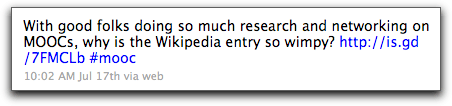
A couple of weeks ago, I needed to link to something defining a MOOC (Massive Open Online Course) for a professional development thang (and for my last post!), so naturally I went to Wikipedia. But the page for “Massive open online course” had very little on it, just a basic definition and a list of years and some courses.

So I tweeted, of course:
And Dave Cormier answered:


Now, I’m not a MOOC expert at all. No research, no articles. I’ve participated fully in three of them, as a student. I taught one in History, and failed. I am teaching another one in fall, POT’s Online Certificate Class. But I started editing, though I’d never edited a Wikipedia article before that I recall. I put in a few names, like George Siemens and Stephen Downes. Then I figured I’d get back to it later.

Then it got more urgent. I regret to say that I have not been able to participate much this summer in the eduMOOC: Online Learning Today…and Tomorrow course. However, I subscribe to the feed from the Google Group. I began seeing a thread called “Please help edit the Wikipedia article on MOOCs (before it disappears)“. Perhaps my actions triggered something, but the MOOC page was set for deletion.

So I and a couple of folks from the eduMOOC class have been working on it. I’ve added links to research, and some text with references, and links from other pages (like Connectivism, and George Siemens) because it was an “orphan” page.

But really, I’m thinking some of the Big Players might want to work on this too? The topic itself is about openness and collaboration, and while blogging and writing journal articles and conducting courses is great, Wikipedia is where most people get their information. In an area that emphasizes open education, shouldn’t the Wikipedia entry be pretty important?

I wonder — did Diderot and d’Alembert outsource the Encyclopedia to their students?

From Course Learning to Snapshot Learning

cc shownbyphotos.com

One of my students wrote on her self-assessment today that she was sad our summer course is ending, because she really enjoyed talking to her colleagues using the Messaging feature in Moodle. She wrote “very sad since I greatly enjoyed the lectures in this class and I’ve met new people via messaging them”.

I have noticed this before, that students often use the Messaging system in Moodle (or any LMS) to talk to each other. I’m not aware of it unless they tell me or I have to go into a student’s account for some reason. But it makes sense. It’s less intrusive than trying to be a Facebook friend, and less direct then email. If you use the LMS system, it means, “Hi! I’m in class with you. Wanna talk about class? or something else maybe?” Less risk, and it draws on your immediate and obvious connection.

My student’s sorrow, of course, is based on the fact that this experience is organized as a class that will “close”. No one will come back after this week, and eventually the website will be unavailable as we all move on. It’s like a coffee shop where you meet some people and hang with them all evening, but then the coffee shop closes and really, you’re too shy to ask for anyone’s number.

A lot has been discussed lately about open learning, life-long learning, learning outside the box. We talk about e-portfolios that would span ones whole academic career, and we bemoan courses as isolating events and lack of appreciation for informal learning.

I like to combine things, so let’s try something different, where we still have courses (and grades, and records, and all those socially-sanctioned assessed things everyone needs for credit and advancement regardless of how much you bitch about it). But let’s get rid of the Course in Isolation, and have the Course as Snapshot.

cc Flickr Mykl Roventine

The idea is that everyone would be learning, online and in the open, all the time. I am going to call this Evidential Learning, because you can see that it’s happening. Then an event comes along, which is the Course, and students enroll and work on that course. This happens all the time with MOOCs — one comes along and everyone begins to focus activity they’d already been doing on the schedule, topics, and feedback loops for that MOOC.

So all of their Evidential Learning is considered a flow, but instructors set up courses in their disciplines,and students register as usual, and for that period of time, the student’s energy is directed toward working on that class. This could be in their usual environments, or other online environments added or encouraged by the instructor. Their directed activities during the course are then seen as a “snapshot”, to which is assigned a grade.

Then students will connect to each other in their own way, and the coffee shop need never close.

nEver-ending search for pdf annotation

Not happy with converting pdfs using Google docs so I can annotate them in Diigo – it’s too hard and looks lousy.

So I’m trying Evernote, which Everyone has been telling me to try for years. Of course, Everyone has a smart phone and I don’t.

With Evernote the workflow for accessing a pdf I’ve annotated is two-step:

1. Download PDF to a computer
2. Annotate it there (in Preview for Mac – at least Preview can do that in 10.5)
3. THEN put it into a Notebook in Evernote

It holds the annotations so I can at least access an annotated document from Everywhere, even if I can’t annotate the document from Everywhere.

However, this could be a Good Thing. It means I have to sit and annotate the whole pdf all at once. That involves focus and concentration, which aren’t a bad idea when reading an article with, say, a sustained argument.

So in this case, the tool might be a little bulky for workflow, but as there’s no better way, I can take advantage of its Ever-attentive nature.

The Wild West and Mobile Learning

I’m immersing myself in Bernie Dodge’s EDTEC700 seminar  in Mobile Learning, and going through materials from EDUCAUSE’s Mobile Computing 5-Day Sprint from April, but my thoughts are out on the range with the cowboys.

I am always wary of EDUCAUSE because of its central IT/administrative focus and corporate sponsors, but the people in the discussions supported the opportunities and concerns that are forming in my own mind about the taming of the wilderness.

Not so long ago, the internet was the Wild West. Those of us teaching on it when it was new, long before technology plans and wireless hotspots, may not have had a lot of spiffy technologies but we had pretty much total freedom. Over the years, the wild horses have been corralled and tamed by Learning Management Systems, the swift emergence of central IT, and the even swifter development of graduate degrees in educational technology and distance learning.

In the first part of the EDUCAUSE Now podcast #38, Bryan Alexander, Terri-Lynn Thayer, George Claffey Jr, Joanna Young, and Gardner Campbell discuss how movile devices are affecting higher ed:

EDUCAUSE Now #38

I am hearing here an echo of the early web-based teaching concerns: how can we keep the freedom? Mobile devices permit all the affordances of the internet (massive amounts of information, social contact, and fun distractions) to be carried around. This provides opportunities to teach in new ways.

Just as some profs didn’t want (and still don’t want) the internet impacting their teaching and their classrooms, some don’t want mobile devices in the classroom (the Turn Off All Mobile Devices in Class syndrome). But, as Gardner Campbell says in the podcast:

“Rather than raise a generation of students who will be waiting until the bell rings so they can go outside and consult their mobile devices, we can and must incorporate the riches these mobile devices present to us into teaching and learning.”

At the same time, out of conferences like this come directives, often along the lines of :

“From a planning perspective, CIOs should assume that the entire user community wil require support for one or more mobile devices.”

“…those institutions with with a well-defined strategy for exploiting mobile technologies will discover significant advantages.”

(These are also from EDUCAUSE, the recent Review).

Last time, the internet cowboys were on the open range. This time, the mobile learning cowboys are already outnumbered by the bank managers, sheriffs, back room accountants in green visors, and federal marshals. There are concerns about central IT and others taking control. I sense these “stable” forces working hard to figure out how to promote the advantages of mobile learning while “organizing” it into “plans” and “strategies”. To me, that means an inevitable restriction of the range by fences.

True, the very mobility of mobile learning should mean it will be more like fencing in birds than cows, but technological and commercial limitations take care of the rest. Apple’s success has already shown that people care more about style and snaz than independence and creativity. (I am currently being “encouraged” to buy a new iPod since Apple refuses to create software so I can update my “old” one, even though nothing is really different inside except a camera the software could ignore.) “Apps” now dominate, and many are proprietary, even when they operate on systems that are open source (like Android). Even QR codes are patented by Denso Wave, though they choose not to exercise rights .

Arcade Saloon, Eldora, Colorado 1898, Denver Public Library

So the railroad investors and moguls will make sure whatever range isn’t limited by managers will be limited by their products.

My hope is that the mobile cowboys will do as much as they can now, making models of independence and creativity, before we enter the next age (which should be, what, a year from now, at the outside?).  Those who exercised insane creativity on the last frontier seem to be the only forces holding the web itself as an open space, against the enclosures of property-owners like Facebook.

So let’s do some jailbreaks and fight in the saloons before things get really civilized (and dull) around here.

A Pink Mind

A student of mine, who teaches preschool, told the class that she’d approached the father of a 4-year-old to tell him his son was very good at art. The father replied that he’d better pick something else, since there was no money or appreciation in art until after the artist was dead. Her comment got a lot of responses, supporting the child’s talent. I advised she give the father Daniel Pink’s book, A Whole New Mind (2005).

An interesting, pleasurable read, this book promotes the idea that a right-brained set of skills will be necessary for the 21st century workforce. It reads like an article extended to book-length, and the writing style is very similar to everyone else who’s written a book recently on the brain, the brain and the internet, the internet, etc. (Gladwell, Surowiecki, Powers, Tapscott, even Carr). These books are becoming a little formulaic — a couple of really good ideas and lots of folksy examples in the new tradition of “storytelling as information”. I confess that the pattern began to annoy me as the elements of arguments got weaker near the end of the book — I began skimming.

Pink claims that the driving force behind the need for right-brained workers is Abundance, Asia, and Automation, which is cute and alliterative but I don’t buy it. Abundance is not prevalent to the extent he perceives — the argument mostly applies to the middle class in industrialized Western nations. Asia (by which he mostly means outsourcing jobs to India) is not in itself a cause of anything, but rather a symptom of Automation, and Automation isn’t really what’s meant, but that’s where the good idea is.

The basic thesis: we need to be more right-brained because most left-brained things can be increasingly accomplished by machines. He claims a pattern of historical development from the Agricultural Age (through the 18th century), Industrial Age (19th century), Information Age (20th century) to the now new Conceptual Age (21st century). (Yes, I often have to turn off my historians’ mind when reading these books.)

I use the term “right-brained”, though Pink uses “R-directed” (no matter — we are all still in thrall to Julian Jaynes’ The Origin of Consciousness in the Breakdown of the Bicameral Mind). The skills/aptitudes are presented as dichotomies, claiming we need to move from one more toward the other:

Function -> Design
Examples include people spending more money on cell phone accessories than on the phones and the butterfly ballots of the 2000 election (showing bad design as costly), so everything needs to be properly seen as a design issue. Items need to have significance as well as utility. (I like this, because it will help support several arguments I make about Learning Management Systems.)


less talking, more listening, please


Argument -> Story
Since everyone has access to a zillion facts, putting them into a narrative context becomes the important skill. Revive those ancient narratives, and tell those stories. More specifically, a great example is medical schools teaching doctors to listen to patients’ stories.  (I have trouble with this transfer to narrative, as logic often goes by the wayside — but notice I started this post with a story, which is alien to my nature.)

Focus -> Symphony
This is the ability to synthesize and see the forest instead of the trees, using pattern recognition and the creation of new metaphors. (This works for me because it’s what I do with my students for History — the facts are just building blocks and support for the argument. But they’re still needed, which another reason I have trouble with Argument – > Story.)


We’re all very sorry you’re having this problem today.


Logic -> Empathy
Although he acknowledges exceptions, here we must buy that the female brain is more empathetic than the male, and that we need to move toward a female brain. Much of this is based on the work of Simon Baron-Cohen. (This shift is already  happening, of course: it is a trend I’ve noticed in cinema and in my students, the belief that feelings are more important than rational thought. And it’s pretty clear I have a male brain by these definitions.)

Seriousness -> Play
This got more into gaming than what I would call “play” (by which I mean experiementation), but the idea is that we need to play to learn, and to laugh.

Accumulation -> Meaning
Pink says the predominance of the baby boomer mentality means that the goal of accumulating meterial goods is changing to the desire to find meaning in life, a kind of “post-materialism”.

For each chapter on these aptitudes, Pink provides resources and tips to develop your own brain along the new lines. Thus we go from theory in Chapter 1 to a series of storied examples, then each chapter ends with self-help advice. (It’s already pretty light — I find it very funny that there’s a “Summarized for Busy People” version available.)

But the mental yoga commercial was a distraction from the main idea. What’s significant here is that right-brained, big picture, contextual, design-based thinking will likely be increasingly respected in our culture.

cc Flickr by torres21

“Knowledge” jobs where humans do things that can now be done faster by machines (anything featuring repetitive tasks and computation, such as accounting or basic manufacturing) will become less common or will be outsourced (up to a point — people still need to input and program the machines — ask anyone working on the Google Books project or who spends 9 hours a day typing in medical records).

So if his father can get over it, my student’s 4-year-old pupil might be in luck. Art, music and all those things we cut from the curriculum as fluff may soon be understood as necessary to engender the skills society needs. The book is worth it just for that.


SOS or in light of the web?

I’ve been grading student Contribution Assessments in my online classes. This is an assignment, done twice during the semester and worth 10% of the grade each time, where they have to do a self-assessment of their participation in the class and the contribution they’ve made.

The emphasis is on the forums, which is where the constructivist work goes on. As I’ve said in workshops, I consider my online classes to be 50% instructivist and 50% constructivist. Since the instructivist elements (planned reading and lecture) are prepped in advance, my energy during the semester is focused on the constructivist side, guiding them through finding and posting cool primary sources, then creating increasingly complex theses that use them.

My CMS (Moodle) lets me see where each student spends their time. I graded by comparing their self-assessment to their actual work in the forums, and their stats, including whether they used the Study Guides, looked at the sample exams I posted after a test, etc. And I started to notice something.

A number of the students doing just fine in the class were not viewing the Assignments. This is where I post the pages for assigned textbook reading, and a link to my lectures. I’ve worked very, very hard on these lectures, for every class. Yet here were A and B students not bothering to read them, and passing the tests anyway.

Why? Because the exams are 60-70% multiple choice, and 30-40% essay. The MC is based on the textbook and lecture, and the essay is based on the constructivist portion. But I give them Study Guides for all the multiple-choice, with all possible questions and two chances to practice and see whether they’re right. I planned for them to use these to do strategic textbook reading. But if, out of say 14 MC questions, only a couple are from lecture, why do the lecture? Why even open the Assignment in the first place? So they aren’t.

I graded down a bit students who hadn’t done the Assignment/Lectures, because I figured that was part of participating in the class. I think most people would see that “doing the work” is part of participation. Then a student wrote me:

My first response was, “oh, great, now they won’t even do the work without my telling them! better add it to the rubric…”

My lectures can no longer be assumed to be an inherent part of the class. I see my classes based around them because they took me so much time, and define the order of events. But students see them as supplemental, while they spend much time constructing work in the forums.

But wait. If the connectivists are right, this is actually a new issue. Not because students won’t do the work (hardly new), but because the nature of the web is theorized to be creating new forms of learning. With all the “information” available, what use is a textbook? I’m even getting rid of my textbook for summer, because my lectures are sufficient for “information” purposes in a compressed 8-week class.

But this may not be a mere pedagogical choice. It’s possible that new forms of pedagogy are being forced upon us by the nature of the open web, and the habits of people who use it. It’s strategic studying combined with the ability to pick and choose your work. Yes, I could add more lecture-based multiple-choice questions to the exams, and I likely will. But that’s not the larger issue.

My lectures, which I used to see as providing an active learning opportunity (they contain visuals, audio, self-tests), have become passive when compared to constructivist opportunities in the forums, and connectivist opportunities (which they may or may not use) provided by the web. The role of my creation has shifted, and I will also have to shift, sooner rather than later, or risk the irrelevancy that so many internet pundits say is automatic now that “everything” is on the internet.

My History MOOC failed. Long live the Online Teaching MOOC.

I thought I was teaching a History MOOC.

But really I am teaching an online teaching MOOC. No one knew about it. Not even me.

When the Program for Online Teaching team set up our Online Certificate Program, we had a major element of community: the Pedagogy First! blog. For the first several iterations, we had faculty attend on-campus workshops, and blogging was just part of reflection. But over the last year or two, the blogging component has been refined until it’s become a full online course of its own.

Beginning this semester, the focus was already there, with assigned readings and reflections. For next year we’ve combined the readings (spaced better), tool exploration, and blogging together into a Certificate Class. We wanted to make sure that faculty were aware of the time commitment involved, and knew what would be covered in advance.

Then it became obvious. The syllabus, when I looked at it a second time, was clearly a MOOC syllabus. All work is done online, with weekly postings on the blog. The article readings and videos are online. The book can be purchased online. Why not invite others to join in? We could have our local MiraCosta folks as authors on the new WordPress blog (we’re moving from Typepad, which only allows one administrator), but have anyone who likes blog for themselves, adding their own blog links to the blog roll.

Our Certificate program has always been open to anyone, though we have limited space. We’re still limited for the number of certificate candidates (we’re a volunteer group), but the class itself is completely open and anyone can join.

We’ve already had interest from six MiraCostans and two people at other schools. Since the focus is online teaching (pedagogy and technology), the Certificate Class is suitable for anyone wanting to learn more about educational technology, online pedagogy and approaches to learning.

The failure of my History MOOC, and my interpretation that the failure was caused primarily by the topic, is what made me realize we already have a MOOC much more appropriate to the audience of educators and technologists who are online a lot already, tend to be self-directed learners, and love playing with ideas and technologies.

We’ve updated the FAQ. We’ll start September 1. Won’t you join us?

The MOOC That Wasn’t

Having been inspired by the Massive Open Online Courses of George Siemens, Stephen Downes, Dave Cormier, Alec Couros, Jim Groom and others, I opened my History 104: Western Civillization course as a SOOC (a Small Open …) this January.

Nobody came. I created discussion questions, opened all readings and provided extensive online lectures with audio.  I alerted enrolled students of privacy issues and set everything up in an open WordPress blog so it wouldn’t overload college servers. I post all in-class activities in audio and broadcast with video. I built it.

They didn’t come. Analytics make it clear that no one outside the enrolled class is even observing, much less participating.

George Siemens asked, in a comment to his own What’s wrong with (M)OOCs?:

I’d also like to see other domains try the course format. Most open courses that I’ve seen have been somehow related to educational technology. Where is the mathematics mooc? Or biology?

At the time (December), I answered with my own concerns about technology proficiency on the part of the professor, course design, professorial load, etc. But then I decided to try it anyway.

One may hypothesize on the various reasons why no one showed up for mine. I didn’t advertise properly (mostly I used Twitter, meta tags, and an announcement in our online newsletter for the Program for Online Teaching). We’re not a university, and I wasn’t sure I would get support at my college. But the most significant reason, I think, was implied by Dave Cormier when he responded to my Twitter invitation to everyone to join my MOOC:

My cocky reply (that he hadn’t taken it from me) didn’t hit the point. [I’m sure it’s very common that people think that because already took a history class, they have nothing important left to learn. This isn’t at all true, of course – history is a changing field that transforms its theses with every new generation that analyzes the evidence, and every new discovery of evidence itself (for example, the possible discovery of Olaudah Equiano’s baptism record that has caused such controversy) .]

There are several other ideas at play here. Maybe it’s not about the offering of MOOCs, but about the participants (or lack thereof). Perhaps the question is not why are there no (or so few, assuming we can’t find them) MOOCs in mathematics, biology and history. It’s why would anyone want to participate in them?

The subject matter?

Unlike educational technology and contemporary media/web studies, history is a traditional discipline. The “data” doesn’t change every few months, or at least not at a level where ordinary people might feel comfortable shaping (and sharing) an opinion. The feeling that one may contribute something to a MOOC about education, technology, or modern media is likely much higher. Anyone can play. Everyone can find something interesting to explore, since they’re on the web and think about it all the time anyway. Or they figure, I’ve been through the school system, so I have something to say about education. I know the web, so I have something to say about technology. I know these edufolks, so I have something to learn from them and to share with them.

The “students”, then, are inside the course content before they even start. They can’t start from inside the 17th century.

[It is tempting to point to Michael Wesch’s wildly successful anthropology classes at Kansas State as the obvious exception to the ed/tech focus, but even there Wesch is focused on the anthropology of culture and communications in such a way as to make the web central to the task. It’s not just that he has students using RSS feeds: the focus is often Digital Ethnography rather than traditional anthropology, although all the tools of the discipline are in play.]

If it’s about the subject matter, and if I were at a university, I could offer a History of Contemporary Media or something trendy that would catch interest like this, and possibly have a successful MOOC.

The content? The community?

In traditional fields, there is no need to join a MOOC to get information about the subject. You can go to anywhere on the web to learn not only the facts of history, but to read journals and analysis. You can find all my lectures on Slideshare (and hundreds have, apparently, from all over the world). If you don’t like me, MIT, Harvard and other big schools will be happy to provide you with the “content”.

If it’s not the content, connectivists (and even constructivists) would say it’s the community. Getting all the minds together to work on something creates something much bigger than the sum of its parts. It could spontaneously self-create, which would encourage participation. According to Rick Schwier, such a virtual learning community would need elements such as motivation and rules for engagement. But a community forming around an issue isn’t, I think, a MOOC — it’s missing the “course” element in the same way that content alone is missing the course element. A learning community is more like a social network.  A MOOC needs a facilitator.

The facilitator(s)?

The facilitation provided by the instructor is what makes a MOOC a course rather than a website or a social network. If the subject matter were just OK, and the content could be found anywhere, and the learning community really wasn’t exciting, then the only reason to join a MOOC would be to learn directly from the teacher, that particular teacher (or teachers). And we know the names of these desirable teachers only through the subject matter interest, content, and networked connections that we have already accessed.

So it’s also entirely possible that no one cares about a MOOC unless it is:

* led by a university-connected person well-known in the blogosphere, Twitterverse, etc.
* focused on contemporary trends already of interest, and
* instrinsically appealing to the digerati, edubloggers, researchers, or edupunks (sorry, Jim)

This conclusion would, unfortunately, make the modern MOOC simply the shiny object of the new age, rather than a harbinger of meaningful online learning experiences.

Now, of course I (a non-university, not-very-well-connected, traditional discipline-focused instructor) will continue with open courses, and encourage open education in general. I believe strongly in public education and my responsiblity as a public servant, which to me includes what Dean Shareski calls the “moral imperative” of sharing my methods and knowledge.

But perhaps this is a start to answering George Siemens’ question, and why no “M” is participating in my OOC.

Reorganizing professional development to emphasize pedagogy

Our Program for Online Teaching says we emphasize pedagogy, that we want faculty to think first about what they want to achieve in class, then look at the tools.

That’s important to us, because a primary emphasis on the technology leads to bad things among novices. I’ve written about this before, so I won’t go into it here, but starting with Blackboard training is the road to canned courses and standardized pedagogies based on using the system defaults. It also leads to the IT tail wagging the teaching dog.

Anyway, we all know there are many wonderful tools out there that can be used instead of, or combined with, a CMS. Most POT leaders, including myself, are easily enchanted with these tools, and faculty who attend our workshops want to know how to use them. They want step-by-step guidance through the tools they’ve seen or are interested in. That’s fine, but it’s training, not pedagogical preparation for teaching online.

Tackling the POT website is the first step. Our website has a page of cool tools, organized by type. Our Pedagogy First! blog, the basis for our certificate program, explores different tools each week for its first of two semesters. Both of these are backward. We should be starting with the pedagogy. But how?

First, I want to take a tip from a great list of resources, the DiRT Digital Resources list, which is organized as “I want to…” items (mine data, network with other researchers, make a screencast). The tools themselves should be accessible through this somehow.

Second, there are organizational problems. I’m thinking that the category pages (Cool Tools, Guides and Handouts, Outside Resources) are very difficult to update and won’t help faculty find what they’re looking for. On the front page right now (the real “blog posts”) is what’s new in terms of workshops and activities. As the site has expanded with more information, I’ve found it increasingly difficult to keep it organized and useful.

So somehow I want to redesign to display our own pedagogical priority: starting with what faculty want to achieve. I have added a How Do I Start? map for faculty, and updated the look of the site, but more is needed.

Third, I want to flip the certificate program. Right now we have the first semester exploring tools, and the second semester applying them, and we plan to add prompts for the second semester (like we have for the first). The first semester should be pedagogical preparation, with articles and maybe even this book to read and explore together. Our faculty deserve more than just guided tool exploration and a place to post their accomplishments, and we’re not utilizing all the pedagogical resources we’ve been collecting.

That means a better place to post as well. Pedagogy First!, where faculty post who are working on the certificate, is a multiuser TypePad blog, administered by the excellent Jim Sullivan, one of our volunteer faculty. It’s a bit cumbersome, and the faculty might not have a chance for ownership of their work, though the blog has certainly helped build community. It might be better to shamelessly copy Jim Groom’s idea of WordPress with FeedPress, so that faculty who are formally enrolled in the certificate program could have their own blogs, and their posts would automatically appear. Then we could add, as I have to my on-site 104 class, a signup for anyone who likes to join us and have their blog linked from the “outside”. A MOOC for professional development!

Time for some meetings and discussion among the POT leadership, I’m thinking…

A possible SOOC set-up

Having decided what to do about my SOOC (Small Open Online Class or Semi-Open Online Class, depending on how crazy it gets), I set up a WordPress blog to do it.

104blog

Basic steps to installing WordPress:

– Downloaded current WP.
– Created a new database in Control Panel – MySQL. (I have Lunarpages hosting.)
– Changed the config file and uploaded all files according to the Five Minute Instructions.
– Logged in to new blog.
– Installed Atahualpa theme.
– Added plugins:
Comment Form Toolbar — to allow students to add images by URL.
Comment Image
Comment Image Embedder is now… -> Comment-Images — — to allow students to add images by URL
Editable Comments (didn’t work) –> Edit Comments added and we’ll see
Email Users — so I can email all users
Insere Iframe — so I can use iframes to display pages, like the syllabus and Engrade book
User photo — so students can have a photo with their account
Custom Meta — so I can give instructions in the title of the Meta box and leave out the wordpress.org link

Stuff that didn’t work last time and won’t work this time:
Students use Reply (comment, essentially) to add their material — nothing in the universe lets them edit their own comments without editing everyone’s, so they can’t edit their comments once they’re posted.

Embedding my web pages

I have static web pages elsewhere for things like Grading policies and the Syllabus. The tabs at the top are Pages, so I createdone for each page, but to get a static web page to embed in an iframe is a little tricky, and involved templates.

In a plain text document, I have to create a template for each page, naming it something obvious, and saving it in the atahualpa folder.

They look like this (this one is called “iframetemplatehome.php”):

templatecode

and have to be saved as .php.

Atahualpa theme options

I discovered last semester that the Atahualpa theme is the best for something like this, because it lets you customize everything.

I got rid of the Posts and Comments images in the upper right corner — my typical students won’t know what they are, and Guest Students can use the text links at the bottom. I got rid of the “You may use these HTML tags” from above the comment windows by turning it off in Style & Configure Comments. (I don’t need it with the Comment toolbars, and they confuse people.)

For the header, I added three images to the themes-atahualpa-images-header folder, all 1200 w x 160 h. I added image credits and the college logo to plain HTML widgets.

For users I allowed anyone to register, then used the About the Class page to ask Guest Students not to register. I removed all the Links, then stole an idea from Jim Groom’s ds106 class and added the Add Links plugin so I have a widget where if anyone is working on the course at their own blog, they can add a link.

I made categories for each task (Post Theses Here! and Groupwork), and more child categories for each week and each group. I had to add a post to the Theses and Groupwork categories to get them to show, but I scheduled the Theses items to appear after the previous homework was due so they couldn’t post too far ahead and wouldn’t get confused.

I added the Simply Exclude plug in so that all posts to the Groupwork and Theses categories don’t appear on the main page. This way all discussion can be on the main page without other stuff interfering (like a…blog).

Now on to what I didn’t do last time — create scheduled posts for each week so that everyone (on-site students and Guest Students) can discuss some cool issues for each era. That will be the fun part!

You can take a peek. Suggestions welcome!

A false start on a SOOC

I’ve decided to try planning one of my spring courses as a SOOC — a Small Open Online Class. I am simply not ready for anything Massive or Massively Open. Rather I want to start with what I already do, and let others join in.

So what I wanted do was offer one of my standard half-instructivist, half-constructivist classes in Moodle, which are traditionally closed but allow self-enrolling. I wanted to give my enrolled students the same private, individual feedback as I always do on tests, and group feedback as I always do in the forums, where image collections are constructed and theses developed. But on top of that I wanted to allow Guest Students who would be able to access all lectures and materials, and participate in the forums, but not mess up my gradebook. They could do tests if they want, but I wouldn’t be grading them, so only the multiple-choice would grade, and that’s already automatic.

I figured out I could create a Guest Student role and a Guest Student group. A separate role would make it so that each list of students would be separate in Assign Roles, so I could easily check official registration and drop the enrolled people who no longer wish to participate. The group function would separate the two cohorts in the Gradebook, so long as the whole course was based on groups. I went to my US course and set the Course Settings to Groups, visible and not forced, so activities could be set in common (like the forums). I was pretty sure there wasn’t a way, however, to have the system automatically sort those who get an account and “enrol” in the Moodle class. It wouldn’t be able to automatically put them in separate groups — I’d have to do that by hand.

So then I would have an Open-Closed MOOC, only smaller, with people coming in to my LMS instead of me moving the whole course outside the LMS. (While I would love to engage in the more open pedagogy and teach a real Open-Open MOOC, there is no way I can do this starting, as I must, with over 200 students each semester in five different classes.)

But then I discovered I can’t do any of this, because MiraCosta does not host our own installation of Moodle. Rather we have an external vendor, Moodlerooms. The college’s account allows a limited number of participants — I can’t fill it up with external people who aren’t enrolled. Oh no! Now what?

So on to idea #2. Start with my on-site class instead, since that’s not in a LMS anyway. I could take this class and put all the materials on an open WP site. I already have online lectures, and a textbook. I don’t usually use my online lectures for an on-site class, but what the heck. I spent most of today creating a new WordPress blog and setting it up. To be continued…

CC “False start” photo by Stephen Downes via Flickr

Got MOOC?

I have now been an enrolled student in two classes being referred to as MOOCs (Massively Open Online Classes). I attended a discussion today that was offered by George Siemens in his blog post “What’s wrong with (M)OOCs?“. I commented there on some challenges to MOOCs in traditional disciplines, but I am also formulating some ideas regarding the possible different types and formats of MOOCs as I adapt my own thinking in a way that will help me design a History MOOC.

The advantages of MOOCs are many. They open up both content and instruction, and allow people from all over to participate in a class. But even after only a handful of offerings have been attempted, it is clear that there is a spectrum of course design for MOOCs.

The Open-Open MOOC

At one end is what I’ll call the open-open MOOC, where the scaffolding for the course is minimal. There might be one or several “instructors”, but there are no lectures or required assignments. Any synchronous meetings are purely optional. Guidance might consist of weekly topics, perhaps phrased as suggestions. The course environment might be set up in a central location for part of the class (for example, an instructor’s blog or a Moodle installation), but the use of it is de-emphasized. Instead, course activity is distributed as widely as possible. For today’s web technologies, that usually means each student creating his/her own Personal Learning Environment through blogs, wikis, and RSS aggregated feeds. No one’s work is truly “assessed” (as in graded) but may be featured through distributive means such as retweeting or linking from ones own blog. The course may have start and end dates, or it may be so open as to really constitute a form of guided community instead.

An example of an Open-Open MOOC would be the recent PLENK course, taught by George Siemens, Stephen Downes, and Dave Cormier.

The Open-Closed MOOC

In the middle is what I’ll call the Open-Closed MOOC, where the root of the course is a for-credit class (usually offered via university or university extension). The start and end dates are set, usually by the sponsoring institution. The “core” students are there to earn a grade, so their work is assessed. The technologies used may be identical to an open-open MOOC, and those who are not officially enrolled (but may have “registered” somehow so they are known) have an active role to play. Their work and activities may be indistiguishable for those who are enrolled, or they may be given a separate role, such as mentor or contributor.

An example of this format might be EC&I 831, taught by Alec Couros.

The Closed-Closed MOOC

A Closed-Closed MOOC (I realize that seems to contradict the world “open” in MOOC) would simply be a large course, offered on-site or online, where only the materials/content, and perhaps commenting in a connected community, is open to the web. The instructor would not monitor the non-enrolled student activity, but rather allow it to contribute to the closed class, and vice versa. In a very closed version, student activity could reside in a course management system or other controlled/semi-private space, and the world outside the course could be connected via blogging, RSS feeds or other technologies. Some student work might be private, and some public.

A number of courses may fit this model, including standard on-site or online courses which access the larger world in various ways via the web.

The pedagogy used for each model is heavily influenced by the nature of web-based communications and source-gathering. The more heavily these are used, the more learner-controlled focus is likely. In the Open-Open model, the model itself forces a decentralized, learner-directed approach. In the Open-Closed and Closed-Closed models, the pedagogy for enrolled students can range from more instructor-directed work to more student-centered activity, so long as such activity can be shown to match course outcomes as determined by the institution.

My distinctions might provide for a way to discuss such courses in a way to encourage greater openness and variety of pedagogical approaches. As I noted on George’s blog, the challenge of offering a MOOC may be about larger issues, such as instructor workload, institutional restrictions, and lack of resources. But the fact is that each MOOC so far has been taught by a particular kind of tech-savvy instructor teaching a subject already suited to (and dependent on for meta-referential research purposes) the Open-Open framework. Perhaps we can consider now massaging the possible frameworks to enable other kinds of instructors to see where their work would fit.

Chef as metaphor

Last year, as part of the huge Connectivism course, we were asked to consider various metaphors for the role of the instructor in this new internet-influenced world of learning by association (and with ones associates).

The metaphor of curator, which George Siemens used, seemed to me the best at portraying the new paradigm. At the time, I suggested the role of Organic Gardener or Wizard to be apt also.

But this week, after preparing Prezis and recordings and providing worksheets for translating lecture material into a handy chart of political shifts during the French Revolution, many students did very poorly on the quiz. The brighter students easily saw that I had prepared them thoroughly for the exam. Others wandered around the essay question, not realizing it reflected what we had done together in class. We had spent an hour with me putting the events of the French Revolution within a framework of conservative/liberal/radical politics, and many essays didn’t use any of these words.

I was not using open, connectivist learning, but rather classic lecture and a classic essay question. Nothing should have been in the least surprising. It occurred to me that I had cooked the meal, laid the table, and some had simply refused to eat. It should have been comfort food, what they were used to, but seemed somehow exotic.

So my new analogy is that of chef. I am a master of the ingredients of history. I can combine them into multiple complex formulas to please the most discriminating palate. I do not like being treated like a mere cook, whose role it is to simply serve up the quick info and then expect quick consumption. Our current model of student as customer has, of course, encouraged the White Castle burger (or In ‘n’ Out if you prefer) approach. The items on the menu are assumed to be limited, and to cater to pedestrian tastes, familiar to all.

I served up a wholesome meal, a chronology of the French Revolution with a pleasing side dish of political philosophy. They picked at it, and would probably have preferred macaroni and cheese.

I suppose if I taught at a university, it would be like being a gourmet chef, the kind that gets his name in the newspapers. People come to that chef’s restaurant to eat what he cooks, because he is an expert. Only those who can afford it, those who at least think they have discriminating taste even if they don’t, would visit. At an open access community college, however, I get a much broader spectrum of clientele. I do not mean this in a socio-economic sense, but rather in an intellectual sense. I have students who are there to get into a good university and already come to me with intellectual skills, ready to hone them into historical skills during my class. They ask what’s fresh today, order on my recommendation, use their napkin, and tip properly. But I also have those who casually made it through high school, and who think this is “high school with ashtrays”, and who are very much enjoying the fact that unlike in the cafeteria of secondary education, where they had to sit at a certain table for 45 minutes, they can now refuse to eat at all. A number are there only to stay on daddy’s health insurance, and will happily take a D. They clean their nails at the table, order too many drinks, and make fun of the French names on the menu. They expect a TV chef, that I’ll juggle knives or get all choked up if the judges don’t like me.

How do I serve them, as society assumes I am supposed to do? Open education means opportunity for all, and everyone deserves a chance to succeed, so all must understand the menu, and be able to digest what I’m offering. At our Adventures in Online Pedagogy session in January, my colleague Jim asked the attendees to move to the corner of the room representing their pedagogical comfort zone: instructivist, constructivist, or connectivist. It was assumed that I would be the only one in the connectivist corner. I really couldn’t go there yet. I’m still part instructivist and part constructivist, as my forum design demonstrates. I still think I need to serve them something, and that I’m the best person to decide what the something is. But the fact is, I was trained as a chef, not a short order cook. I can’t do Adam and Eve on a Raft, wreck ’em. My understanding is that I was hired to make the decisions in the kitchen, yet the pressure seems instead to make sure that everyone eats. If I have a high drop rate, I must be doing something wrong. If too many students get below a C, it’s seen as my fault. They don’t like the food, I must be cooking the wrong things.

What I would like to do is serve a connectivist buffet, and let them make their own plate. But I worry that they will not make good food choices. Some will go for the sugar, having been given their own choice for the first time since high school, selecting sensationalist tidbits from the History Channel. The only ones who will create a nutritious plate will be those in the habit of doing so, or who are bright enough to understand the digestive consequences of an unbalanced meal. These are the A students, the ones who could have cooked a decent meal for themselves anyway.

I just wonder whether the buffet, or connectivist approach, would make this better or worse. Would providing a huge selection of choices lead to real learning? or would they just get too many carbs?

A Tale of Two Chapters…well, one

Way back in the distant past (2007), I was asked to write a couple of chapters in a forthcoming book about digital learning in the humanities. I agreed, and wrote one on Course Management Systems (duh) and one called “Learning With Style”. They were well-documented, yet informational, designed for the new online college instructor.

The second chapter focused on learning styles. I was big into learning styles then, the idea of catering our teaching to hit as many learning styles as possible, based on Gardner’s multiple intelligences. I had even given presentations on the subject, including one at San Diego City College, which I was asked to reprise in 2008.

The chapters disppeared into the void for a couple of years. Then this fall, the editor contacted me. A new editor had been assigned at the publisher, and would I be willing to update the sources and do a little editing in response to her suggestions? Why, sure.

Trouble was (isn’t there always a problem?), I no longer believe what I wrote in 2007 about learning styles. I have, quite simply, changed my mind. (As the saying goes, if you can’t change your mind, how do you know you have one?)

I was conversing with a colleague at San Elijo, and we were discussing how students on campus have been using their challenges and difficulties in life as justification for not completing their work. My response was, “This is college. They’re here to overcome those things, not wallow in them.” Then I started thinking about learning styles, and how I’d changed what my students do in class in a way that clearly emphasizes writing: gathering evidence and developing a thesis. And how this semester, not for the first time, I had a student say to me, “Well, I’m no good at taking notes from lecture. I’m a visual learner.” But he wasn’t a genuine visual learner — he just liked pictures. He didn’t analyze visuals any better than he did text.

A number of my students have been told that they have a particular learning style already, before they get to me. They are beginning to figure it’s my job to cater to it. But I need them to write, too — we’re doing historical inquiry here. Is it good teaching to let them wallow in their “preferred” learning style?

So I decided to rewrite the chapter. First I wanted “Teaching the Students We Have”, with an emphasis on how students really are today, what they need, how we should teach them. My editor said OK. Then I changed it to “Reducing the Distance in Online Classes”, which involved less rewriting, but reducing the learning styles thing to a small section and bringing in some current research. My editor said OK (he’s quite amiable).

Then I found it. A great new study saying (ta dah!) that there is no evidence that catering to learning styles increases their learning, linked from this post at the British Columbia Institute of Technology. Vindicated!

Education or Schooling?

In every issue of FACCTS (the publication of the Faculty Association of California Community Colleges), there has been a column by David Megill, my former colleague at MiraCosta and a wonderful advocate for faculty rights and independence, one of the first “edupunks” I ever encountered. In the Fall 2009 issue, instead of just Dave’s column, there was a Point-Counterpoint feature with Dave on one “side” and Rachel Winston on the other.

Megill argued that mass education itself is problematic, especially with its efforts to create “student learning outcomes” to apply to all courses and every student. He argued for “multileveled education not defined by arbitrary degrees.” In response, Winston argued that community colleges are there to provide access to all, precisely for those degrees, our “ticket” in society.

These ideas connect to the main paradox of community colleges: we are open access, yet provide transfer-level curriculum that takes the place of the first two years at university. Universities, of course, choose their students; we do not. So for those of us who teach transfer classes, can we provide the equivalent university experience? By law, we must, for everyone who comes: grades alone determine who is suited and who isn’t for academic work.

But the bigger question is whether we are here to provide “schooling” (with its requirements and degrees and accountability) or “education” (a meaningful experience of discovery for each student, something only that student can make useful in their lives). Megill is critical of “schooling” and wants “education”; Winston sees the value of “schooling” as an opportunity for all to possibly achieve in society.

And this connects to, interestingly enough, educational theory itself, particularly the new field of connectivism, pioneered by George Siemens and taught with Stephen Downes in the mondo CCK09 massive open online course. I was a member of CCK08 and tracked my learning in a blog. That class was clearly “education”, although I also got “schooling” credit. But the premise of connectivism itself was clearly “education”, and many of its adherents are anti-schooling.

As usual, I think we need a combination of both.

http://lisahistory.net/media/TeachersPetshort3.mov

This clip from Teacher’s Pet (1958) — and indeed the whole film, regardless of how one feels about Clark Gable and Doris Day — brings the issue into relief. Gable is a high school drop-out, a die-hard experienced journalist (“newspaperman”) and Day is a college journalism instructor (at a night school, like community college). He has “education” in terms of practical experience, she has “schooling”, and each shares their point of view with the other. Each becomes changed as a result. Romantic nonsense aside, it’s a good film for highlighting these issues.

Compartmentalizing After All

After having begun my analysis of an article for the Connectivism class, I have decided against using this blog to post my reflections. Not because they won’t be relevant to the issue of online teaching (this relevance, after all, is why I’m taking the class), but because I realized I am likely to write somewhat lengthy (and possibly unillustrated) responses to written work. That will make it difficult for the online teachers who use my blog to find what they want here to support their pedagogical goals or seek answers to their technological problems. I found that in one analysis, I got into issues of morality and dystopian visions that don’t really fit the character and tone of this blog. So I’m taking my academic set of posts to another venue, my new Lisa’s Edublog for the Connectivism class.

Connecting Already

The huge online class on Connectivism is about to start. The draft syllabus has been created. I posted my introduction to the Moodle forum, and added myself to Rodd Lucier’s Google map.

But I’m already stumped by the first requirement: creating a blog. I have a blog. It’s right here. Should I create a separate one just for this class? That seems in opposition to the whole point of the course. I think I would rather post my work here. On the other hand, it might be nice to have it separate.

I immediately began posting in Twitter to get advice, and find out what everyone else was doing. Normally this wouldn’t be my mode of operation. Usually I’d just ask the teacher and get my own information. But I won’t for several reasons:

  • My students have been pestering me for individual answers to questions all week, despite the fact that most are already answered in the FAQ at my class websites — it doesn’t seem fair to do that to my instructors, especially since
  • there are over 1400 people taking part in this class, from all over the world and
  • the whole point of this is connecting with others

So I’ll see what all my colleagues are doing, but I’m leaning toward keeping the work right here, especially since my main goal in taking the class is to apply what I learn to online teaching.

Connecting Connectivism

Like 1,200 other people, I’m planning to take George Siemen‘s and Stephen Downes‘ Connectivism class through the University of Manitoba in September.

I listened to the planners’ podcast at EdTech Talk this morning, and it sounds like they’re expecting only about 30 people to take the class for credit (I will be doing so, and think it will be many more than 30). There is already a mail list, a blog, a Google group, a wiki, a tag (CCK08) and numerous groups forming by language and location. The instructors are organizing for what is already a welcome experiment in open education, a class which is a model of its own learning theory. I am spending the morning organizing feeds in preparation.

One of the intriguing elements of this class is that its organization seems to be paralleling what we’re doing with the new Program for Online Teaching Online Teaching Certificate. In terms of assessment (of interest to every student, even me) the Connectivism instructors sound like they’re developing versions of self-assessment through blogging as a primary tool. This is also what we’ve created for the Program. As instructors accumulate workshops and outside information while learning how to teach online, they are required to share by using a blog, wiki, or web page.

The intention is both documentation and building of community among our online instructors, which has been sorely lacking. People show up for workshops, we get rave reviews, but then I tend to hear from participants individually, rather in a group setting (such as the forums on the POT Moodle site). At the same time as I encourage more discussion online, I hope that the certification plan will lead to more sharing of technology methods and pedagogy.

I originally thought that the Connectivism class would be of most help with my teaching history, and I’m sure it will. But the overlaps are making me think that it might be even more helpful for POT.

Referencing Rhizomes

In a sense, this is the first post I’ve been “asked” to write, since Dave Cormier invited all those attending his online session today to blog about the ideas.

In his recent article in Innovate Journal (also at his blog), Cormier described his rhizome metaphor. According to the abstract:

In place of the expert-centered pedagogical planning and publishing cycle, Cormier suggests a rhizomatic model of learning. In the rhizomatic model, knowledge is negotiated, and the learning experience is a social as well as a personal knowledge creation process with mutable goals and constantly negotiated premises. The rhizome metaphor, which represents a critical leap in coping with the loss of a canon against which to compare, judge, and value knowledge, may be particularly apt as a model for disciplines on the bleeding edge where the canon is fluid and knowledge is a moving target.

During the backchannel conversation, I realized I am becoming somewhat critical of collaboration as a source of knowledge, of constructivism, of the foundations of this rhizomatic concept. I do believe in the democratization and construction of knowledge. I do not believe that “experts” know all the answers. I know that the role of instructor can shift from an expert who relays her/his knowledge to a guide or (as we discussed in the session) a mapmaker. We draw the maps that can lead students through our subject. I have no problem with educators as facilitators rather than lecturers, though I strongly believe that pedagogical planning is what faculty should be doing.

Cormier is clearly not fond of the current system of knowledge dissemination; his words imply it is static and petrified. The rhizomatic alternative is more dynamic. But surely the new model already exists at the advanced level of our disciplines? “Fluid” canons aren’t canons at all, unless it’s in their application, and “knowledge” moves whenever a paradigm shifts. We all know that knowledge is not the core facts, but the absorption of concepts for analysis. History is hardly a discipline on the “bleeding edge”, yet doing history is conceptual and fluid — only the sources may be considered canonical. I do not see in my own field the petrification implied by the traditional model, although sometimes the changes move more slowly than I would like.

I get a little worried about weeds, those invasive rhizomes that can threaten native growth. The issue seems to be social constructivism. The question I raised, and which I still don’t really have an answer to, is whether knowledge must be social. To an extent, as was pointed out by a colleague, all knowledge obtained by the individual is, in a sense, social. Even if I’m reading a book written 250 years ago, I am “communicating” with the author, or s/he is communicating to me. As I read, I apply ideas from others that I have adapted to my own purposes over the years. Thus my knowledge could be seen as socially constructed.

At the same time, my own learning style is not social. I score high in “interpersonal/self” on Gardner’s Multiple Intelligences. I prefer to read and be left alone to analyze scholarly material, not discuss it with others. I despised group work as a student and don’t much enjoy committees.

But none of this is true when it comes to the web. I am thrilled at all I learn from Twitter and finding out what others are thinking and learning online, and I enjoy contributing (obviously — this is my blog!). But the enjoyment and usefulness of my social network is limited to online issues, instructional technology, geeky teaching stuff. Could it be that the field of instructional technology is in itself the “bleeding edge”, and thus the most suited to the social construction of knowledge? Given my own predilections when I am learning about, say, history, I much prefer to be on my own with the hard-earned context inside my head.

If mostly geeky teachers like me, ed tech professionals, and webheads are lauding social constructivism, then is the rhizomatic idea self-referential? Does it grow best in the environment which gave it life (web-based IT) and struggle for a toehold beyond that area? I have witnessed many a chat session where teachers and ed tech folks bemoan the fact that this collaborative internet learning stuff just isn’t catching on as much as we would hope. Most Twitterers and Ningers are educators and techy trendsetters. Our students respond when activities are engaging, but we aren’t even sure that engagement means learning.

It is tempting to visualize an anti-social networking movement. (And no, I do not mean the sites snubbing people.) Here we would admit we’re not very social, there would be no emoticons, and we’d read what others have written without feeling an obligation to respond. We would not reject Wikipedia like the Middlebury folks, but we wouldn’t wax rhapsodic about socially constructed knowledge either. We could tell who the experts are in our fields by how well they communicate and how well vetted their contributions are. Current traditions of peer-reviewed and scientific-objective oriented work would continue, albeit available in a handy web-based format. We could contact each other personally or join social networks as clubs to hang out, echo chambers for our egos, and places to find like-minded individuals with whom to communicate. But we don’t have to construct knowledge together. Perhaps we’d use a bulb analogy instead, where we come back every year after resting in the winter, having stored our own individual energy inside. Our smaller prodigy bulbs will spring up beside us. A more domesticated form of nature, rather than rhizomatic wildness. Surely our ability to weed out junk would be appreciated in the long run?