History and historical fiction

This post will be the first in a series examining the differences between history and historical fiction.

Surely that’s ridiculous, you say. History is what really happened. Historical fiction is just made-up stories. Alas, as I tell my students about historical events, “it’s more complicated than you think”.

First, history as an academic discipline is not what really happened. We have a limited historical record for a particular era, a mix of archaeology, material culture, and written work (diaries, newspapers, letters, etc.). We have lists of events that most people agree actually occurred, because we can trace the lead-up to them and the impact afterward. What historians do is interpret the historical record, trying to create meaning that informs us about the past.

If we say something about that past (such as most workers in London in 1860 walked to work rather than took an omnibus or cab) then we must possess the factual support for that. If we say that most workers in London in 1860 walked to work rather than took a cab because they were too poor to pay for a cab, that’s a conclusion based on facts about wages and cab fares, but it’s an interpretation. Another historian could say that no, most workers walked because the streets were so jammed with traffic that if they hadn’t walked they would have been late for work. That historian could back up his/her thesis with facts.

London Bridge, 1890

History is a living discipline because for each historian who creates a thesis with meaning, another will come along and try to defeat or amend it by either using different sources or the same sources from a different perspective. The growth of historical knowledge through these arguments is called historiography.

So if history as a discipline isn’t what really happened, then is historical fiction just made up stories? Yes, it can be, but some writers of historical fiction prefer to create a more authentic atmosphere by engaging in research. In some cases this is the same kind of research historians do: finding 1860 guidebooks showing cab fares, articles in the Times about London traffic, Dickens novels where characters talk about their wages. But instead of participating in the academy of ideas, fiction writers are doing this research to make their plot or characters more real.

Some do deep research, on par with academic historians. Others do just enough to give their story some realistic elements, and they are happy to change things or people if the historical information doesn’t suit their purposes. The historical facts, in other words, are at the service of the story the author is trying to tell, not the quest for some sort of historical truth.

A really good non-fiction book

In non-fiction (books filed in the History section at the bookstore), the recent trend is to try to make it more exciting for readers, to read “like fiction”. Now anyone who enjoys reading non-fiction will tell you there are many talented non-fiction authors who do intensive research in their subjects even when they aren’t historians. They also try to have a lively writing style, and recently many non-fiction books contain more speculation than a historian would accept. Some even put dialogue in the mouths of historic figures, or say things like “Benjamin Franklin never had a dog, but it he had it would have been a retriever”. This approach comes so close to fiction that it blurs the borders between history and historical fiction.

So the division isn’t clear-cut. In the next post, I’ll talk about the use of the historical past as a setting for fiction.

Part II coming soon
 

When a historian writes fiction

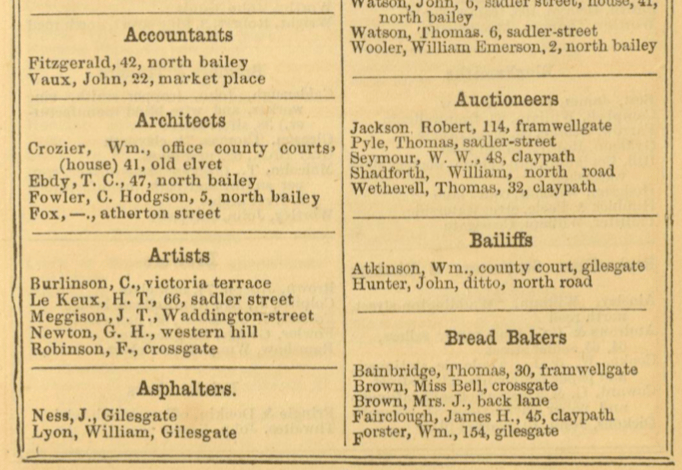
Of what use is it to know that if you were in Durham in 1869, you could go Thomas Bainbridge in Framwellgate in the early morning and find him baking bread? It is extremely useful, if your character needs a job that starts at 4 am.

Authors of fiction sometimes talk about “world building”, especially with fantasy. A believable world has to be created, with its own history, culture, and consistency. For historical fiction, it’s a little different, because the places were really there, and in many cases still exist.

There is disagreement among authors of historical fiction of how accurate one needs to be. I’ve read quite a few historical novels that do what I’m trying to avoid, treating the locations as mere settings for stories that could take place anywhere, anytime. In fact, I began writing historical fiction out of total frustration at several novels which, although supposedly set in Victorian England, did not in any way rely on that time or place for the story. I set out to do better.

I’ve done well with London, because I’ve found old maps for the years where my stories are set, from map-sellers, on the web, and in guidebooks. Street names may change, but often the street is still there. The 1860s and 70s were times of great change, so I have to be careful.


For example, there was no Piccadilly Circus or Oxford Circus in 1869 — it was Regent Circus (south) and Regent Circus (north) — apparently the whole Regent development project didn’t work out quite right. Shaftesbury Avenue hadn’t been cut through yet, the Holborn Viaduct hadn’t been built — this stuff is pretty easy, and fun to research.

In my current WIP (Work in Progress), the third novel in my trilogy of cozy Victorian mysteries, quite a bit of the book takes place in Durham in 1870. Durham is one of my favorite places on the planet, so it’s important to me that it be accurate. I want my character, who is fictional, to encounter places and people who actually existed. Because I was trained in the discipline of social and economic history, when he visits a business, I want it to have been a business that was really there.

I began by searching the web to find directories of Durham, because I’d discovered that directories of London listed both businesses and street listings, with who lived on a particular street. Durham, it turns out, had the same, plus a Slater’s Commercial directory, but I couldn’t find any for 1869/70 (the story takes place in April 1870). I tried using the two I could find, for 1852 and 1879, but of course these wouldn’t be fully accurate. While I was happy to find names and areas of towns where certain types of people lived, I didn’t have the actual facts for that year.

The Durham County Records Office came to my rescue*. I cannot go there right now, or I’d just look them up for myself. They charge £50/hour for research, but the Archivist suggested I go for a quarter hour and see how much they could do. And they did a lot!

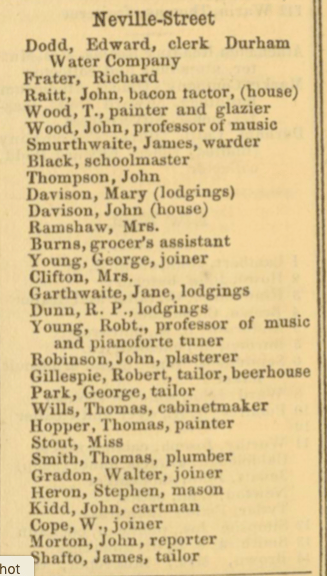
I have listings of types of businesses, and their addresses. I wanted a character to live in Neville Street, because I stayed there and know the street. He’s an engineer for the coal mines. So I was able to see whether his sort of people (class and vocation) would have lived on Neville Street, and yes!

And then there’s just the fun stuff, like the fact that I’ve walked past this place a lot:

I can make sure there’s a bath house somewhere, since one character arrives in town having spent much time traveling. I can see how there are many Hendersons, because I want a scene at their carpet mill and I suspect the family must have been a huge employer and influence (turns out John was busy representing Durham in the House of Commons at the time).

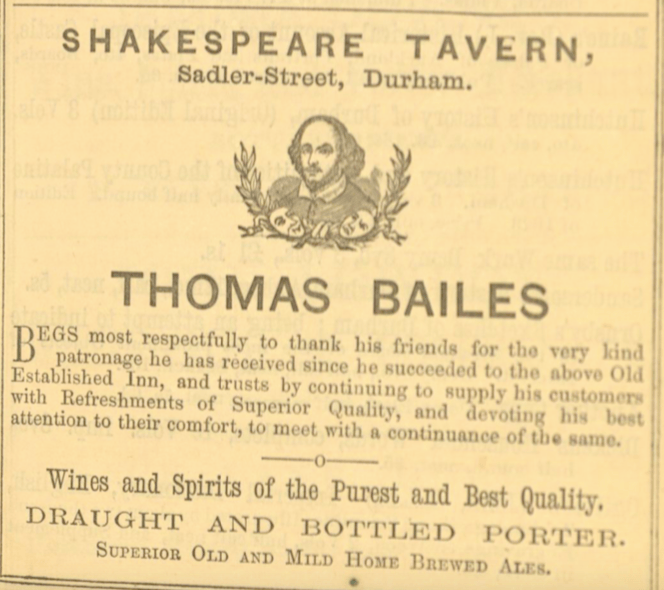
I already know how far a walk it is from place to place, because I’ve walked it, but I looked up the phases of the moon for those days (and asked a friend of mine who’s an astronomer to be sure of its location for my moonlit scene), researched which hymns might have been used for the Easter Service (and hopefully at Durham Cathedral), and who might have lived at the old mill house by the river. I’ve checked the shape of vent doors on the range in the kitchen, whether or not they would have had bottled beer (yes), and what St Cuthbert’s shrine would have looked like then rather than now.

But I can’t finish the book because I don’t have a proper railway timetable for that year, which has made some people laugh at me and shake their heads. Too bad — if it isn’t real to me, I can’t write it, and whether the readers know it’s fact or not, I get a thrill out of knowing that it really was Mrs Duncan who ran the Durham County Advertiser and that the fever ward of the workhouse was added on in summer and so must have been being built in April.

And that’s what happens when a historian writes fiction.


*George Walker, The Durham Directory and Alamanack for 1869, Durham County Record Office (subsequently ‘DRO‘), Londonderry Estate Archives, D/Lo/J 59


Notes on history and historical fiction, Part II

As I continue my new avocation of writing novels, there is no avoiding history. Even my first book, a novella, was split between the present and the 1880s, and the mysteries are set in 1860s. This makes them historical fiction, or historical mysteries.

One of the reasons I began writing mysteries is because I read some novels that I believe misused the historical past, stories that could have taken place in any time, including the present. For these authors, the past just seemed to be a setting, where you could use hansom cabs and hoop skirts for effect. In some of these novels, people spoke anachronistically, but even when they didn’t the possible sounds and smells of the place simply weren’t there.
To me that’s the difference between using the past as a setting and setting a story in the past. My books are set deeply within the past. The reader should have a sense of what things were like in 19th century London. It’s not enough to have the clop-clopping of horses and the misting of fog. I want the click of door latches, the smell of tanneries, the gray light on London Bridge. The street names and omnibus routes must be correct for 1863, not 1880 or 2020. I want to show the city being torn up for sewers, the distinctions in how people of different classes might behave, the way women in skirts dealt with toileting. And it all must be based on fact, on historical research.

I recently joined the Historical Novel Society, and in the first week on the Facebook group there was an argument about how accurate a writer of historical fiction needed to be, and another about whether the show Bridgerton was worth watching. It was distressingly easy for me to take sides.

I would say “no” on Bridgerton, but that has nothing to do with the color-blind casting. In my research I keep stumbling on evidence of both women and people with various differences having more agency and being more visible than is portrayed in the movies and television shows of the last century. So it’s possible that some of the things that don’t seem “real” (a black man hob-nobbing with other upper middle-class snobs) might actually be more accurate for the time.

A great deal of what we “know” about the past comes from prescriptive documents, works designed to convince people to correct their behavior. I try to teach my students that when they read a law code punishing adultery, theft, and trespassing, there must be a great deal of adultery, theft, and trespassing going on in the society. Otherwise there’d be no need for a law.
So if you find a lot of literature telling women that their role is to be very good at managing a household, you can be damn sure that a lot of women aren’t doing that but are doing other things. We are discovering that more and more artworks and literature were created by women using the names of men, for example.

No, my problem with Bridgerton, and many contemporary historical novels, is that the historical setting is ignored as an influence on the characters, and sometimes even on the plot.

I think I first noticed this trend in the movie Elizabeth, the 1998 film with Cate Blanchett. As I was watching her being attacked by her poisoned gown, I was thinking wait, what about the motives of the assassin? How can we tell this story without the religious or political context? It seemed to be all about the emotions and reactions of the characters. We could have been in 12th century France or early 20th century China. It could have been Macbeth. The Emotions of Elizabeth was not what I came to see.

Movies and books that use the past just as a setting for telling a story are not, to me, historical fiction. They’re just fiction. In the next post, I’ll talk about the recent revival in the popularity of historical fiction, and where it might come from.

Part III coming soon

Notes on history and historical fiction, Part III

Recently the New York Times published an article, “For Literary Novelists, the Past is Pressing“, about the revival of historical fiction. In examining its recent popularity, Jonathan Lee mentions novels that apply today’s culture wars and public moral codes to the past, such as novels showing the horrors of slavery, and puts forth the idea that our own time is so unsettling that putting a story in the past avoids difficult issues from the present. We might wish to encounter historical wrongs, but it’s easier to do it from a distance. He closes with: “A new generation of writers may find in the past better ways to capture the present.”

Using history to explain the present isn’t doing history, of course, not like academic historians do. Historians use history to explain the past. We want to know how the people of the 19th century, for example, explained themselves.

But the topics that may interest us do originate in the present. They must — historians live in the present, and it is impossible not to be interested in the issues of our own time. But the curiosity of historians is about how people lived then, what they believed, how they behaved, what they wanted from life. Right?

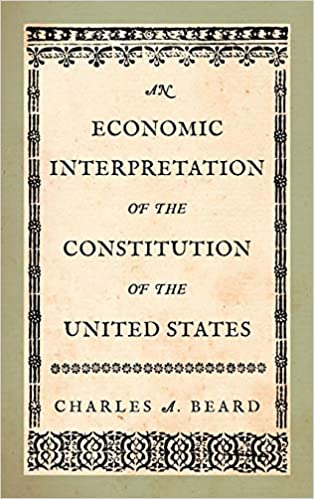
Not exactly. The discipline of history has trends and schools, and has changed over time. Historians often have axes to grind, and become historians precisely because they have a beef. When a historian creates one interpretation (such as the idea that the American Constitution represented intellectual enlightenment), another comes along with a different interpretation (that it represents the interests of wealthy landholders). There are conservative, Marxist, and classically liberal historians, and they work within these philosophical paradigms.

Does this mean, as Henry Ford was quoted as saying, that history is bunk? That it’s all fiction anyway, because historians are biased?

Not exactly. Bias is natural, and it is the conflict of various biases that moves knowledge forward. Historians are trained to consider the evidence, all the evidence, even if they don’t like it. They are trained to analyze each other’s arguments in order to counter them. Some do this better, or more thoroughly, than others. And most do it within the context of the bias they’ve been taught.

Unfortunately, right now historians are being trained in post-modernist approaches which counter the Enlightenment-based focus on reason and evidence. This undermines the entire idea of doing history, and leads to an emphasis on emotion, intuition, and zealotry. Wrongs must be corrected, evil must be exposed and uprooted. How people might have felt is more important than what they said or did. It’s a reflection of the current post-modern societal ideas, which question whether facts are real and wants to punish people who think the “wrong” way.

Photo by freestocks on Unsplash

This is an unfortunate trend for history, but it’s a great trend for fiction. Historical fiction allows writers to emote all they want about the past (or about the present set in the past), and for readers to enjoy feeling empathetically horrified and morally superior. Combine this with the escapism of binge-reading series of books featuring fatally flawed emotional characters, and the ease of loading a zillion novels onto ones device, it’s no wonder historical fiction is becoming more popular.

Johnathan Lee is right: the carhartic effect of setting our polarized views in the past is selling books. It’s a shame it isn’t doing anything truly historical.

Never on Sunday

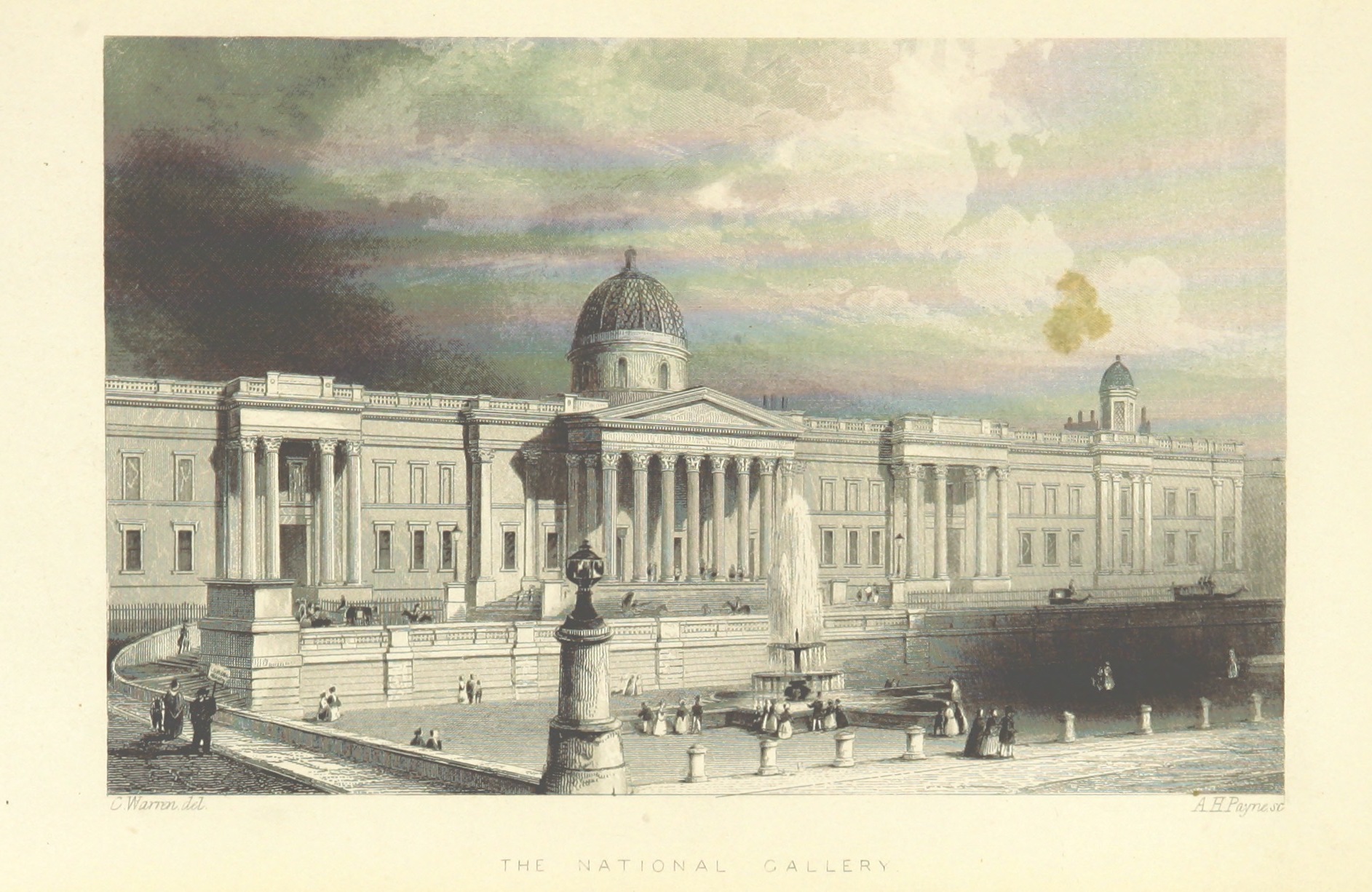
or at least not until the 1890s at the National Gallery.

I had just completed the first draft of Murder at an Exhibition, the second book of what should eventually become the Tommy Jones Mystery trilogy. I’m working now on the editing.

Deeply embedded in the plot is the idea that the National Gallery in London was closed on Sundays. The murder victim has special permission to be there on Sundays, and is murdered there on the quiet. The action takes place in 1863.

As a fiction writer, I admit to keeping much rougher notes than I do as a historian. I had looked through a couple of guidebooks of the era, and had confirmed, to my satisfaction, that the gallery was open six days a week, with four for the public and two for students only (which two days differed by guidebook, strangely). No source mentioned Sundays, so I kept writing.

Then a wrench appeared in the works.

I love how many free lectures there have been during the pandemic, and I recently attended one about the Victorian art world. The speaker noted that in 1845, the National Gallery opened on Sundays to encourage working people, who worked six days a week. The speaker also said that the grubbiness of the working people caused problems, leading to a Select Committee meeting in 1850.

The speaker used this image:

This shows working men viewing pictures at the gallery in 1870. I know that the National Gallery offered many free days, so there’s no reason this had to be on a Sunday. But it made me uncomfortable. Her talk led me to believe that perhaps the National Gallery had been open on Sundays in 1863, ruining my story.

Members of the Facebook group for the Historical Novel Society helped me out, not just with their own information but their encouragement to contact the National Gallery, where a wonderful assistant actually sent me their record of opening hours for their whole history as they knew it. No Sundays in 1863.

But the speaker had been so sure. Could there have been a trial run? I researched through Hansard, which has the debates of the House of Commons, and found much arguing about opening both the National Gallery and the British Museum on Sundays, but no conclusion. So I posted at the Victoria listserv, a place where every Victorianist who’s anybody meets up. Several members helpfully responded with books and records. I’m now 99.9% sure the Gallery was closed.

Yes, I know, if it’s this much trouble for me to confirm, I should be comfortable just showing it was closed on Sundays. It’s a fictional work, not a research project. Except that all my fictional works are research projects. Whether it’s important to the reader or not, it is ridiculously important to me that the facts be accurate, and if they’re not accurate then I’d better have a damned good reason why, and an Author’s Note. That’s just how I roll.

Suspicion: technology and murder on the North London Railway

In 1864, a 69-year-old bank official named Thomas Briggs was murdered on a moving train. In those days, the compartment doors opened only on to the platform, so each compartment had complete privacy.

The deed was discovered when two clerks entered the compartment and found blood, a walking stick, and a hat which had been cut down to half-height. A ways along the line the wounded Briggs was found and carried to a pub where he died of head injuries.

Rewards for information were posted, and a cabman named John Matthews came forward claiming that a man he knew should be suspected.  Franz Müller, a frequent visitor at Matthews’ house, had given Matthews’ 10-year-old daughter a box from a jeweler named Death (a common name, apparently pronounced Deeth), and Matthews remembered this when he saw on a handbill that Death had exchanged a gold chain that might have belonged to Briggs.

Not many of the sources mention that the cabman’s other daughter had been at one time engaged to Müller, but the engagement had been broken off. Matthews claimed this was due to Müller’s temper. Reading through the sources, I found it strange that this reason for enmity was rarely discussed.

By the time police went looking for Müller he had already left, on a sailing ship to America to make his fortune. It had been a planned journey — he had told Matthews goodbye. Police, and Matthews, followed him, taking a steamship. They would thus arrive before Müller and make the arrest, extraditing him back to the UK, and that’s what happened. I could find no explanation for why so much money would be spent on such a journey, when the suspect was only a suspect.

What with the transatlantic chase, the newspapers had plenty of time to speculate and gather information (and rumors and innuendo) about the suspect. By the time he was returned to England, everyone knew who he was and most had already decided he was guilty. A fair trial was pretty much impossible.

One can read the transcript of the trial online, and the story of it in books like Judith Flanders’ The Invention of Murder, in the broadsheets of the time (below), and in the Notable British Trials volume of 1911. The evidence, although all circumstantial, invites examination. Was the hat left on the train really Müller’s? Why were Müller and Matthews always owing each other money? Was the evidence of the brothel keeper, who said Müller was at her place at the time of the murder, dismissed because of her profession? Could the entire attack really have happened between two stations only minutes apart?

The jury in the Müller case took only 15 minutes to convict, and the judge sentenced him to death. Although a Lutheran minister spent much time with the condemned man, Müller did not confess his crime. Then at literally the last minute he supposedly said he had done it, right before the drop was put on him in one of England’s last public hangings. There was back-patting all round.

Despite the high-powered barristers on both sides, the transcript makes it clear that Müller’s team was by no means as prepared as the prosecution. And as one reads, one begins to suspect a few things. Why did Matthews not come forward before he heard about the reward?  He knew Müller well, and had reason to dislike him — he was hardly a disinterested witness. Was the watch found on Müller the property of Briggs, as testified by experts, or a watch he’d owned for two years, as Müller claimed? Why wasn’t the alibi provided by the brothel keepers believed, with doubt being cast on the accuracy of their clock? Did Müller even have a reason to kill Briggs? None was found, but robbery was said to be the cause. However, although Briggs’ watch and chain were taken, some money was left in the man’s pocket.

And consider the social context. Müller was a foreigner, with an accent, and he was not well-liked. He apparently had a temper, although other witnesses said he was a nice, quiet man. He was a tailor, a lowly profession, and he frequented a brothel, considering one of the girls his sweetheart.

But also consider the technological context. Trains were fairly new as a mode of transport in 1864. They were louder than horse and carriage, traveled on fixed routes, and followed strict timetables. Their advent tore up the traditional landscape, necessitated stations that could be as grand as cathedrals, and hurtled people along at astonishing speeds that some thought would adversely influence physical health. Train carriages were divided by class, and this crime had taken place (as Flanders notes The Times was at pains to point out) in the First Class Carriage. If one could not be safe in a First Class Carriage on a London train, what was the world coming to? People put their daughters on trains to visit relatives. What if trains weren’t safe?

After the trial, the train companies drilled peepholes (colloquially referred to as “Müller lights”) between the compartments so that people could report suspicious activities. Not long afterward, they had to fill them in again, partly because young couples complained they had no privacy (which lets you know what else was going on in the compartments). Eventually compartments would open onto a common corridor, with glass so people could see each other.

History, I believe, is not just the facts and suppositions of the past, but rather the context of everything. The context here is deep and complex. What seems like a straightforward trial and execution brings up issues now that weren’t in the public conscience then, but may have affected how the trial was run. And yet the case is known today mostly for having been the first murder on a moving train, and one of the last executions to take place in public. Knowing how people thought about trains and foreigners may not make the verdict any more conclusive, but it does make it more understandable.


Also published on Medium

A character pesters the author

Jo is back, looking over my shoulder.

“So when do I come in?” she asks, with a frown.

“I’m not even sure you’ll be in this one,” I say.

“How can I not be? I was in the other two. It’s a trilogy, you said.”

“I only said that because I didn’t want to write more than three. I’m not even sure I want to write the third one, but now that I’ve started with Clerkenwell, I might as well.”

“I’m in Shoe Lane,” Jo points out. “That’s not far from Clerkenwell, and there are a number of printers in both places.”

“I didn’t discover there were printers in Shoe Lane till yesterday. How did you know?”

“I live there. So when do I make an appearance in this book?”

“I only just started,” I protest. “I’m barely halfway through the first scene. Right now I don’t know anything except Samson Light is in jail for a crime he didn’t commit.”

“Oh, Samson,” Jo says, looking at the ceiling. “That’s Tommy’s tutor, right? I don’t remember whether I’ve met him.”

“I don’t either. That’s part of the problem. I keep having to return to the other books to know where I am. But if I set this one in 1870 –”

“Then I’m thirty-six. A perfect age for an independent woman. I could be running the Illustrated London News by now.”  She starts sorting the pencils in my cup.

“No, you can’t. I’m trying to keep as true to history as possible.” Jo makes a face.

“Jo, I adore you. I do. I made you the detective in the second book. The entire novel went all feminist because of you.”

She smiles. “Of course it did.” She smooths her skirt and perches on the corner of my desk. Easy to do, since she never wears a crinoline. It’s one of the things I like most about her. “Will I be solving the crime they think Samson committed?”

I shake my head. “No. I think I need to have Tommy solve it.”

“But he’s only nineteen!”

“I know, but you see, this was supposed to be the ‘Tommy Jones Mysteries’. In the first one he helps Inspector Slaughter, but he’s hardly even in the second book. He needs more visibility.”

Jo thinks for a moment. “I’d call them the ‘Jo Harris Mysteries’, and make me the detective. Or even the villain.”

“I’ll think about it.”

“What will you do with Rossetti?”

“I don’t need him here. I only needed him for the art mystery.” She looks sad. “Will you miss him?”

“I have no idea,” Jo says haughtily, “since I don’t even know if I’ll be here to miss anyone.”

I say nothing.

Jo sighs. “You take away all my friends, you know. Nan in the first book. Now Rossetti. If you give me a friend, may I keep him, or her, this time?”

“Yes.”

“You promise? If I’m in the last book I can keep my friend?”

“Would you like to be with someone? A lover or life partner?” I reach for a pencil.

“Yes. Maybe with a child? A little girl that we can raise together. We could raise a little suffragist, and she could grow up to gain women the right to vote.”

I do some calculations. “If she’s three years old in 1870, she’ll be almost 50 before women get the national franchise.”

Jo’s chin drops. “What? That long? That’s outrageous.”

I shake my head. “I know, I know.”

“Well,” says Jo, her jaw set in that way I’ve come to know so well, “Even if I don’t live to see it, it’s still worth doing.”

24 hours in Clerkenwell Gaol

Yesterday, lazily wondering what the premise might be for the last mystery in my trilogy, I decided I wanted a character held in prison awaiting trial while my protagonist runs around London trying to clear him of the charge of . . . well, I don’t know yet. Having already set the first mystery in Southwark, and the second around Holborn, I was cruising around Clerkenwell because I wanted to get a little more East End-ish but not go all out Dickensonian. I’m thinking 1870. Maybe my guy should be accused of stealing this clock (Clerkenwell was known for clock-making):

I knew the infamous Coldbath Fields prison was in the area, because I have a previous character in prison there for debt, but I was seeking not a prison but a gaol, a place where they hold people until they go to trial.( I’ve seen too many Father Brown episodes to want my character rescued after he’s been convicted — it’s way too complicated.) And there seemed to be one in the area, but it took a lot of searching to get it all separated from Coldbath Fields and the other prison buildings that had been on the same property before. As one website tried to explain it:

Clerkenwell (old) Prison, also known as the Clerkenwell House of Detention or Middlesex House of Detention was a prison in Clerkenwell, London, opened in 1847. It held prisoners awaiting trial. It stood on Bowling Green Lane conveniently close to the Middlesex Sessions House, where prisoners would be tried, on Clerkenwell Green to the south.

Well that helped with location, anyway. Then it goes on:

The House of Detention was built on the site of two earlier prisons, the Clerkenwell Bridewell for convicted prisoners and the New Prison for those awaiting trial. The Bridewell closed in 1794 and its functions were taken over by the Coldbath Fields Prison at Mount Pleasant. The New Prison was rebuilt in 1818 and in 1847, at which time its name changed to the House of Detention.

Confused? Me too. Was it the Middlesex House of Corrections? No, I think that’s Coldbath Fields. House of Detention? Why isn’t anyone calling it a gaol? So Dickens Junior, ever the tour guide, decided to help out, via this page:

House of Detention —affectionately termed by the “profession” the House of Distinction, or more familiarly “the Tench “—is designed primarily for untried prisoners, the discipline being less severe than elsewhere. Prisoners under short sentence of imprisonment without hard labour—technically first-class misdemeanants — are also confined here; being not required to wear any distinctive dress or to have their hair cropped. It stands between Woodbridge-street and Rosoman-street, Clerkenwell. NEAREST Railway Station, Farringdon-street; Omnibus Routes, Exmouth-street and Goswell-road; Cab Rank,Clerkenwell-green.

– Charles Dickens (Jr.), Dickens’s Dictionary of London, 1879

I also started coming across the floor plan, which made it easier to identify.

http://www.victorianlondon.org/prisons/detention.gif

One ghost tour also calls it the House of Detention. By this point, I’m pretty sure I have the right place. And look! It’s still kind of there, though it’s called Clerkenwell Prison.

The Old Sessions House was the Middlesex Sessions House, where the cases were taken for trial, so that helps too.

I even found some engineering information. (And this, children, is why I abandoned studying medieval technology for Victorian England, where there are a fabulous number of sources, all in English and none of them copyrighted.)

This picture kept coming up as I worked, claiming to be visiting hours at Clerkenwell prison, but I was unable to verify if this was the place I wanted.

It looks so nice, all the visitors talking to their friends and loved ones in the door holes. But is this the place? I start looking, as one does, at the Illustrated London News, but no. After doing image search and finding the image on Wikipedia, which does occasionally cite sources, it appears it’s not from the Illustrated London News (or the “Chronicle” as noted on another page), but from Henry Mayhew’s The Criminal Prisons of London, and Scenes of Prison Life (1862). Stupidly, I go looking at Biblio.com and other vendors to buy it ($65!) only to find the whole book, downloadable for free, at Google Books. (Every time I start to yell at Google for being a monstrosity, they do something nice.)

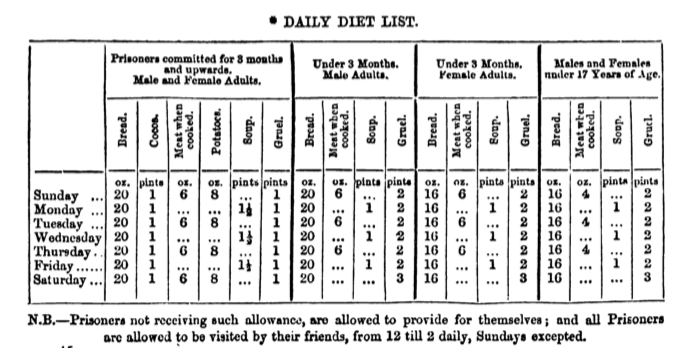
And in that book was everything: not just the image but what kind of prisoner went in what sort of cell, what furniture was in each cell, where the windows were, what sorts of crimes people were in for, and even a menu:

I don’t think it’s right that if he’s there for three months he doesn’t get a pint of cocoa, but no one asked me. Or Mr Mayhew.

After 24 hours, I have a place! And then something serendipitous happened. I was having trouble finding something to watch on the Roku during my exercises when BritBox conked out, so I started watching the film The Guernsey Literary and Potato Peel Pie Society (I have been waiting till it was long enough after reading it to see the movie). There’s a scene in a jazz club, and I’m thinking, that looks like Clerkenwell Prison. But of course I’ve got Clerkenwell Prison on the brain, and so I look it up and what do you know: that’s where it was filmed, in the cellar. You can go there and visit the cellar, which didn’t get destroyed in the Blitz, or even hire it for events.

Was the first female doctor in England a man?

Whenever historians discuss the “first” of anything, they use qualifiers. In the case of the first female doctor in the UK, there might be several candidates, depending on how one qualifies the word “doctor.” The innumerable wise women and healers who made diagnoses and prescribed treatment for centuries may be unknown to history. So we define “doctor” in terms of official qualification and credentials.

The honor of being the first female doctor in the UK thus goes to an extraordinary person, Elizabeth Garrett Anderson. Although she had been refused admissions to the College of Surgeons and Physicians because of her sex, she was admitted to the Worshipful Society of Apothecaries because their rules stated nothing forbidding women (an oversight they remedied shortly afterward). The University of Paris then admitted her to the examination necessary to certify her as a medical doctor in the 1860s.

Before her, one might argue, was Elizabeth Blackwell, the first woman on the UK Medical Register as a practicing physician. She would not have been able to obtain a medical degree but was grandfathered into the Medical Act of 1858.

But there is an even more startling possibility. Dr. James Barry was a famous figure in nineteenth-century military circles. He obtained his medical degree from the University of Edinburgh and might have been prevented from sitting his exams due to his youthful appearance but for the intervention of the Earl of Buchan, who was friends with his tutor.

 Portrait of James Barry, Wellcome Collection

Dr. Barry was a good physician, known for an excellent bedside manner, and he became a talented surgeon in the army. He served in South Africa and the Caribbean and performed the first successful European caesarean section in Africa. He became Inspector General in 1857 and traveled the British Empire enforcing sanitation in hospitals.

There is much evidence of Dr. Barry’s personality. He was known for his squeaky voice and violent temper. Florence Nightingale, whom he met in the Crimea, hated him, even though his emphasis on hygiene was as energetic as her own. Others reported that he was quarrelsome in the extreme.

He also never undressed in front of other people. This, and his clean-shaven face, curly hair, and short stature do not appear to have caused much comment among most of his colleagues. Later, however, there were rumors of duels caused by insults about his appearance and the expected posthumous claims that “I always suspected” or “I always knew.”

When he died in 1865 of dysentery, a charwoman named Sophia Bishop laid out his body. This action was against Barry’s known wishes that under no circumstances should his body be disrobed in death. The woman claimed that his body had full female genitalia and stretch marks, indicating a possible pregnancy. Barry’s own doctor, Major D.R. McKinnon, simply refused to care about his patient’s sex, having been called upon to identify the body and sign the death certificate. He had written the sex as male on the certificate. When Bishop told him her observations and tried to get him to pay for her silence, McKinnon famously reported to George Graham of the General Register Office:

The woman seems to think that she had become acquainted with a great secret and wished to be paid for keeping it. I informed her that all Dr Barry’s relatives were dead, and that it was no secret of mine, and that my own impression was that Dr Barry was a Hermaphrodite. But whether Dr Barry was a male, female, or hermaphrodite I do not know, nor had I any purpose in making the discovery as I could positively swear to the identity of the body as being that of a person whom I had been acquainted with as Inspector-General of Hospitals for a period of years.

The army sealed the records, supposedly for a hundred years. Isobel Rae’s 1958 book The Strange Story of Dr. James Barry, based on access to those papers, broke the story in the subtitle: Army Surgeon, Inspector General of Hospitals, discovered on death to be a woman. The only evidence, despite the new batch of papers, was the word of the woman preparing the body.

James Barry qualified as a doctor in 1812, so if one says he was female, then he would be the first woman doctor by several decades. The story has fascinated many, and more documents have since been uncovered demonstrating that Barry was Margaret Ann Bulkley in his earlier life. (This includes items like a letter from young Barry to a family solicitor where the recipient wrote “Miss Bulkley” on the outside of the envelope.*) The current wisdom that James Barry was, in fact, a woman, is happily disseminated in more recent books, both for adults and children.

It is natural that current discussions of gender would play into how we interpret James Barry today. Did he simply dress as a man to have a career not open to women? Is it right to call him the “first female medical doctor” if we believe he identified as male? Should we call him a transgender man? Or is it best to respect his own view of himself?

Even if we accept the report of the avaricious charwoman and the handwriting analysis of Margaret Bulkley, we have no way of knowing whether Dr. Barry actually identified as male or would simply be labeled a cross-dresser hiding his female identity. His last wish that he not be undressed for burial seems to speak to something deeper. But here, we are certainly engaging in supposition unsupported by the sources. Instead, it might be best to celebrate an extraordinary career, acknowledge the good he did with his medical skills, and enjoy critiques of his explosive personality from a safe distance.

*see Pain, Stephanie. “The Extraordinary Dr. James Barry.” New Scientist, vol. 197, no. 2646, Mar. 2008, pp. 46–47.

Also published in Medium: Frame of Reference

Two Characters in Search of their Teaching Author

“Excuse me,” said Jo, from inside the computer. “Lisa? I’m sorry to bother you, but I’m afraid we need some attention here.”

“I know, I’m sorry,” I said. “But I have a lot of grading to do.”

“You always do,” said Jo. “And we understand. But you’ve left us hanging around here in Chapter 3 for almost six weeks.”

“Yes, yes,” I said, trying not to sound exasperated. “But we are in a pandemic, you know, and I’ve had a death in the family, and I’m behind on my teaching work.”

“But we’re losing the thread here,” said Jo, “and I’m afraid Rossetti is getting impatient.”

“Hmmm,” I said, trying to grade just one more set of student lecture notes.

“Lisa?” This was Rossetti now. “Trouble is, I’m an actual historical character.”

“Unlike me,” added Jo.

“Unlike Jo,” agreed Rossetti, “And I’m known for my impetuous nature.”

“And your charm,” said Jo.

“And my charm,” conceded Rossetti, “And my brilliance and talent and vivacity. You can’t leave us sitting here in the chapter like this. We must shine.”

“We need to know where things are going,” said Jo.

“Well,” I said, “You know where things are going. There’s the outline.”

Jo laughed. “You said you weren’t going to use the outline. Right after you took that Mystery Writing class. I can’t do all this planning, you said, and bought a book about writing in the dark, or something about the seat of your pants.”

“Yes, I know,” I said, “But you can use the outline to know what’s going to happen.”

“But I don’t know,” said Jo. “We’ve only just discovered the body of Mr Pratchett. I’m supposed to be the lady detective this time, aren’t I?”

“Yes, you are. The Inspector did all the work in the first mystery, but this time it’s you.”

“I cannot detect without having something to detect with. A plot or a clue or something. If I don’t have it, I can’t share it with Rossetti.”

“And we’re becoming such good friends,” added Rossetti.

“Yes, we’re becoming such good friends,” said Jo.

“Which you hadn’t planned,” added Rossetti.

“Which I hadn’t planned,” I said, “because Rossetti was a rather famous lover of women, and you, Jo, are a lesbian.”

“She’s a lesbian?” asked Rossetti.

“Yes,” said Jo, “Didn’t you know about my lover Nan, the one who died?”

“No,” said Rossetti quietly.

“She was in the first book.”

“I didn’t read the first book,” said Rossetti, “I wasn’t in the first book. Why would I read a book I’m not in?”

“Oh,” said Jo.

“Look, you two,” I said, “Maybe you’ll become close friends because there’s no sexual tension. Or maybe you’ll both just get excited about the case and enjoy joining forces. You’ve already joined forces really. You’ve already taken Jo to see the wombats.”

“I did,” said Rossetti proudly, “and she’s to be my very dear friend. If you write it that way.” There was a pause. “Are you going to write it that way?”

“I think so,” I said, “But it’s been awhile. I was having trouble with the plot.”

“Well,” said Jo, “you need to write us more, give us more things to do. We can’t just sit here waiting for you to finish your grading. It’ll be all term. We won’t move till winter break at this rate. And all the time, the killer is getting away.”

“How can he be getting away, if I haven’t written about him either?” I asked, reasonably.

“Maybe he’s planning another murder. Maybe the head of the National Gallery is involved. Maybe he’ll start killing artists!” She sounded afraid.

“Or Bridget,” said Rossetti, “He might kill Bridget. Bridget is Mr Pratchett’s assistant, isn’t she?”

“And a very dear friend of mine,” said Jo.

“And a very dear friend of yours. What if she’s in danger? How would we know?”

“She’s already been locked in the darkroom once. And somewhere back here,” Jo paused. She must be searching the previous chapters, I thought. “Somewhere back here there’s a Millicent somebody, who comes to the photographer’s studio.”

“I didn’t know that,” said Rossetti.

“I haven’t been written to tell you yet,” said Jo, “but maybe she’s involved? She’s in the same philanthropy group as I am.”

I shook my head, “I’m not sure what to do with her yet. I thought someone could blackmail her about her hair color. Or a forgery of a painting she owns.”

“Yes! Forgery!” said Jo, “You were going to do something with forgery. And that character, the Italian who knows all about art. He could identify the forger.”

“Besides,” said Rossetti, grumbling, “You’re leaving us here in 1863, while you sit comfortably in 2020.”

“I’m not comfortable,” I said, “Did you hear what I said about a pandemic?”

“More time to write,” said Rossetti. “The fact is, a story about me should be an inspiration, should override all need for mundane work. I want to inspire you! I want to be your muse!”

“It’s not a story about you,” I said, “I am fascinated by you, of course. Who wouldn’t be? But the story is about Jo solving the murder. You’re a side character. You’re her foil.”

“Oh,” said Rossetti, quiet again. “I thought you cared. At one point you had a scene with all of us, with Christina and mother. And Mr Dodgson.”

“I did have,” I said, “I wasn’t sure what to do with it.”

“And now it’s in a file marked ‘not used’,” said Rossetti, sadly. “My family. Not used.”

“Really, Rossetti,” said Jo, “You’re being too sensitive.”

“Am I?” cried Rossetti, “Am I? What if she starts slaughtering the Pre-Raphaelites? What if I’m the next victim? What if poor Lizzie didn’t kill herself, if this murderer gave her an overdose of laudanum? We need this thing written. I deserve to know where I stand!” He was getting very upset.

“Please don’t worry,” I said. “I won’t kill off the Pre-Raphaelites, and you and Jo won’t be harmed.”

“Bridget?” said Jo nervously, “You won’t kill off Bridget?”

“I hadn’t planned to,” I said. “But I really don’t have time to get back to this right now.”

“Hah! You always say that time is made, not found,” said Jo. “So make some time for us and get us to where we can find the forgery and do some detecting.”

“Yes, dear,” I said, and sighed. “I honestly had no idea you characters were so demanding.”

“I’m sorry,” said Jo.

“I am too,” said Rossetti, “but please don’t abandon us.”

“I won’t,” I said. “But do let me grade another set of lecture notes.”


What about Ann Little Ingram?

While I will again emphasize that I am not a women’s historian, or a feminist historian, I must say that tracking down a historic woman has again proven extraordinarily difficult.

This time the story revolves around the Illustrated London News, a highly popular periodical in Victorian England. While not the only newspaper to use illustrations, the ILN was known for the quality and quantity of its images. This is why the character in my novel, Jo Harris, wants to be an artist for the ILN.

Knowing this was unlikely for a young-ish woman with no connections, I had her doing odd illustrating jobs in the first novel, for lesser periodicals like the Penny Illustrated Paper. But in the sequel, she has become more skilled, and is ready for the big time.

Wanting to create another character based on an actual person (I did this throughout the first mystery), I looked up who the proprietor was of the ILN in 1863.

Ann Ingram. Prounouns would be she/her, as they say. I confess I didn’t expect that. But apparently her husband, Herbert Ingram, founded the Illustrated London News, with a loan from Anne’s brother, who would also be publisher. But in 1860, Herbert took a holiday with his teenage eldest son, and they died in a massive boating accident on Lake Michigan aboard the cursed steamer Lady Elgin. So Ann took over the paper.

She is mentioned briefly in several sources, who essentially say she took over as editor only until her sons became old enough to do it. I think this is unlikely, since she was proprietor for eleven years from 1860-1871. The Waterloo Directory (the bible of Victorian periodical research) fails to list her name as editor. A Google Search, with either spelling of Ann or Anne, is unprofitable.  So I posted on the Facebook group for the Research Society for Victorian Periodicals, and the venerable Patrick Leary responded that she has indeed been neglected. He mentioned her in this history of the ILN written for Gale, and called her “a woman of considerable business acumen”.

What a possibly fascinating person. Leary has suggested that Isabel Bailey, who wrote a book on Herbert, might know something, having accessed their unpublished papers. If only I could find her.

But the point is, I shouldn’t have to. How can a woman who managed a paper which sold 250,000 copies for its special issues, not be more well-known? He certainly was — he became an MP, and there is a statue of him in the marketplace in old Boston. His life is chronicled. His picture is right here. –>

She bore him ten children, then ran his business, and her name isn’t even on his Wikipedia page. Was she photographed or engraved? Did she keep a diary? Was she written about in other people’s letters?

I sense yet another rabbit hole, dark with the story of another ignored woman.

On Victorian female painters

I have been notoriously lax in my advancement of the feminist cause. I just assume that women were far more active historically than they have been portrayed. Those who control the media control the message. But at the same time I do notice when women have important public roles to play, and in writing fiction I have made sure that my Victorian females have a great deal of agency.

That’s not wishful thinking. It’s simply that the ordinary academic practice of history tends to believe its sources, without looking at all of them. That’s human. So I just want to say up front, it takes quite a bit to get my feminist hackles up. I’m a humanist.

But as I look into the Pre-Raphaelites, I have found myself getting annoyed with the focus on the men. Rossetti, Burne-Jones, Millais — there are women who took their names, but they are seen as muses alone. No one says “Rossetti” and means Christina, Dante Gabriel’s highly published and respected poet sister. No one says Millais and means Lady Millais, or “Burne-Jones” and means Georgina, an accomplished artist, or “Morris” and means Jane, a talented embroiderer. Why, when most of them published or exhibited their own work? I’m not even sure the men themselves saw them as sidelines — there is much evidence of respect and collaboration. And yet in most of the books, the men’s work is emphasized, and the women’s downgraded. Most of the explorations of the women’s work are recent, like Jan Marsh’s Pre-Raphaelite Sisters, or the National Portrait Gallery exhibit.

For inspiration and pandemic-driven amusement, I’ve been looking at the portrayal of the Pre-Raphaelites in cinema and television, so I’m watching Desperate Romantics. It was made in 2009, not exactly a bad time for feminism. But even there, little mention is made of anything the women themselves created or exhibited. I realize it’s set early (1850s), but the writer didn’t even imbue them with any ambition.

Jane Morris embroidery

by Georgiana Burne-Jones

Clerk Saunders, by Elizabeth Siddall

I thought perhaps I’d look into their lives a bit, see whether they would make good characters in my book, or whether the tale I’ll tell could be through their eyes, instead of the men’s. I don’t know much about the art history of this period, so I’m investigating. My book is set in 1863, so I thought I’d see what the Royal Academy of Arts was doing then. I found The Royal Summer Exhibition: A Chronicle, a great resource that for 1863 discussed several of the key works including Millais, comparing his dark work in The Eve of St Anges to the lightness of a painting by Edward Matthew Ward. And then I saw in the Context section:

For some critics, Henrietta Ward’s picture of Mary Queen of Scots surpassed her husband’s efforts, and the Mutrie sisters were described as “still supreme among flower-painters”.

Who’s Henrietta Ward? I tried to search her by name and “Mary Queen of Scots”. I found an engraving from the Illustrated London News of it, but not the painting. So then I found the Royal Academy of Arts catalogue for that exhibition on HathiTrust. I wondered whether she’d be listed like the male painters, as “H. Ward”. I found the work, and her name as “Mrs. E. M. Ward”, and she had half a dozen works in the exhibition. I looked her up at the NPG, but there’s not a lot there. I found a review in the Athaeneum, which said:

They used “Mrs.” but referred to the artist as a male. How strange.

I thought I’d pick at random another female, since they are so clever indicated with “Miss” and “Mrs.” Item 571, Always welcome, by Mrs. J. F. Pasmore. Started searching on Google. “Mrs. J. F. Passmore painting 1863”. Very frustrating. I had spelled the name wrong. Then I stumbled on this at an antiques dealer site:

And here’s the description:


Middle initial and last name spelling confusion aside, she “also exhibited paintings”? Hers is in the Royal Academy exhibition, but I can’t find a copy of Always welcome online (there are plenty of paintings around by John F., mostly for sale). And this website attributes the above painting to him anyway, not her. So now I don’t know what to think. Maybe this is just a picture of her.

I don’t like to class everyone together: all women, all men. Some women had extraordinary power, both in the home and out of it. Others were taken advantage of. This sort of problem makes one wonder whether it’s the sources or the perception. Looking at the sources, I find more and more evidence of women’s agency. But finding those sources seems inordinately difficult.


What the Dickens

Funny the things that happen when you’re a historian just trying to read a book, and the ways in which being a historian can get in the way of a good read.

I recently joined the Victorians! forum on Goodreads. People there read Victorian-era books. I’ve read some of those myself, including a few by Charles Dickens. I’ve read The Old Curiosity Shop (which someone spoiled for me, thinking everyone knows the ending), A Christmas Carol (of course), and Hard Times (ok, so I listened to the audiobook). The rest await me, eight or so volumes on the shelf. I figured Oliver Twist would be next.

Then I saw that the Victorian group would be reading Nicholas Nickleby. I’m not much of a joiner, but I thought it might be fun. I’ve never read with a group, never been in a book group or anything. The closest I get is reading the “book group questions” at the back of  novels.

But I didn’t have a copy of Nicholas Nickleby. I could have downloaded it from Internet Archive, but I don’t like reading things on a screen. Ironic, isn’t it? Backlit screens are for work, but reading for pleasure is different. I want a book in my hand, turning its pages, absorbing its history.

My ultimate site for second-hand books is abebooks.com. But I’m very choosy, because to me books are historical objects. My first preference is for a book published during the author’s lifetime, so “publication date ascending” is my go-to sort. Ending 1870, when he died. Whoa! the prices! How could Dickens be fetching such prices? OK, maybe not 1870. . . But even with an edition from 1920, we’re talking some money.

I knew Mr. Dickens was not getting a cut from my purchase, but I’m not a huge fan of him as a person, despite Simon Callow’s brilliant portrayal in Dr Who. As a historian, I try very hard to separate the creator from his creation. Where would I be with Rousseau if I cared about how he gave up his own children to foundling hospitals? Or if I ignored the brilliance of Thomas Jefferson because I was busy judging how he lived? People are not their ideas. We are all flawed. Good ideas survive long past the person’s lifetime.

Dickens is somewhat different because I went to his house. Not while he was there, of course, but several years ago. It’s a shrine to him.  I found this bizarre, because it was really her house. His wife, Catherine. She raised his ten (!) children. She wrote the best-selling menu book What Shall We Have for Dinner? Since 2016, the museum has made a huge effort to include her in the house’s story. The problem is that Mr. Dickens, who was having an affair with young actress Ellen Ternan, didn’t want his wife anymore. After she discovered the affair in 1858, he turned the situation on her, separated from her, and dissed her all over London. He even tried to get her committed to an asylum. (I’ve begun reading Lillian Nayder’s 2011 biography rehabilitating her reputation. I feel I must.)

I’ve learned that you cannot be a Victorianist without enjoying, or even reveling in, Charles Dickens. Certainly I admire his detailed portrayal of the era, the wonderful characterizations, the turns of phrase that make you chuckle aloud. He wrote so fast, and so much, that I know I haven’t even scratched the surface of his talent. But the hagiographic approach to him annoys me anyway.

So I clicked past the volume of Nicholas Nickleby that said “Works by Charles Dickens” on the spine, because it was part of a collection. I scrolled beyond the $1,000 matched sets of his work. I searched for the small 8vo versions I prefer, but there aren’t any because the novel is too long. I finally found one I liked and ordered it.

I do not hold it against Dickens that I spent so much time looking for a book I hadn’t wanted to read, by an author I personally dislike, just to join a discussion with a group I do not know. It’s just another case of a historian making things more complicated than they need to be.

At a cost to the economy, 1862

Although it was not as beloved as the 1851 Crystal Palace Exhibition, the Great Exhibition of 1862 in London was extraordinary, as I noted in a previous post.

In addition to celebrating industrial and artistic achievement, the Exhibition also hosted meetings of several international groups. This included the International Congress of Charities, Correction and Philanthropy. On June 13, the speaker was Sarah Parker Remond.

A free person of color born in Massachusetts, Remond was anti-slavery from an early age. It is reputed that she made her first speech against the practice when she was 16. Her parents were successful business people. They were active in anti-slavery societies, and made sure their children got a good education, despite the lack of good schools for non-white children.

Sarah was already known as a lecturer for the American Anti-Slavery Society (founded by William Lloyd Garrison) before she was asked to go to London in 1858. Her intention was to get a better education, and she enrolled at the Bedford College for Women while continuing to lecture. While she was there, the American Civil War began.

Her speech at the Exhibition in 1862 emphasized support for emancipation, and by implication the Union blockade against the Confederacy. Britain had declared itself neutral in the conflict, and British ships continued to bring in products to northern ports. She pointed out how the British cotton industry used the products of slaves, although Britain itself had outlawed slavery in 1824. The British Parliament had further passed the Slavery Trade Act of 1873 and were actively involved in confiscating slave ships, but were continuing to benefit from the manufacture of cotton grown by slaves in America. She said,

Let no diplomacy of statesmen, no intimidation of slaveholders, no scarcity of cotton, no fear of slave insurrections, prevent the people of Great Britain from maintaining their position as the friend of the oppressed negro, which they deservedly occupied previous to the disastrous civil war.

This was despite the fact that she recognized that:

Thousands among the commercial, manufacturing, and working classes, on both sides of the Atlantic, are dependent upon cotton for all material prosperity. . .

As the result of the efforts of Remond and others like her, Britain respected the Union blockade of the Southern states. But the result of the decline in raw cotton importation was mill closures and starvation in places like Lancashire. There it’s become known as the Lancashire Cotton Famine.

In 1862, as now, the problem was not just that economic strain had thrown people out of work. It was that there was not enough of a social safety net to provide for them when they lost their jobs. The British government engaged in some compensation experiments, including minor funds distributed directly (similar to today’s stimulus checks), but it was minimal and in many cases never reached the people who needed it.  The new Poor Laws had funded workhouses rather than “outdoor” relief to help people at home. Ultimately, some relief occurred when the government provided money to local councils, who then created new opportunities for employment in public works. But that wasn’t until 1864. Before that any efforts were supported primarily by private charity (similar to today’s GoFundMe), partly out of a suspicion of increased government activity*.

In 1862 the issue was the moral culpability involved in profiting from slave labor. Now it is the moral culpability of forcing workers into plague conditions. Jobs that take place indoors have the greatest risk of infection, while those outdoors have the least.  Safer jobs could include massive infrastructure repair on America’s roads, bridges, and parks. Designs could be implemented to move commercial, educational, and political enterprises into better ventilated conditions.

Perhaps public works, and a bit of advice from Miss Nightingale (see previous post), might be an answer beyond 1864.


____

* Hall, Rosalind. “A Poor Cotton Weyver: Poverty and the Cotton Famine in Clitheroe.” Social History 28, no. 2 (2003): 233.

Visiting 1862: The International Exhibition

I’ve been doing some research into London in the year 1862. For me, this is stepping back 25 years from my usual research area, so I find a lot of surprises, in addition to this novel technique for social distancing:


The first thing to do after putting on my crinoline was to find good maps of London, big maps where you can see street names and even buildings:

Guide to the what? The International Exhibition of 1862. Although the Great Exhibition of 1851, with its Crystal Palace, is more famous, this one was supposed to be even bigger. You can see the catalogue here. It took place in South Kensington, on Cromwell Road, where the Natural History Museum would be later.

The Victorianist blog has some good information, and points out that the death of Prince Albert in December 1861 put a damper on the whole proceedings from the start. And it says the building, above, cost £300,000 but the cost was covered by the profits from the Great Exhibition of 1851. My studies of Victorian science education claim that the entire system of British science education was basically financed by the same pool. Which makes me think that the money from the Great Exhibition of 1851 is like pieces of the cross. There is no possible way that they made enough profit in 1851 to fund everything that’s been claimed.

Another page with information is here.

And look, they even had cameras then:


St Thomas’s Hospital at the Zoo

The cholera ward, of course, was in the giraffe house…

In my recent researches of St. Thomas’s Hospital, Southwark, I have discovered an unusual episode, a time when the hospital went to the zoo.

St. Thomas’s Hospital was located on Borough Street in Southwark from the medieval period until 1862. (What remains of it, the Old Operating Theatre Museum and Herb Garret, is my all-time favourite museum in London.) At that time, the railway was forcing itself through the area as companies competed with each other. The proposed railway went right through the heart of the hospital grounds. So in 1862 the hospital was sold to the railway company, for £296,000, according to this.

Guy’s and St. Thomas’ Hospitals shown on “Improved map of London for 1833, from Actual Survey. Engraved by W. Schmollinger, 27 Goswell Terrace”

‘St Thomas’s Hospital 1860’, aerial view. Credit: Wellcome Library, London. Wellcome Images, Roberts, G.Q., A brief history of St Thomas’s Hospital (1920)

A new hospital site was arranged to be built where most of it still stands, in Lambeth, across from the Houses of Parliament. But this site wasn’t complete until 1871.

View of St Thomas’s Hospital with plan taken from Henry Currey’s, St. Thomas’s Hospital, London. [London] : [Royal Institute of British Architects], 1871 [St Thomas’s Historical Books Collection PAMPH. BOX RA988.L8 T1 CUR]
Most sources skip over this gap. Where did the hospital go in the meantime, for nine years?

It went to Surrey Gardens, in Newington, Walworth, in September 1862. Surrey Gardens had been a pleasure garden, like Vauxhall. It had a zoo. But as business declined, the animals were sold off to build a huge music hall. The hall was gutted by fire in 1861, which coincidentally led to a court case that determined you cannot hold someone to a contract when it’s impossible to fulfill it (in this case, a concert reserved for a burnt-out hall).

St. Thomas’s Hospital decided to lease the whole property, repaired the building, and repurposed some of the zoo.

I’ve been looking for histories and records of St. Thomas’ Hospital to learn more about the situation at Surrey Gardens. The St Thomas’s Hospital Report of 1867 is available, for some reason, at Google Books. Amputation fatalities, I discovered, were lower at the new location.

[Aside: there were also some figures in the Report tables that seem odd to me. How could the average stay in hospital for an ankle sprain be 11 days (p602)? This made me wonder whether one had to stay in hospital to be allowed off work, or whether people really had no one at home to take care of them (or no home — quite possible in a poor neighborhood), or whether ankle sprains were for some reason more serious then? Four men and four women had sprained their ankle that year, and the average stay was 11 days? Perhaps they had more wrong with them than a sprained ankle.]

The giraffe house really was the cholera ward, and the old elephant house was used for dissections. That piece of information comes from a book about Florence Nightingale, who was a big part of all this. She had opened her first nursing school at Old St. Thomas’ only two years before the move, and helped provide for room and board for nurses at the hospital. She also helped design the new Lambeth hospital for maximum light, ventilation, and separation of patients into pavilions. [And she promoted hand-washing as the best anti-infective, as true now as it was in 1860.]

The Illustrated London News of December 1862 (copy available at HathiTrust) features a quick column on how the facilities at Surrey Gardens boasted the “rapid and complete conversion of the old buildings to their new and beneficent uses”, and imagined the gardens would provide a unique opportunity for medical students to stroll and contemplate. Nightingale, who believed in patient access to the outdoors, would have approved this. She wrote a letter to Henry Bonham Carter (her cousin and the Secretary of the Nightingale Fund) on the advantages of temporary buildings for hospitals, but it isn’t available online.

The 9-year relocation gets only a single-sentence mention in Wikipedia. That’s a shame. It seems like such an interesting interlude.