Conversation with a feline character

“I don’t understand,” says Hephaestus, snuggling his large orange body onto my belly. “Am I the protagonist?”

“No, honey. You’re not. The protagonist is Rosie McMahon, your human.”

“Am I the antagonist?”

“I’m not sure there is one. The murderer, I guess. But no, you’re not the murderer.”

“I am in every scene, though?” He turns and rubs my arm with the side of his head.

“Um, no.”

“What is my role here?” His eyes open wide. “My motivation?”

“You’re going method on me now? You’re a cat. A big orange tabby cat. You go for walks on a lead. You knock things off flat counters at the police station. You sit near Rosie as she writes her memoirs.”

“Do I find the killer?” The tip of his tail is starting to twitch.

“I don’t know yet.”

“But you know who the killer is, right?”

“Um, no. I haven’t written that part yet.”

“Excuse me,” he says, sitting up on my thighs to look me squarely in the face. “Don’t writers know who the killer is before they start?”

I sigh. “Some do. I don’t. I have to write my way to that part.”

“Maybe I could be one of those red things.”

“A red herring?”

“Yes, a red herring. I’m red.”

“You are. Well, orange, anyway. I suppose you could be part of a detractor of some kind. I should go back and write you better.” I tap my pencil against my lower lip.

He licks his paw and cleans his eyebrow. ”There is no need. I am perfect as I am.”

As I continue typing, he becomes increasingly nervous. “Are you writing about me yet?”

“I’m on Chapter 4. I’ve written about you several times already.”

“Do I get to do interesting things? Swim in the ocean, find a gang of rats you’ve been looking for, meet the pope, get kidnapped?”

“No. But you do get to help Rosie, and add commentary.”

“I get to talk?”

“Well, no.” The tail swished faster.

“You know what I think?” Hephaestus’s voice purrs with disdain. “You just want me for decoration, a bit of color. The token cute animal in the cozy mystery. That’s not what my contract says.”

“You wrote your contract, honey. I never signed it, though I appreciated the thought.”

He began cleaning his paws, making sure that each long claw nail was fully visible as he did.

“If I don’t like the manuscript, I could just shred it.”

“All right.” I sigh and lean back. “I’ll tell you what. I’ll go back and give you more scenes, and more action. And I’ll figure out how to have you be part of a red herring, or engage in a daring rescue. Do you like Lou?”

“Yes, I like Lou very much. He pretends not the like cats. That’s why I sit in his lap.”

“Then I’ll make sure it involves Lou. Maybe one of you could rescue the other.”

“No undignified up-a-tree scenes, though?”

“I promise. Nothing undignified.”

Hephaestus puts his nose up against mine and blinks slowly.

“Very well, then.” And he curls up next to my hip and goes to sleep, snoring as usual.

A mystery writer writes romance

Having never done it, I was nervous about writing a romance. So before I began, I did some reading about how to write romance fiction, and concluded that there are some other challenges with a mystery writer doing romance:

1. The typical tendency to start with a dead body

When you write semi-cozy historical murder mysteries, starting with* a dead body is de rigueur. In a romance, not so much, and I did try to avoid a corpse. For about ten minutes. So, yes, I have a dead body, but only because he died without a designated heir and that’s part of the romance. Nobody gets murdered. So far as we know.

2. The intense desire to have an underlying puzzle

I could not for the life of me figure out what two people could do while falling in love that would be remotely interesting to an outsider. But if they solve a mystery together — aha! So I cheated and created a mystery to guide the plot, involving a lost miniature and some family papers. Such things aren’t huge stakes because I needed the focus to be on the relationship.

3. The nagging feeling that there must be an antagonist

I learned that the romance couple must experience not only the opportunity to be together, but also face obstacles that make the relationship unlikely or tricky. This adds an element of suspense. In mysteries, this obstacle would be an antagonist trying to stop them. Yeah, he’s in there, not trying to stop them from falling in love, but from getting what they want. I also found ways to keep the lovers separate, especially so they could imagine the worst of each other.

4. The perpetual confusion of goals

Each main character was supposed to have a goal, and in a romance it should be a goal other than to fall in love and have a romance. See why I ended up with a mystery back story? They must both want something for which love would get in the way. Love is inconvenient when you’re trying to do something else. It tends to overcome intentions, plans, and motivations. We want to be rooting for the lovers to both get what they want and fall in love.

5. The unbearable burden of not being a romantic myself

I’m unfortunately not a “romantic”, although I’m certainly not averse to candlelight and chocolates (the latter being more important, of course). Love can make people unsure of themselves and too daring at the same time. They do things they’d never do, experiencing a transformation of self that may be overly attached to the other person’s actions. I prefer motives like jealousy, money, revenge, hatred. So it was more difficult for me to understand my characters, even as they wrote their own stories. Making them likable, and adding a bit of screwball comedy, made this a pleasure rather than a burden.

I am very happy with the result. Amanda is a young, swearing, intelligent woman. Jack is a charming, clever, secretive man. It’s a Victorian romance with both serious intents and light-heartedness, as our main characters balk at the things society expects of them. There is no sappiness, sexual explicitness, or background trauma. If you haven’t read it, give it a try. 

More thoughts posted while I was writing the book are here.


*ok, maybe by Chapter 4 — I like to set the stage and characters

Which point of view?

I’m working on a scene for my beach cozy mystery. It could be a short scene, indicating Sam’s desperation, or one that continues at the POV (point of view) character’s workplace (real estate office for Mary, hardware store for Sam). Which is better?

Mary’s point of view

“I’ve got to see you.” Sam was being as insistent as he could, considering he had to keep his voice down so customers in his hardware shop couldn’t hear.

“I’ve told you not to call me at work,” hissed Mary Gunter. There was no one in the office at the moment, but a wealthy widow was expected at eleven. Sam’s voice sounded desperate.

“Lunch? Please?”

“Not a chance. I have a meeting.” She thought for a moment. Sam Struthers was a nice guy, but mostly he did nice things to her that she liked. She wondered where they could go in the middle of the day. The parking garage under the bank? No, she’d ruined her shoes last time . . .

“Tonight, then. At the beach.” She could hear the tension in his voice. Well, if he wanted her that badly . . .

“All right. After midnight, though. I’ll meet you there.”

Sam’s point of view

“I’ve got to see you.” Sam was being as insistent as he could, considering he had to keep his voice down so customers in his hardware shop couldn’t hear.

“I’ve told you not to call me at work,” hissed Mary Gunter. She must have a customer in the office, thought Sam.

“Lunch? Please?”

“Not a chance. I have a meeting.”

Sam switched tactics. “I want you,” he said, his voice deep and husky. He heard her intake of breath, and felt bad. This wasn’t about sex, but he had to talk with her. She must be imagining they would meet in the parking lot under the bank again so he could drive her insane. Let her think that.

“Tonight, then. At the beach.”  Her voice was low and silky.

“All right. After midnight, though. I’ll meet you there.”

A cool review

Murder at Old St. Thomas's, a "richly developed historical mystery"So delighted with this Critic’s Report of my book from BookLife Prize, I just had to share. So grateful it’s called a “richly developed historical mystery”. I’ve never had a reviewer understand exactly what I was doing!

Title: Murder at Old St. Thomas’s

Author: Lisa M. Lane

Genre: Fiction/Mystery/Thriller

Audience: Adult

Word Count: 76691

Assessment:

Plot/Idea: Murder at Old St. Thomas’s is a richly developed historical mystery filled with fascinating period details, including those surrounding the medical profession, theatrical productions of the era, and societal conflicts.

Prose: Lane’s prose is layered, immersive, and immediately transports readers to nineteenth century London. The police procedural aspects of the story are carefully constructed and finely detailed.

Originality: Lane’s novel readily calls to mind works of classic mystery, while allowing the events, atmosphere, and characters to fully resonate with modern readers. 

Character/Execution: The story’s many characters range from doctors to nurses to apothecaries to actors to an extremely intelligent and observant 12-year-old boy. Lane creates a complex and decidedly unlikable character in the novel’s victim, effectively establishing early on the number of potential suspects. While the Dickensian cast may overwhelm readers, Lane brings them each to life. References to historical figures provides verisimilitude and context, while both central players and peripheral ones add to the splendor of the world Lane creates. 

Score:

  • Plot/Idea: 9
  • Originality: 9
  • Prose: 9
  • Character/Execution: 9
  • Overall: 9.00

Report Submitted: June 5, 2023

Stumbling upon another woman editor

Skimming the internet for photos of Victorian women, I came upon one I was quite taken with, of a Lady Welby, Victoria Stuart-Wortley. It was the right era, 1859 or so, and she’s wearing a crinoline with luxurious dress fabric and signs of wealth.

Miss Victoria Stuart-Wortley, later Victoria, Lady Welby (1837-1912), Royal Collection Trust

Usually such aristocratic women don’t interest me very much, except that I had never heard of her. A historian’s curiosity wants to know! Turns out she was Maid of Honour to Queen Victoria for awhile, and educated herself to become a philosopher, musician, and artist after she had become a mother of three. There’s ambition for you.

Searching some more, I came upon a Wikipedia page, short but informative, about her mother: Lady Emmeline Stuart-Wortley. Her image is romantic even for a romantic age.

Lady Emmeline Charlotte Elizabeth Stuart-Wortley (1806-1855), National Portrait Gallery

Supposedly this is 1855/59, which means not that far apart from the image of her daughter, but it could have been commissioned in memoriam. Lady Emmeline is more than just a pretty face. She was a poet and writer, and editor of the 1837 and 1840 editions of The Keepsake, a magazine aimed at young women. She would have been about 30 years old then.

And after her husband died in 1844, she and Victoria traveled the world, as one does, until her death 11 years later, age 49 or 50, far from home. Mrs. Henry Cust wrote a book about their journeys in 1928.

They remind me a bit of Mary Wollstonecraft (18th century feminist) and her daughter Mary Shelley (author of Frankenstein), although those two couldn’t have known each other much since Wollstonecraft died shortly after giving birth. But both mother and daughter were writers, philosophers, and, in modern parlance, influencers. And, in 1829, Mary Shelley contributed to The Keepsake. An interesting connection.

Women editors have come to fascinate me. Beginning with Anne Little Ingram of the Illustrated London News, I started imagining a woman in charge of printers, engravers, and writers, almost all of whom would have been male (not all – both Ingram and engraver Margaret Dalziel are featured in Murder at an Exhibition). A new line of research, perhaps!


Sources:

Royal Collection Trust on image of Lady Welby.

Wikipedia on Lady Emmeline (with long list of her published works)

Victorian medicine: poisons and forensic science

In my Victorian mysteries, the question of poison occasionally arises. Most Victorian poisoning stories use arsenic, because it was everywhere. Yes, it was in rat poison, but also in face lotion (stronger than Clearasil), wallpaper, and fabric (a cool green was made from copper arsenic pigment*), and it was easy to obtain. Arsenic, I’ve learned, is a very slow poison. It’s perfect for killing your husband over six months and making it look like he died of natural causes. It’s not going to cause your victim to keel over as he’s drinking tea, which is what I wanted. But eventually my detective must figure out what happened, so the question is: what did they know about detecting poison in the 1860s?

A casual internet search suggests very little was known in the 1860s. Most sites say that the only poison that could be discovered post-mortem was arsenic. That’s because of the Marsh Test, famously created after Dr. Marsh’s frustration at having a clear sample that wasn’t long-lasting enough to show a jury.

Looking for information on forensic science, after Marsh, leads to the late 19th century (1880s and 90s) as the time when fingerprinting, chemical testing, blood analysis, etc. came onto the scene. The implication is that there wasn’t much going on until then.

And then I discover that Dr. William Guy, who appears as a character in my Murder at Old St. Thomas’s, was Professor of Forensic Science at King’s College, London. If the field was that new, it seems to me, there wouldn’t be that title. I was looking for books from the 1860s that might have forensics information in them, and I found two by Guy, both written in 1861: Principles of Forensic Medicine (2nd edition!) and On the Colour-Tests for Strychnia, from lectures he had given. Aha!

For me, the story of doing historical research has always been this: whatever you think was “invented” at a particular time, its actual invention and use was earlier. We tend to rely on patents, which may be years later. That’s why I prefer contemporary journals and medical texts instead. Primary sources may not be more accurate (they usually show one point of view, after all), but they are proof of ideas in circulation.

I only knew William Guy for his public health measures, so I am again pleased at how Victorian professionals could be involved in so many different aspects of their calling. Now, to see what’s motivating my poisoner…


*Wallpaper with arsenic could be used in children’s rooms, which sounds horrific until you realize that it was toxic to bedbugs and other critters that bite children. This doesn’t make it ok, just explicable.

You’ve Got Romance

Writing my first romance was a challenge, literally. Some of my author friends were deciding whether to participate in NaNoWriMo (National Novel Writing Month) last November, and two of us who usually write historical fiction decided to write historical romances.

There were no worries getting up to speed on the genre. In younger days, I read historical romances all the time: Amanda Quick, Johanna Lindsay, etc. I was charmed by the strong heroines and the handsome rogue heroes, and the way the characters spoke to each other. I could not resist, however, creating an underlying mystery, problems they had to solve, things they had to find. So the novel does have a “caper” aspect to it as well.

The research part was pleasant, too, because the focus was on the characters and their relationship. I couldn’t let the setting go entirely; to me setting is always a character in the story. I chose a part of England with which I am somewhat familiar: West Sussex. I know this area because I’ve been there for other work. For most of the last several years I have been researching H. G. Wells for non-fiction, and the estate of Uppark is in West Sussex. Wells’s mother worked at Uppark, first as maid and later as housekeeper, and young Wells frequently stayed there. I’ve visited, and was even invited to be a docent.

I used Uppark’s location as Lady Brandon’s house, where my heroine, Amanda, works as a companion. Everything else that happens is measured from there, to the surrounding towns (especially Petersborough, where there’s a pub that claims Wells wrote there at the tables) and south to Portsmouth. Portsmouth I visited many years ago on another historical quest, for the first Duke of Buckingham, who was murdered there in 1628. I even found the room where he was taken, which in the 1980s was an architect’s office, and they were so nice about letting me in to absorb the atmosphere.

Writing about places one has visited or lived is always enjoyable. But the story was another challenge. The standard pattern for a heterosexual couple romance is boy meets girl, boy loses girl, boy gets girl. But I wanted my heroine, Amanda, to be unusual as well as strong, not conventionally attractive but attractive to the hero, and unfailingly honest. I’ve known women who are tough and swear like truck drivers, like Amanda, and men who lie through their teeth as a matter of habit, like Jack. Their innate truthfulness (or lack thereof) plays a major role in the story.

But I didn’t want this to be another tale of a woman falling for a man, like so many romances. Although told from Amanda’s point of view much of the time, I wanted Jack to fall harder. Why? Because in so many romantic stories it is the female character who has to sacrifice something–leave her home, end her associations–to be with the man. I wanted the man to make the sacrifices, and give up things, and change more than she did.

Only recently did it occur to me that this impulse may have come from my feelings about the movie You’ve Got Mail.

<Spoiler alert! If you haven’t seen You’ve Got Mail, stop now, see the movie, and come back!>

I’m a huge fan of Nora Ephron, including her movie romances. But the ending of You’ve Got Mail has always bothered me. The female protagonist loses her business and her associations (with the neighborhood, the customers, and her family memories) because of the man’s actions (in a predatory business), and she gets together with him anyway. Although it’s based on Shop Around the Corner, this takeover aspect is not part of the original story nor any of its variants (the movie In the Good Old Summertime, the show She Loves Me). It wasn’t right; it wasn’t fair. I wanted him to make some sacrifice to be with her. So in my book, it’s different.

For that reason, perhaps, like You’ve Got Mail, my novel A Heart Purloined ended up being a “clean” romance, where physical attraction is there but not explicit sexuality. The emotional connection, the changes to each as a result of knowing the other, were simply more important.

But the reader should in no way feel there is a “message”– it’s a fun, light-hearted story with delightful characters, not a treatise on loving sacrifice. The book is doing well in its first month, and I hope even more readers enjoy it.

Late night with Mr. Wells

Or, rather, a late night with Mr. Kaempffert, a name that Wells would just love.

And this man loved Wells. But he was very hard to find.

It began after midnight with an article I found that I wanted to use for my chapter of the Oxford Handbook on H. G. Wells. Wells is famously known to have written that human history is a race between education and catastrophe. In seeking interpretations other than the obvious, I came upon an article from 2017 by Jeffrey Di Leo entitled “Catastrophic Education: Saving the World with H. G. Wells”. In this article, he wrote:

Upon his death on 13 August 1946, the New York Times concluded his obituary with the claim that he was the greatest public teacher of his time.

This was cited to a (Slater 70), which was in Leo’s bibliography as

Salter, Arthur. (1980). Apostle of a World Society. In Hammond, J. R. (Ed.), H. G. Wells: Interviews and Recollections. Barnes and Noble Books.

So I go looking for Salter’s chapter, and neither it nor the book are online or in JSTOR, but I find it in the Internet Archive, not for download but only checkout. So I check it out and it’s kind of small and hard to read, and I want to keep it and file it. My screenshot to pdf skills being somewhat rusty, that took over half an hour, but I had it. It began with

The obituary leader on H. G. Wells in the New York Times concluded with the statement that he was the greatest public teacher of our time.

I plugged parts of the phrase into Google, and discovered that absolutely everyone who had used anything like this sentence had cited Salter.

An item in Modern Fiction Studies by Richard Costa, reviewing a book on Wells by John Reed, said:

…an anonymous New York Times editorial writer was right when, at the time of Wells’s death, he called him the “greatest public teacher of his time.”

I can only search Reed’s book online at Google Books, and only in a limited capacity. The phrases “public teacher” and “anonymous” yield no results.

Salter, unfortunately, had not cited the New York Times. Because I’m a historian, I wanted the primary source. I wasn’t there yet.

By now it was 2 a.m., and I kinda thought I should go to bed. But with a mystery unsolved? Perish the thought.

So naturally I search the New York Times for the day of his death (August 13, 1946) and find the obituary. There are two, one longer and one shorter, and neither has the quotation or anything like it. So where did Salter get it? I eat a few more fruit jellies and start searching for phrases at the New York Times archive, which luckily I can access as part-time faculty at the college.

It appears on August 25. It is not anonymous at all — it is an “In Memoriam” feature written by a Waldemar Kaempffert. It concludes with:

Anyone who is familiar with the vast output of Wells or only with the “Outline of History,” “Work,” “Wealth and Happiness of Mankind,” the “Anatomy of Frustration” and “Open Conspiracy” will probably agree that he was the greatest public teacher of his time.

This is hardly the resounding declaration claimed by everyone citing Salter, but at least it’s primary.

Other than not using the Oxford comma (and that may well be an editorial decision), Waldemar Kaempffert is unknown to me. But that’s a search for another day. Or night.

New Year’s update

Hello, and a happy New Year to all my subscribers!

It’s been a crazy time here preparing multiple books, but I think I have a handle on it. Murder at an Exhibition was recently released. It’s an art history mystery, with illustrator Jo Harris and her friend Bridget helping to solve the murder of a photographer. Photography, while not exactly brand new in 1863, was at a stage where it was being used for record-keeping, artistic endeavor, and more nefarious activities, just as the internet is today.

So I will reveal more soon about the context of the story, art, and London in 1863. For now, check out the map:

You’ll see the house of Dante Gabriel Rossetti way over in Chelsea, on Cheyne Walk. Rossetti will help Jo with the case, and I love it when real historical people and fictional characters team up!

Murder on the Pneumatic Railway, the third Tommy Jones Mystery and the one featuring Tommy as one of the friends who solve a murder, is in the editing stage and will be released in spring. Before that, Grousable Books is pushing for a Valentine’s Day release of Lydia Greenwood’s historical romance, A Heart Purloined. It’s a light-hearted romance with plenty of history and mystery, so look for that soon.

The best New Year to everyone. I have seen some people saying good riddance to 2022, but for me it was a heck of a lot better than 2021 in a number of ways. Looking forward to seeing what’s next!


At Old St. Thomas’s — This Thursday, December 8

In anticipation of my Conversation to benefit the Old Operating Theatre and Herb Garret in London, which will take place in Zoom on December 8 at 7pm British time, I am posting here about the history of the old hospital and its time in Surrey Gardens. I will be talking about some of this during my presentation. This is a re-post from March of 2020, as I was starting to write the book. Enjoy!


St. Thomas’s Hospital at the Zoo

The cholera ward, of course, was in the giraffe house…

In my recent researches of St. Thomas’s Hospital, Southwark, I have discovered an unusual episode, a time when the hospital went to the zoo.

St. Thomas’s Hospital was located on Borough Street in Southwark from the medieval period until 1862. (What remains of it, the Old Operating Theatre Museum and Herb Garret, is my all-time favourite museum in London.) At that time, the railway was forcing itself through the area as companies competed with each other. The proposed railway went right through the heart of the hospital grounds. So in 1862 the hospital was sold to the railway company, for £296,000, according to this.


Guy’s and St. Thomas’ Hospitals shown on “Improved map of London for 1833, from Actual Survey. Engraved by W. Schmollinger, 27 Goswell Terrace”

‘St Thomas’s Hospital 1860’, aerial view. Credit: Wellcome Library, London. Wellcome Images, Roberts, G.Q., A brief history of St Thomas’s Hospital (1920)


A new hospital site was arranged to be built where most of it still stands, in Lambeth, across from the Houses of Parliament. But this site wasn’t complete until 1871.


View of St Thomas’s Hospital with plan taken from Henry Currey’s, St. Thomas’s Hospital, London. [London] : [Royal Institute of British Architects], 1871 [St Thomas’s Historical Books Collection PAMPH. BOX RA988.L8 T1 CUR]

Most sources skip over this gap. Where did the hospital go in the meantime, for nine years?


It went to Surrey Gardens, in Newington, Walworth, in September 1862. Surrey Gardens had been a pleasure garden, like Vauxhall. It had a zoo. But as business declined, the animals were sold off to build a huge music hall. The hall was gutted by fire in 1861, which coincidentally led to a court case that determined you cannot hold someone to a contract when it’s impossible to fulfill it (in this case, a concert reserved for a burnt-out hall).

St. Thomas’s Hospital decided to lease the whole property, repaired the building, and repurposed some of the zoo.

I’ve been looking for histories and records of St. Thomas’ Hospital to learn more about the situation at Surrey Gardens. The St Thomas’s Hospital Report of 1867 is available, for some reason, at Google Books. Amputation fatalities, I discovered, were lower at the new location.

[Aside: there were also some figures in the Report tables that seem odd to me. How could the average stay in hospital for an ankle sprain be 11 days (p602)? This made me wonder whether one had to stay in hospital to be allowed off work, or whether people really had no one at home to take care of them (or no home — quite possible in a poor neighborhood), or whether ankle sprains were for some reason more serious then? Four men and four women had sprained their ankle that year, and the average stay was 11 days? Perhaps they had more wrong with them than a sprained ankle.]

The giraffe house really was the cholera ward, and the old elephant house was used for dissections. That piece of information comes from a book about Florence Nightingale, who was a big part of all this. She had opened her first nursing school at Old St. Thomas’ only two years before the move, and helped provide for room and board for nurses at the hospital. She also helped design the new Lambeth hospital for maximum light, ventilation, and separation of patients into pavilions. [And she promoted hand-washing as the best anti-infective, as true now as it was in 1860.]

The Illustrated London News of December 1862 (copy available at HathiTrust) features a quick column on how the facilities at Surrey Gardens boasted the “rapid and complete conversion of the old buildings to their new and beneficent uses”, and imagined the gardens would provide a unique opportunity for medical students to stroll and contemplate. Nightingale, who believed in patient access to the outdoors, would have approved this. She wrote a letter to Henry Bonham Carter (her cousin and the Secretary of the Nightingale Fund) on the advantages of temporary buildings for hospitals, but it isn’t available online.

The 9-year relocation gets only a single-sentence mention in Wikipedia. That’s a shame. It seems like such an interesting interlude.

Never on Sunday

or at least not until the 1890s at the National Gallery.

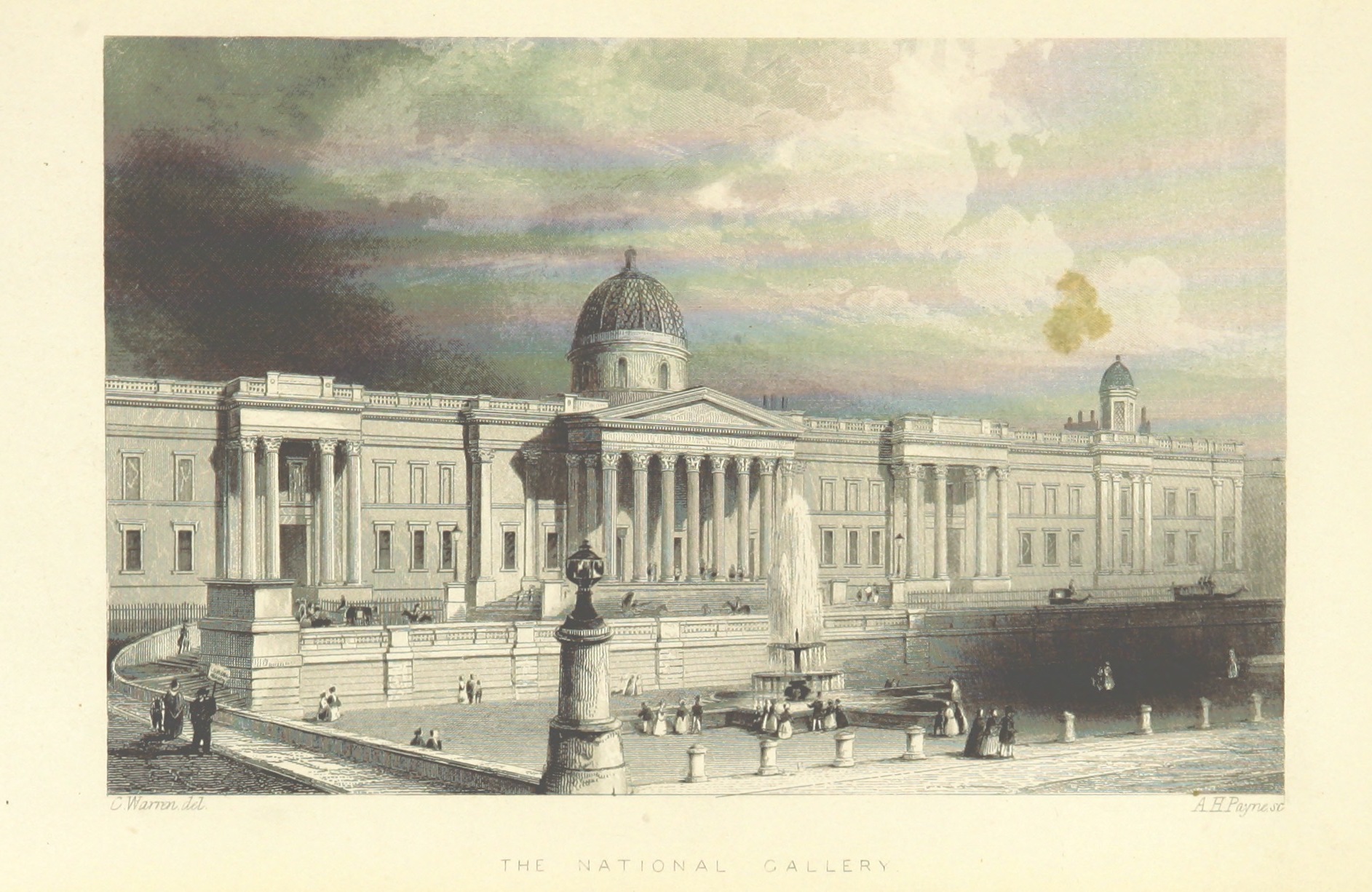
Deeply embedded in the plot of Murder at an Exhibition (recently released) is the idea that the National Gallery in London was closed on Sundays. The murder victim has special permission to be there on Sundays, and is murdered there on the quiet. The action takes place in 1863.

As a fiction writer, I admit to keeping much rougher notes than I do as a historian. I had looked through a couple of guidebooks of the era, and had confirmed, to my satisfaction, that the gallery was open six days a week, with four for the public and two for students only (which two days differed by guidebook, strangely). No source mentioned Sundays, so I kept writing.

Then a wrench appeared in the works.

I love how many free lectures there have been during the pandemic, and I recently attended one about the Victorian art world. The speaker noted that in 1845, the National Gallery opened on Sundays to encourage working people, who worked six days a week. The speaker also said that the grubbiness of the working people caused problems, leading to a Select Committee meeting in 1850.

The speaker used this image:

This shows working men viewing pictures at the gallery in 1870. I know that the National Gallery offered many free days, so there’s no reason this had to be on a Sunday. But it made me uncomfortable. Her talk led me to believe that perhaps the National Gallery had been open on Sundays in 1863, ruining my story.

Members of the Facebook group for the Historical Novel Society helped me out, not just with their own information but their encouragement to contact the National Gallery, where a wonderful assistant actually sent me their record of opening hours for their whole history as they knew it. No Sundays in 1863.

But the speaker had been so sure. Could there have been a trial run? I researched through Hansard, which has the debates of the House of Commons, and found much arguing about opening both the National Gallery and the British Museum on Sundays, but no conclusion. So I posted at the Victoria listserv, a place where every Victorianist who’s anybody meets up. Several members helpfully responded with books and records. I’m now 99.9% sure the Gallery was closed.

Yes, I know, if it’s this much trouble for me to confirm, I should be comfortable just showing it was closed on Sundays. It’s a fictional work, not a research project. Except that all my fictional works are research projects. Whether it’s important to the reader or not, it is ridiculously important to me that the facts be accurate, and if they’re not accurate then I’d better have a damned good reason why, and an Author’s Note. That’s just how I roll.

On Victorian female painters

I have been notoriously lax in my advancement of the feminist cause. I just assume that women were far more active historically than they have been portrayed. Those who control the media control the message. But at the same time I do notice when women have important public roles to play, and in writing fiction I have made sure that my Victorian females have a great deal of agency.

That’s not wishful thinking. It’s simply that the ordinary academic practice of history tends to believe its sources, without looking at all of them. That’s human. So I just want to say up front, it takes quite a bit to get my feminist hackles up. I’m a humanist.

But as I look into the Pre-Raphaelites, I have found myself getting annoyed with the focus on the men. Rossetti, Burne-Jones, Millais — there are women who took their names, but they are seen as muses alone. No one says “Rossetti” and means Christina, Dante Gabriel’s highly published and respected poet sister. No one says Millais and means Lady Millais, or “Burne-Jones” and means Georgina, an accomplished artist, or “Morris” and means Jane, a talented embroiderer. Why, when most of them published or exhibited their own work? I’m not even sure the men themselves saw them as sidelines — there is much evidence of respect and collaboration. And yet in most of the books, the men’s work is emphasized, and the women’s downgraded. Most of the explorations of the women’s work are recent, like Jan Marsh’s Pre-Raphaelite Sisters, or the National Portrait Gallery exhibit.

For inspiration and amusement, I’ve been looking at the portrayal of the Pre-Raphaelites in cinema and television, so I’m watching Desperate Romantics. It was made in 2009, not exactly a bad time for feminism. But even there, little mention is made of anything the women themselves created or exhibited. I realize it’s set early (1850s), but the writer didn’t even imbue them with any ambition.

Jane Morris embroidery

by Georgiana Burne-Jones

Clerk Saunders, by Elizabeth Siddall

I thought perhaps I’d look into their lives a bit, see whether they would make good characters in my book, or whether the tale I’ll tell could be through their eyes, instead of the men’s. I don’t know much about the art history of this period, so I’m investigating. My book is set in 1863, so I thought I’d see what the Royal Academy of Arts was doing then. I found The Royal Summer Exhibition: A Chronicle, a great resource that for 1863 discussed several of the key works including Millais, comparing his dark work in The Eve of St Anges to the lightness of a painting by Edward Matthew Ward. And then I saw in the Context section:

For some critics, Henrietta Ward’s picture of Mary Queen of Scots surpassed her husband’s efforts, and the Mutrie sisters were described as “still supreme among flower-painters”.

Who’s Henrietta Ward? I tried to search her by name and “Mary Queen of Scots”. I found an engraving from the Illustrated London News of it, but not the painting. So then I found the Royal Academy of Arts catalogue for that exhibition on HathiTrust. I wondered whether she’d be listed like the male painters, as “H. Ward”. I found the work, and her name as “Mrs. E. M. Ward”, and she had half a dozen works in the exhibition. I looked her up at the NPG, but there’s not a lot there. I found a review in the Athaeneum, which said:

They used “Mrs.” but referred to the artist as a male. How strange.

I thought I’d pick at random another female, since they are so clever indicated with “Miss” and “Mrs.” Item 571, Always welcome, by Mrs. J. F. Pasmore. Started searching on Google. “Mrs. J. F. Passmore painting 1863”. Very frustrating. I had spelled the name wrong. Then I stumbled on this at an antiques dealer site:

And here’s the description:


Middle initial and last name spelling confusion aside, she “also exhibited paintings”? Hers is in the Royal Academy exhibition, but I can’t find a copy of Always welcome online (there are plenty of paintings around by John F., mostly for sale). And this website attributes the above painting to him anyway, not her. So now I don’t know what to think. Maybe this is just a picture of her.

I don’t like to class everyone together: all women, all men. Some women had extraordinary power, both in the home and out of it. Others were taken advantage of. This sort of problem makes one wonder whether it’s the sources or the perception. Looking at the sources, I find more and more evidence of women’s agency. But finding those sources seems inordinately difficult.


What the Dickens?

Funny the things that happen when you’re a historian just trying to read a book, and the ways in which being a historian can get in the way of a good read. I recently joined the Victorians! forum on Goodreads. People there read Victorian-era books.

I’ve read some of those myself, including a few by Charles Dickens. I’ve read The Old Curiosity Shop (which someone spoiled for me, thinking everyone knows the ending), A Christmas Carol (of course), and Hard Times (ok, so I listened to the audiobook). The rest await me, eight or so volumes on the shelf. I figured Oliver Twist would be next. Then I saw that the Victorian group would be reading Nicholas Nickleby.

I’m not much of a joiner, but I thought it might be fun. I’ve never read with a group, never been in a book group or anything. The closest I get is reading the “book group questions” at the back of  novels.

But I didn’t have a copy of Nicholas Nickleby. I could have downloaded it from Internet Archive, but I don’t like reading things on a screen. Ironic, isn’t it? Backlit screens are for work, but reading for pleasure is different. I want a book in my hand, turning its pages, absorbing its history.

One site for second-hand books is abebooks.com. But I’m very choosy, because to me books are historical objects. My first preference is for a book published during the author’s lifetime, so “publication date ascending” is my go-to sort. Ending 1870, when he died. Whoa! the prices! How could Dickens be fetching such prices? OK, maybe not 1870. . . But even with an edition from 1920, we’re talking some money.

I knew Mr. Dickens was not getting a cut from my purchase, but I’m not a huge fan of him as a person, despite Simon Callow’s brilliant portrayal in Dr Who. As a historian, I try very hard to separate the creator from his creation. Where would I be with Rousseau if I cared about how he gave up his own children to foundling hospitals? Or if I ignored the brilliance of Thomas Jefferson because I was busy judging how he lived? People are not their ideas. We are all flawed. Good ideas survive long past the person’s lifetime.

Dickens is somewhat different because I went to his house. Not while he was there, of course, but several years ago. It’s a shrine to him.  I found this bizarre, because it was really her house. His wife, Catherine. She raised his ten (!) children. She wrote the best-selling menu book What Shall We Have for Dinner?

Since 2016, the museum has made a huge effort to include her in the house’s story. The problem is that Mr. Dickens, who was having an affair with young actress Ellen Ternan, didn’t want his wife anymore. After she discovered the affair in 1858, he turned the situation on her, separated from her, and dissed her all over London. He even tried to get her committed to an asylum. (I’ve begun reading Lillian Nayder’s 2011 biography rehabilitating her reputation. I feel I must.)

I’ve learned that you cannot be a Victorianist without enjoying, or even reveling in, Charles Dickens. Certainly I admire his detailed portrayal of the era, the wonderful characterizations, the turns of phrase that make you chuckle aloud. He wrote so fast, and so much, that I know I haven’t even scratched the surface of his talent. But the hagiographic approach to him annoys me anyway.

So I clicked past the volume of Nicholas Nickleby that said “Works by Charles Dickens” on the spine, because it was part of a collection. I scrolled beyond the $1,000 matched sets of his work. I searched for the small 8vo versions I prefer, but there aren’t any because the novel is too long. I finally found one I liked and ordered it. I do not hold it against Dickens that I spent so much time looking for a book I hadn’t wanted to read, by an author I personally dislike, just to join a discussion with a group I do not know. It’s just another case of a historian making things more complicated than they need to be.

Mystery tropes

I watch quite a few British/Canadian/Australian mysteries on television, so much so that I’ve been keeping a list of tropes. A lot of mystery programs (Midsomer Murders, Death in Paradise, Father Brown, Murder She Hoped, even the Kiwi series Brokenwood Mysteries) have similar settings for murder.

For example, there’s the one at the flying school, the one at the dance competition, the one with chefs in a restaurant, the one with the amateur theatre group. People get murdered when checking into health spas, joining hunting parties, and (gulp) attending author book signings. Sometimes there’s an unusual arrangement assumed to be a motive: the breakup of the band, the tontine (where whoever hasn’t died inherits everything), the dinner to which everyone was invited individually.

Back in the fourth grade, I gave up cursive writing and pens, only using either when it was required. I am trying now to revive both, with a fountain pen, a lovely journal given me by a friend, and mystery plots and ideas. Here’s the first page of tropes (please bear with my handwriting, obviously):

What this creates is a treasure trove of settings and/or a list of what to either imitate or avoid when writing a story. For me, it’s helpful to see the patterns. Many of these seem designed to limit the number of possible suspects. For example, if you have a murder at a music festival, there could be thousands of suspects. How does your detective narrow down? If one of the organizers is killed, they will tend to cast their gaze on the other organizers rather than attendees. This may or may not work, but it allows a lot of people to go home.

Since this is not how I write my mysteries, which sort of grow organically, it’s interesting to see how mysteries can be mass-produced through the recycling of settings.

Luckily, I don’t think that boarded-up operating theatre, the National Gallery, or pneumatic railway are likely to appear on the list any time soon. But about those 19th century health spas . . .

H.G. Wells on Science Education

Amidst my Victorian mysteries is the book I’ve spent five years putting together: a collection of the writings of H. G. Wells on the subject of science teaching.

Most of the 80 articles in this book have not been republished since they originally appeared in places like The Journal of Education, The University Correspondent, and The Saturday Review. Most of them were written before Wells published The Time Machine and became a well-known author of scientific romances, then later more polemical works and a history of the world. Many of the articles had to be rounded up in different British libraries, including the Bromley Library, the Bodleian in Oxford, the Cambridge University Library, and the British Library in both London and Wetherby.

Herbert George Wells originally wanted to be a science teacher, a difficult goal considering his lower middle class origins. Through independent study, he was able to win grants and scholarships and attend the Normal School of Science (now Imperial College) to study biology under T.H. Huxley. His first published book was not science fiction; it was The Text-book of Biology, volumes one and two, written for the University Correspondence College, where he was a tutor for William Briggs, a pioneer of distance education.

From the time he started at the Normal School until his success as a fiction author over ten years later, Wells was both subject to and wrote critiques about the vagaries of science education. He abhorred cramming for exams instead of gaining knowledge, railed against the continued emphasis on classics over science in the schools, and worried about British educational weakness as compared to other nations. His remarks will seem familiar to many in education today, and of interest to Wells fans, science teachers, students, and Victorianists. They appear in this book transcribed, annotated, and footnoted.

Publication date was September 21, Wells’s birthday. It is my first hard-cover release.

    Buy

At a cost to the economy, 1862

Murder at Old St. Thomas’s is set in London in 1862, which was the year of an Exhibition. Although it was not as beloved as the 1851 Crystal Palace Exhibition, the Great Exhibition of 1862 in London was extraordinary, as I noted in a previous post.

In addition to celebrating industrial and artistic achievement, the Exhibition also hosted meetings of several international groups. This included the International Congress of Charities, Correction and Philanthropy. On June 13, the speaker was Sarah Parker Remond.

A free person of color born in Massachusetts, Remond was anti-slavery from an early age. It is reputed that she made her first speech against the practice when she was 16. Her parents were successful business people. They were active in anti-slavery societies, and made sure their children got a good education, despite the lack of good schools for non-white children.

Sarah was already known as a lecturer for the American Anti-Slavery Society (founded by William Lloyd Garrison) before she was asked to go to London in 1858. Her intention was to get a better education, and she enrolled at the Bedford College for Women while continuing to lecture. While she was there, the American Civil War began.

Her speech at the Exhibition in 1862 emphasized support for emancipation, and by implication the Union blockade against the Confederacy. Britain had declared itself neutral in the conflict, and British ships continued to bring in products to northern ports. She pointed out how the British cotton industry used the products of slaves, although Britain itself had outlawed slavery in 1824. The British Parliament had further passed the Slavery Trade Act of 1873 and were actively involved in confiscating slave ships, but were continuing to benefit from the manufacture of cotton grown by slaves in America. She said,

Let no diplomacy of statesmen, no intimidation of slaveholders, no scarcity of cotton, no fear of slave insurrections, prevent the people of Great Britain from maintaining their position as the friend of the oppressed negro, which they deservedly occupied previous to the disastrous civil war.

This was despite the fact that she recognized that:

Thousands among the commercial, manufacturing, and working classes, on both sides of the Atlantic, are dependent upon cotton for all material prosperity. . .

As the result of the efforts of Remond and others like her, Britain respected the Union blockade of the Southern states. But the result of the decline in raw cotton importation was mill closures and starvation in places like Lancashire. There it’s become known as the Lancashire Cotton Famine.

In 1862, as now, the problem was not just that economic strain had thrown people out of work. It was that there was not enough of a social safety net to provide for them when they lost their jobs. The British government engaged in some compensation experiments, including minor funds distributed directly (similar to today’s stimulus checks), but it was minimal and in many cases never reached the people who needed it. The new Poor Laws had funded workhouses rather than “outdoor” relief to help people at home. Ultimately, some relief occurred when the government provided money to local councils, who then created new opportunities for employment in public works. But that wasn’t until 1864. Before that any efforts were supported primarily by private charity (similar to today’s GoFundMe), partly out of a suspicion of increased government activity*.

In 1862 the issue was the moral culpability involved in profiting from slave labor. Now it is the moral culpability of forcing workers into plague conditions. Jobs that take place indoors have the greatest risk of infection, while those outdoors have the least. Safer jobs could include massive infrastructure repair on America’s roads, bridges, and parks. Designs could be implemented to move commercial, educational, and political enterprises into better ventilated conditions.

Perhaps public works, and a bit of advice from Miss Nightingale (see previous post), might be an answer beyond 1864.


____

* Hall, Rosalind. “A Poor Cotton Weyver: Poverty and the Cotton Famine in Clitheroe.” Social History 28, no. 2 (2003): 233.

Editing hours

Editing ones own work is always difficult, but even more so whether there are decisions to be made and things to look up, rather than just errors to fix, in the final pass. For example, in one recent three-hour session, even though I’d already had two professional edits of the novel, I spent time:

  • finding out how I spelled “moustache” in the first book
  • looking up greetings appropriate for an afternoon tea party / art exhibit
  • learning how to force an em-dash to stay with a quotation mark on the same line in Word (you can’t)
  • deciding whether it should be M.P. or MP
  • removing the word “so” everywhere because I use it too much
  • looking up whether they would have called it a comforter in 1863 (yes)
  • changing colloquial phrases (“gone up” to “been increased”)
  • realizing the appalling necessity of a thesaurus

All of which make for a better book. It’s a little different than grabbing a red pen and making some marks, and really shouldn’t be done by someone else. And I admit to some frustration that I missed things, as in “how could I not have caught that on the first four reads?” But it’s all part of the journey.

Was the first female doctor in England a man?

Whenever historians discuss the “first” of anything, they use qualifiers. In the case of the first female doctor in the UK, there might be several candidates, depending on how one qualifies the word “doctor.” The innumerable wise women and healers who made diagnoses and prescribed treatment for centuries may be unknown to history. So we define “doctor” in terms of official qualification and credentials.

The honor of being the first female doctor in the UK thus goes to an extraordinary person, Elizabeth Garrett Anderson. Although she had been refused admissions to the College of Surgeons and Physicians because of her sex, she was admitted to the Worshipful Society of Apothecaries because their rules stated nothing forbidding women (an oversight they remedied shortly afterward). The University of Paris then admitted her to the examination necessary to certify her as a medical doctor in the 1860s.

Before her, one might argue, was Elizabeth Blackwell, the first woman on the UK Medical Register as a practicing physician. She would not have been able to obtain a medical degree but was grandfathered into the Medical Act of 1858.

But there is an even more startling possibility. Dr. James Barry was a famous figure in nineteenth-century military circles. He obtained his medical degree from the University of Edinburgh and might have been prevented from sitting his exams due to his youthful appearance but for the intervention of the Earl of Buchan, who was friends with his tutor.

Portrait of James Barry, Wellcome Collection

Dr. Barry was a good physician, known for an excellent bedside manner, and he became a talented surgeon in the army. He served in South Africa and the Caribbean and performed the first successful European caesarean section in Africa. He became Inspector General in 1857 and traveled the British Empire enforcing sanitation in hospitals.

There is much evidence of Dr. Barry’s personality. He was known for his squeaky voice and violent temper. Florence Nightingale, whom he met in the Crimea, hated him, even though his emphasis on hygiene was as energetic as her own. Others reported that he was quarrelsome in the extreme.

He also never undressed in front of other people. This, and his clean-shaven face, curly hair, and short stature do not appear to have caused much comment among most of his colleagues. Later, however, there were rumors of duels caused by insults about his appearance and the expected posthumous claims that “I always suspected” or “I always knew.”

When he died in 1865 of dysentery, a charwoman named Sophia Bishop laid out his body. This action was against Barry’s known wishes that under no circumstances should his body be disrobed in death. The woman claimed that his body had full female genitalia and stretch marks, indicating a possible pregnancy. Barry’s own doctor, Major D.R. McKinnon, simply refused to care about his patient’s sex, having been called upon to identify the body and sign the death certificate. He had written the sex as male on the certificate. When Bishop told him her observations and tried to get him to pay for her silence, McKinnon famously reported to George Graham of the General Register Office:

The woman seems to think that she had become acquainted with a great secret and wished to be paid for keeping it. I informed her that all Dr Barry’s relatives were dead, and that it was no secret of mine, and that my own impression was that Dr Barry was a Hermaphrodite. But whether Dr Barry was a male, female, or hermaphrodite I do not know, nor had I any purpose in making the discovery as I could positively swear to the identity of the body as being that of a person whom I had been acquainted with as Inspector-General of Hospitals for a period of years.

The army sealed the records, supposedly for a hundred years. Isobel Rae’s 1958 book The Strange Story of Dr. James Barry, based on access to those papers, broke the story in the subtitle: Army Surgeon, Inspector General of Hospitals, discovered on death to be a woman. The only evidence, despite the new batch of papers, was the word of the woman preparing the body.

James Barry qualified as a doctor in 1812, so if one says he was female, then he would be the first woman doctor by several decades. The story has fascinated many, and more documents have since been uncovered demonstrating that Barry was Margaret Ann Bulkley in his earlier life. (This includes items like a letter from young Barry to a family solicitor where the recipient wrote “Miss Bulkley” on the outside of the envelope.*) The current wisdom that James Barry was, in fact, a woman, is happily disseminated in more recent books, both for adults and children.

It is natural that current discussions of gender would play into how we interpret James Barry today. Did he simply dress as a man to have a career not open to women? Is it right to call him the “first female medical doctor” if we believe he identified as male? Should we call him a transgender man? Or is it best to respect his own view of himself?

Even if we accept the report of the avaricious charwoman and the handwriting analysis of Margaret Bulkley, we have no way of knowing whether Dr. Barry actually identified as male or would simply be labeled a cross-dresser hiding his female identity. His last wish that he not be undressed for burial seems to speak to something deeper. But here, we are certainly engaging in supposition unsupported by the sources. Instead, it might be best to celebrate an extraordinary career, acknowledge the good he did with his medical skills, and enjoy critiques of his explosive personality from a safe distance.

*see Pain, Stephanie. “The Extraordinary Dr. James Barry.” New Scientist, vol. 197, no. 2646, Mar. 2008, pp. 46–47.

Also published in Medium: Frame of Reference

Visiting 1862: The International Exhibition

Murder at Old St. Thomas’s is set in 1862, so I did quite a bit of research. For me, this was stepping back 25 years from my usual research area, so I found a lot of surprises, in addition to this novel technique for social distancing:


The first thing to do after putting on my crinoline was to find good maps of London, big maps where you can see street names and even buildings:

Guide to the what? The International Exhibition of 1862. Although the Great Exhibition of 1851, with its Crystal Palace, is more famous, this one was supposed to be even bigger. You can see the catalogue here. It took place in South Kensington, on Cromwell Road, where the Natural History Museum would be later.

The Victorianist blog has some good information, and points out that the death of Prince Albert in December 1861 put a damper on the whole proceedings from the start. And it says the building, above, cost £300,000 but the cost was covered by the profits from the Great Exhibition of 1851. My studies of Victorian science education claim that the entire system of British science education was basically financed by the same pool. Which makes me think that the money from the Great Exhibition of 1851 is like pieces of the cross. There is no possible way that they made enough profit in 1851 to fund everything that’s been claimed.

Another page with information is here.

And look, they even had cameras then:

The Exhibition caused a lot of traffic snarls, especially in west London. And it really was international, with exhibitors and visitors coming from all over the globe. More in my next post…


Home health tips from Florence Nightingale

While she was not writing about people quarantined in their homes, Florence Nightingale’s Notes on Nursing (1859) were about caring for people in their homes, and doing it well.

Nightingale is known, of course, for her service during the Crimean War and her active reform of nursing and hospital hygiene in the mid-Victorian era. She’s the one who realized that many deaths in military hospitals were unnecessary, caused by unhygenic conditions rather than wounds or injury. And she came to this conclusion when aneasthetics were in early days, and antiseptics as yet unknown (Joseph Lister would start his famous work after the war).

Contrary to her “lady with the lamp” image, Nightingale was a no-nonsense, if not actually abrasive, person. She was once even cussed out by a doctor who might have been the first woman to get a medical degree in Britain, except that s/he identified as a man (more on this person in a future post).

I have had a copy of Nightingale’s Notes on Nursing for awhile. I don’t even recall why I bought it. I assumed it was a book for teaching nurses, since Nightingale founded her school of nursing at St. Thomas’s Hospital. But it’s a book about nursing, not just in hospitals, but in the home. And her emphasis, not surprisingly, in on creating healthy conditions.

It is also not surprising that this was considered a job for women, and in my opinion this book should reside on a shelf alongside Mrs. Beeton’s Book of Household Management, published in series at the same time, and printed as a book only two years later. Most people know that Ms. Nightingale was a big advocate of fresh air. In fact, the odd configuration of the new St. Thomas’s Hospital, opened in 1867, was the result of her promotion of cross-ventilation.

Have you ever opened a window for fresh air, and it became so chilly you wished you could leave the heat on? Nightingale recommends this, or at least keeping the fire going with a window open, so that an ill person can have fresh air. She points out that you can keep the patient warm with blankets, and safely allow fresh cold air into the room.

Her book also notes that opening doors and windows is to no avail if the air that comes in isn’t fresh. If your room opens onto a utility closet, or you leave your chamber pot open under the bed (oh those master bathrooms!), or your window overlooks a refuse heap, you are not doing any good with air. Ill people really should be taken out into the garden to get a little sun and air, which I see done all too seldom. I’ve been in elder nursing homes where the windows don’t open and the only outside is a little paving of cement in a courtyard. Nightingale was not a fan of courtyards — the air isn’t fresh enough, going round and round.

Too much bedding, too many visitors

All of her advice was based not only on her experience, but on research and statistics. Her faith in scientific endeavor was firm. In the early 1860s, when the plot was being hatched for passing the Contagious Diseases Act, she argued against it based on statistics. The idea was that preliminary arrest and examination of prostitutes would prevent venereal disease in the military. The act would give the police power to arrest any woman they suspected of being a prostitute. Many who were against the idea argued on the basis of feminine modesty, or the inappropriateness of making a private disease a public issue, or the likely abuses by the police. Nightingale argued on facts: everywhere that harsh measures arresting and examining prostitutes had been enforced by a state, the V.D. numbers had actually increased rather than decreased.

Her household nursing advice seems so common-sense, and yet is often ignored, then and now. She had to recommend that damp towels be spread out to dry, that one not chit-chat inanely with someone who wasn’t feeling well, and that one should always sit beside the sickbed rather than hovering over it, forcing the ill person to crane their neck. And here’s more:

  • Reading the patient the funny bits of a book you’re reading (update: bits and memes off the internet) is extremely annoying to the ill person.
  • Quiet is important, because when someone is ill certain sounds can be distressing or even intolerable.
  • A bedroom, where one sleeps, is not the same as a sickroom. A person in bed because they are ill needs not only air but light, and should be able to see out an open window.
  • The bed needs to be aired daily — in fact Nightingale suggests two different beds so the sheets of one can always be aired. Not doing this, or using too much bedding and thick mattresses, leaves the patient essentially in their own waste of sweat and their own breathed air. (The current metal hospital bed is likely based on the iron ones she recommended.)
  • Cleaning must be thorough. Damp cloths, not dusters that just raise the dust into the air. Carpets are horrible even if lifted and beaten 3 times a year (I can just imagine what she’d think of wall-to-wall carpeting). Bad smells indicate organic matter is stuck to things, and it shouldn’t be.

See why I want this filed next to Mrs. Beeton? It’s far less about medical nursing than about good housekeeping. The medical advice reminded me of Hippocrates, especially when it came to diet (“The diet which will keep the well man healthy may kill the sick one”). But at this time, when there is more than the usual concern about people being ill at home, it’s still good advice.

Murder at Old St. Thomas’s is published!

My first Victorian mystery, Murder at Old St. Thomas’s, is now available at a number of shops, with more purchase options to come!

THE BODY WAS SEATED IN THE OPERATING THEATRE

In 1862 London, the body of a famous surgeon is found, sitting upright, in an old operating theatre. His dead eyes stare at the table at the center of the room, where patients had screamed and cried as medical students looked on.

The bookish Inspector Slaughter must discover the killer with the help of his American sergeant Mark Honeycutt and clues from Nightingale nurses, surgeon’s dressers, devious apothecaries, and even stage actors.
Victorian Southwark becomes the theatre for revealing secrets of the past in a world where anesthesia is new, working-class audiences enjoy Shakespeare, and women reformers solve society’s problems.

Murder at Old St. Thomas’s is a traditional historical mystery, meant to be read in front of a fire, real or electric, with a cup of cocoa. The story unfolds evenly, without jump scenes or shockers, and there is no graphic violence.

Real historical figures guest star throughout the book, bringing Victorian London to life. A book for lovers of Agatha Christie and Anne Perry.

Murder at Old St. Thomas’s
Novel, 240 pages
Historical Mystery / Historical Fiction
ISBN: 979-8-9853027-2-1 (print)
ISBN: 979-8-9853027-3-8 (e-book)
Library of Congress Control Number: 2022901917

Paperback ($11.99/£ 8.99/€10.99):

E-book: $7.99/£ 5.99/€ 6.99