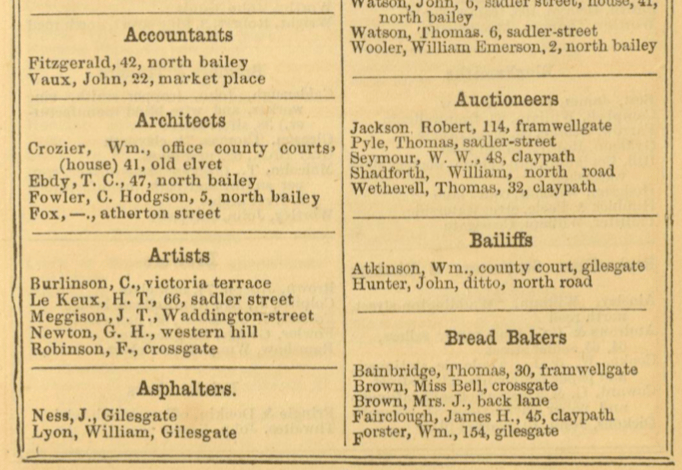
Of what use is it to know that if you were in Durham in 1869, you could go Thomas Bainbridge in Framwellgate in the early morning and find him baking bread? It is extremely useful, if your character needs a job that starts at 4 am.
Authors of fiction sometimes talk about “world building”, especially with fantasy. A believable world has to be created, with its own history, culture, and consistency. For historical fiction, it’s a little different, because the places were really there, and in many cases still exist.
There is disagreement among authors of historical fiction of how accurate one needs to be. I’ve read quite a few historical novels that do what I’m trying to avoid, treating the locations as mere settings for stories that could take place anywhere, anytime. In fact, I began writing historical fiction out of total frustration at several novels which, although supposedly set in Victorian England, did not in any way rely on that time or place for the story. I set out to do better.
I’ve done well with London, because I’ve found old maps for the years where my stories are set, from map-sellers, on the web, and in guidebooks. Street names may change, but often the street is still there. The 1860s and 70s were times of great change, so I have to be careful.

For example, there was no Piccadilly Circus or Oxford Circus in 1869 — it was Regent Circus (south) and Regent Circus (north) — apparently the whole Regent development project didn’t work out quite right. Shaftesbury Avenue hadn’t been cut through yet, the Holborn Viaduct hadn’t been built — this stuff is pretty easy, and fun to research.
In my current WIP (Work in Progress), the third novel in my trilogy of cozy Victorian mysteries, quite a bit of the book takes place in Durham in 1870. Durham is one of my favorite places on the planet, so it’s important to me that it be accurate. I want my character, who is fictional, to encounter places and people who actually existed. Because I was trained in the discipline of social and economic history, when he visits a business, I want it to have been a business that was really there.
I began by searching the web to find directories of Durham, because I’d discovered that directories of London listed both businesses and street listings, with who lived on a particular street. Durham, it turns out, had the same, plus a Slater’s Commercial directory, but I couldn’t find any for 1869/70 (the story takes place in April 1870). I tried using the two I could find, for 1852 and 1879, but of course these wouldn’t be fully accurate. While I was happy to find names and areas of towns where certain types of people lived, I didn’t have the actual facts for that year.
The Durham County Records Office came to my rescue*. I cannot go there right now, or I’d just look them up for myself. They charge £50/hour for research, but the Archivist suggested I go for a quarter hour and see how much they could do. And they did a lot!
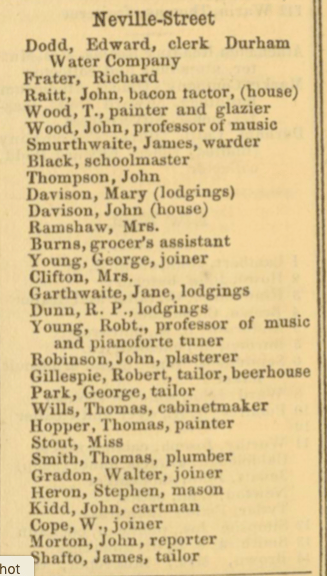
I have listings of types of businesses, and their addresses. I wanted a character to live in Neville Street, because I stayed there and know the street. He’s an engineer for the coal mines. So I was able to see whether his sort of people (class and vocation) would have lived on Neville Street, and yes!
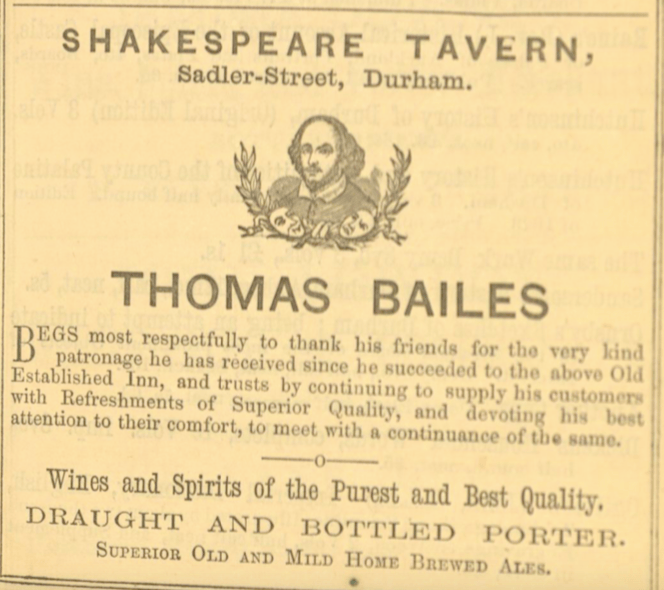
And then there’s just the fun stuff, like the fact that I’ve walked past this place a lot:
I can make sure there’s a bath house somewhere, since one character arrives in town having spent much time traveling. I can see how there are many Hendersons, because I want a scene at their carpet mill and I suspect the family must have been a huge employer and influence (turns out John was busy representing Durham in the House of Commons at the time).
I already know how far a walk it is from place to place, because I’ve walked it, but I looked up the phases of the moon for those days (and asked a friend of mine who’s an astronomer to be sure of its location for my moonlit scene), researched which hymns might have been used for the Easter Service (and hopefully at Durham Cathedral), and who might have lived at the old mill house by the river. I’ve checked the shape of vent doors on the range in the kitchen, whether or not they would have had bottled beer (yes), and what St Cuthbert’s shrine would have looked like then rather than now.
But I can’t finish the book because I don’t have a proper railway timetable for that year, which has made some people laugh at me and shake their heads. Too bad — if it isn’t real to me, I can’t write it, and whether the readers know it’s fact or not, I get a thrill out of knowing that it really was Mrs Duncan who ran the Durham County Advertiser and that the fever ward of the workhouse was added on in summer and so must have been being built in April.
And that’s what happens when a historian writes fiction.
*George Walker, The Durham Directory and Alamanack for 1869, Durham County Record Office (subsequently ‘DRO‘), Londonderry Estate Archives, D/Lo/J 59
