Grousable Books Newletter: 15 August

Grousable Books Newletter banner

Welcome to BookFunnel readers 

First, a special welcome to those who downloaded a copy of “The Dancing Colonel” through Find Your Next Favorite Author on BookFunnel. The short story features the characters from my Tommy Jones Mystery books, and ties in to some themes of the British empire. I hope all newsletter readers enjoy it!

A freebie cuz Bouchercon

Just in honor of Bouchercon, the big mystery writing convention, I have a free copy of a contemporary short story available to newsletter subscribers. It’s called “Murder Steampunk Style”, and takes place at a San Diego steampunk convention. And there’s a little Victorian twist in it too, of course!

You can download the story free from BookFunnel until the end of the convention (September 4) at BookFunnel. I’ll be posting it everywhere for purchase soon, if you’d rather have hard copy.

Now, to prepare for going to Bouchercon, I really should start thinking about what I might say on the panel (Historicals: Navigating the Past from the Present, Thursday at 9am). Instead I keep thinking: what am I going to wear? should I get my hair cut? how early should I get there? how will they display my books in the shop? will it be fun and exciting? will I shrink into introspective silence in response to being with so many people? 

I shall report out later!

Dover books

At book fairs and events, I don’t just sell my own books. I also have quite a few actual Victorian and Edwardian works of the literature, the sort of thing that informs my own work. Dover has wonderful examples, including books by Charles Dickens, Jules Verne, Joseph Conrad, and H. G. Wells. 

Most certainly I recommend these. Dover editions are low-cost because many of the works are out of copyright.

Life in San Benno

This feels a little Garrison Keillor-ish, but the fictional seaside So Cal town of San Benno is taking on a life of its own as I continue writing the tentatively titled Death at Luna Beach. I’m even thinking of making a map of the place.

The City Council of San Benno is very pro-business, and the town has become increasingly gentrified. A lot of the funky beach town vibe has been lost, and a number of citizens aren’t happy about that. Rosie McMahon, a bright woman in her 70s, will help solve the murder of a man from Bakersfield whose body was found buried in sand from a bluff collapse. By her side is Lou, the grumpy newspaperman, and Tiffany, a high school student earning her civics credit by serving on the Beach Estates Homeowners Association. Plans are afoot for a new development, and then this body turns up. 

What about the police? Well, the town has only recently become a city with its own tiny police force. Rory Gallardo, who used to patrol for mountain lions above L.A., is the official in charge.

Nearby San Drogo, named after the patron saint of coffee, even hosts a state university and their resources help solve the case. 

Featured blog post

There is only one blog post this fortnight, but it’s a fun one! I conversed with Hephaestus, the big orange tabby cat from Death at Luna Beach. Always pleased to talk with one of my characters.

In the garden

If you’re following the tale of the possums in our back garden, here’s the news. 

The two children of big mama Nobby (she has a nob on her tail) return every night. Apparently, I should call them Jack and Jill, the formal names for adult male and female possums. But I’ve been saying Little Brother and Little Sister and that works just as well. She is bigger than he is. He tends to turn away from my camera.

Panda2 (very white with very black ears), who is now the size of a pot-belly pig (and resembles one!) still comes around. He could be their dad. When he and Nobby encounter each other their dislike is palpable. Might be a short story in that one . . .

We’re on the third or fourth generation of these families living in the garden, which pleases me enormously. I like my guests to be comfortable. 

Links

Want to read previous newsletters? They’re located here at my website, where you can also find information and buy links to all my books.

Want to read previous blog posts? They’re here. 

Until next time!


Grousable Newsletter 2 August: Mystery and more

Grousable Books Newletter banner

Bouchercon Historical Mystery Panel

Big news this fortnight is that I’m on a panel for Bouchercon, one of the biggest mystery writer conferences anywhere.

Bouchercon poster

It’s a panel on historical mysteries, although I believe I’m the only actual historian. Which is good, because then I can bring a different viewpoint. In fact, I hope to mention two salient ideas:

  1. Primary sources are fantastic for both ideas and accuracy. (So diaries, newspapers, old photos can both trigger a story and make it more authentic.)
  2. Historians have training and tendencies that other historical fiction writers may not have, such as an understanding of the larger historical context in which the action takes place, or an obsessive tendency to find out whether smoke/fog in a can had been on the market in 2004 (see below).

But mostly, of course, I’ll be there to learn things, meet people, and get to know new works. 

Creating a California town

Back in April I had some questions about my Work in Progress, a beach cozy mystery that begins with a body buried in the sand near a bluff: Who is he? How did he get there? And what does it mean that one of those little paper umbrellas was found at the scene?

I’ve discovered that he is Bud Carson, a scout for Western Petroleum in Bakersfield. What was he doing in . . .

San Benno. That’s my So Cal beach town. It’s somewhere vague between Los Angeles and San Diego, a previously sleepy seaside town that’s just become a city. I have a professional sleuth (the new-in-town detective Rory Gallardo) and my amateur sleuth (Rosie McMahon, an older woman who has a writing shed filled with technology, some of which she built herself). And I now know the paper umbrellas came from Dino’s, one of those wood-sided old restaurants with a neon dinosaur decor trying to go upscale. 

Mystery image for San Benno

Creating a town is a fun thing to do. It’s ironic that I set my English mysteries in real places, but I live in So Cal and I’m going to invent one. 

Featured blog post

Well, to be honest, it’s the only post I did in July! It’s been a busy month. This post is about a mystery writer (that’s me) writing a romance (which I did), and some lessons I learned along the way. 

Featured blog post

Gardening update

Mid-July here in SoCal took us from the amazingly steady rains in June to heat and dryness. That shouldn’t be news — the warm and dry happens every year. How did plants respond? It varied. At first the roses went nuts; now they’re tired. The tomatoes cowered in the cool rainy days; they they started jumping up when it got warm. One of the possums in the yard had her babies. This is her second litter this year. It was easy to tell she’d birthed them–her poor pouch was practically dragging on the ground when she walked, and when she sat to eat your could see little hands and tails poking out.

a possum eating dinner

But this possum has not seen any Disney movies or wildlife websites, so she doesn’t know she’s supposed to do the cute thing: carry around the babies clinging to her back (and singing “When I Was Single”, for those who remember America Sings at Disneyland). As she dide for her last litter, as soon as she can she leaves them hidden in the nest to go feed herself. It makes me feel good that she thinks my garden is so safe. 

AI and writing

The biggest talk everywhere these days, other than the writers’ strike, is the impact of Artificial Intelligence on writing. Already quite a few things we read on the web are written by a computer, so this should’t be news. But most studios, producers, and publishers like nothing better than to make money and getting rid of writers saves money. The creative writing produced by computer may not be up to snuff yet,.

asking AI for sources and getting a mystery

But AI can certainly deal with anything formulaic. This is because AI garners from the web not only its information (sometimes false) but also its format (which it does much better). So heck, go ahead and use AI to write a draft of that form letter/book summary/resumé. Since AI doesn’t have a handle yet on the creative stuff, most people won’l like how it writes fiction. The plots may be good (formula again!) but the expression is banal. Rather like Data on Star Trek reading an adventure story aloud.

Will I use AI to write a mystery? Absolutely not–I’m the author, so I do the writing. Will I use it as a sophisticated search engine? Absolutely. The other night I was trying to research something for my Work in Progress. I needed to know whether they had canned smoke/haze in 2004, since I wanted my sleuth to use it with lasers. Google searches yielded nothing, but ChatGPT told me when it was invented and whether it might be likely or not. 

This month’s e-book promotions: & a free book! 

Starting today through August 20, you can download The Dancing Colonel: A Short Story for FREE in the Find Your New Favorite Author campaign.

Murder at Old St. Thomas’s is being featured through Kobo for UK readers only. Special price is £2.99 through August.


Not signed up for this newsletter? You can do so here.


Grousable Newsletter 15 July

Grousable Books Newletter banner

Traveling books

I’ve always wanted my books to travel. When I was writing Murder at Old St. Thomas’s, I imagined leaving copies on trains and in bus stations, particularly in England. When I got there with books in hand, I wasn’t sure how to do it. I was quite positive that a nearby helpful British person would say, “Miss? You forgot your book”. 

So instead I gave them to individuals I met. At my hotel in London, I saw that the day person at the front desk was often reading a book. After talking about what she liked to read, I gave her a copy. 

My book Murder at Old St. Thomas's travels to Austria

This is a photo she sent of my book, which she’s reading on her holiday to Austria. I like this a lot more than leaving it on a train!

The Garden

Finally the sun has come out, so although the tomatoes are still suffering I’ve got boysenberries, cucumbers, and butterflies (I didn’t grow those, but there’s a chrysalis hanging from one of my flower pots so I’m taking credit). 

Butterflies are symbolic, and the complete transformation from the caterpillar, stem-bound and sluggish, is nothing short of magical.

The garden is a place of magic and the other stuff of fantasy, including epic battles. I’m currently having one with a bunny I’ve named Señor Conejo, so called because I used spicy pepper spray to keep him off the beans and he found the flavor quite tasty. I have built several structures to keep him away from the beans (he likes the leaves) and he has defeated each one, either by tearing it down or standing on top of it to reach higher leaves. Bunny 16, Beans 1. 

In cases like this, one can get upset or give up gracefully. Choosing the latter, I now consider the beans a “trap crop” for the bunny, so that he eats that instead of my tomatoes and squash. The lobelia, which he denudes of its blue blossoms, must be a trap crop too, I suppose. 

Lisa in London

While traveling in May, I visited many locations from the Tommy Jones Mysteries. I’ve posted them all on the video page. Here’s one of my favorites (I have not tried embedding a video in a newsletter before, so let’s see if it works!).

The pandemic meant that while I was writing Murder at an Exhibition and Murder on the Pneumatic Railway, I had to rely on my notes from previous visits, research, memory, and Google Street View. So it was quite exciting for me to visit the locations. I didn’t get to them all, but was happy to do videos near the ones I visited. On some, however, the sound isn’t so great. Next time I’ll have a lavalier microphone and do better!

A Draft is (Almost) Done

I’ve been working on my assigned chapter for an upcoming book on H. G. Wells. I’ve had almost a year to complete the research, which was significant since my expertise is only his early life and I’m supposed to cover his entire life (he lived to be 79). Now I’ve written the chapter and had it edited by three readers and two editors, so I’m doing my final (?) pass through. 

Section of the chapter I'm writing for a book on H.G. Wells

What’s interesting about editing your own work is how it changes in your mind. My first draft felt awkward, and I keep working on it until it wasn’t horrible. Then I put it aside before working on it some more, moving things around, and figuring out what was wrong with it (in this case, that I was repeating myself in several places). Knowing this, my wonderful helpers could look for those things, and they found them and more. With each edit, the work tightened up and became better. I’m pretty proud of it now.

Soon it will go to the book’s editors, who undoubtedly will find more things I need to change. That should make it better still. To say it’s an iterative process would be an understatement. 

Books are like this too, of course. That’s why they say you should write the book you want to read. Because you will be reading it many, many times!

Promos

Murder at Old St. Thomas’s is on Amazon promotion for the July Perfect Book Nook Cozies through BookFunnel.

Cozy book sale at Book Funnel this month

And all of my e-books are still at 50% off at Smashwords through the end of the month. Take advantage, e-book readers!

Don’t subscribe to my newsletter yet? Subscribe here!

Grousable Newsletter 1 July

Grousable Books Newletter banner

Book news

Book fairs are seriously fun. Readers get to meet authors and vice versa. And when the weather is warm and sunny, people come out thinking they might buy a book. The North Park Book Fair in San Diego was just such an event.

People were there with their dogs and children, and they had a microphone set up for author readings. A very good day.

Here’s some big news: All my fiction e-books are 50% off this month only through Smashwords. So if you’re an e-book fan, now’s the time.

As for works in progress, I am focused for just a little longer on a non-fiction chapter for a book on H.G. Wells. As soon as that’s edited, I hope to get back to writing my California beach cozy. The body has been discovered, and Rosie McMahon is on the case, but how can an elderly woman do more than the local police? And why are there developers sniffing around the town?

A chat

In addition to reading from Murder at Old St. Thomas’s at the North Park Book Fair, I also chatted with a group from the Historical Novel Society on the uses of Artificial Intelligence (AI) programs for writers. 

The best uses of AI for writers are to do business tasks: query letters, library requests. Also, AI can suggest options, create summaries and synopses, make outlines. What it’s lousy at is telling the truth or writing creatively. And sometimes it just doesn’t work.

Murder mystery writers have a hard time getting information on the things that matter to them: the effectiveness of poisons, methods of death, and how to get away with a crime!

Is it Victorian?

The Victorian era is famous for repression — repression of sexuality, women, and open speech. But we know much of this from 19th century “prescriptive” literature. These are books and articles on how a woman should tend to her home and husband, how police should behave on the job, which books are suitable for children. Men and women who don’t know each other, some say, shouldn’t mix in public.

I like to tell my students that if people weren’t committing the crime, there wouldn’t be a law. In other words, people must be doing the opposite if prescriptive literature is trying to encourage certain behavior. So to me, a tract on how women shouldn’t be uppity means that women were being uppity. Treatises on improper literature means that people are reading it, and strict behavioral rules for boys and girls means there were wild and free boys and girls. And men and women most certainly mixed in public. Here’s a bunch of people crammed onto an omnibus:

Omnibus Life in London, by William Maw Egley (1859)

So while free, sexual, open-minded characters in novels may seem to be outliers, they might not be. If you went back in a time machine to Victorian London, you would see women walking the streets alone, individuals breaking class boundaries, and people laughing at rude jokes. It was not as stiff and staid as rumors would have you believe.

Gentleman Jack

Since I don’t have HBO, I was only able to watch some of Gentleman Jack with a friend, but found it fascinating. Based on Anne Lister, the show used her diaries for information and the character’s direct address to the audience. Lister’s diaries were partly written in code, especially for the sections detailing her love affairs with young women, in the first half of the nineteenth century. She married her lover (unregistered) in 1834.

Copyright HBO

While she’s not the first lesbian (or even the “first modern lesbian” as web pages assert), she was different from other women yet respected by her tenants and local society as a businesswoman and landowner. That she cohabited with another woman wasn’t unusual; commenting on it would have been. 

The production values for the show are excellent despite a tendency toward exaggeration: Anne did not look quite as masculine and her hair did not have the 18th century double-roll style. She did wear black, unusual for women not in mourning. So yes, she was an outlier. But the fact that she was successful indicates that Victorian mores, while strict and prescriptive, didn’t always hold.

Social media

I’ve been posting daily on Instagram and Facebook, but if you want to see all my posts I have a “social posts” page on the website. It helps me keep track if nothing else! 

More news coming soon from the garden…

Lisa


Grousable Newsletter 15 June

Grousable Books Newletter banner

Book news

Well, I manned my table (yes, a woman can man a table) with my mystery books at the Once Upon a Book Fair in Escondido, but although there were many authors there were few customers. Blame the weather (see below) or the location, but it just wasn’t happening. Met some nice authors though. That’s always the good side of these things. And I did sell three paperbacks.

Lisa at fair table

The California Crime Writers Conference in Culver City just ended, my first in-person book conference, so I was glad it focused on mystery books. It was so fun! I got to meet some of my favorite cozy mystery book authors, such as Ellen Byron, and learn from her and other expert writers in the break-out sessions. I did a signing session for my books, and enjoyed talking with other authors, working out plot twists and sticky research situations.

My first Victorian mystery, Murder at Old St. Thomas’s, also received a wonderful Critic’s Report from BookLife Prize. Rarely does a review understand exactly what the author is trying to do, but this one did!

First drafting

Some authors work on one project till it’s published; others work on multiple books at once. I’m afraid I’m one of the latter. 

Blame the hypertext mind, which many of us have from spending so much time on the internet. I could actually feel that happening to me back in the 2010s. The hyperlink (we just say “link” now) was such a cool thing in the 1990s. You clicked an underlined word and–behold!–you were on another web page. Many of us clicked and clicked and clicked until we couldn’t focus on one page anymore. 

This reprogramming means that if I’m working on one novel, and I get stuck, I just open up the next one and work on that. So people ask, “what are you writing at the moment?” and I have to say:

  1. a prequel to the Tommy Jones Mysteries, where we learn about Tommy’s childhood and how he got adopted by Inspector Slaughter and his wife, except that I have two dead bodies, one on each side of the river, and I don’t know who the murderer is–or wait, do you think there should be more than one?
  2. a California beach cozy, wherein an old lady and her cat Hephaestus work with a local curmudgeon reporter to solve the mystery of the body on the beach–do you think it’s ok to have one of those paper cocktail umbrellas be a clue?
  3. a literary novel where I have three characters set up: an older man who lives alone in London, a female tour guide who hates her life in the same city, and a high school student from America who comes over there–not sure what happens yet?

People usually nod off in the middle of listening to me explain #1.

More England stuff

So I promised more about my trip to England. I went to the British Library, both to renew my card after the pandemic years made it expire, and to view some maps.

The cool thing about setting novels in Victorian London is that there are maps: Ordnance Survey maps, maps for tourists, maps showing things like fire department zones. At the British Library, you order from their catalog on the computer, choose a room to sit in (and a table you must remember the number of), then get your books from the desk. 

Ordering off the online catalog, I had no idea how big any of the maps were. I’d also never been to the Map Room. When I got there I noticed the tables were much bigger. I went up the the desk and asked for my order, and they brought out four small items and a book so huge they could barely carry it. I flipped through the small ones quickly, then opened the giant book.

It had huge maps of parts of London, with tons of detail.

Using my new necklace with the magnifying glass pendant, I had a closer look. The guard jumped up from his seat, advised me to ask at the desk for a larger magnifier, then showed me how to use large leather weights to hold the map flat for my photos. So helpful!

The Rose Code

Just finished Kate Quinn’s The Rose Code, and I highly recommend it. Not a Victorian mystery book, and unfortunately situated among the many many World War II novels, it’s about Bletchley Park during the war. I confess I’m a Bletchley fan. I watched The Bletchley Girls on TV, and The Imitation Game. I’ve visited Bletchley and talked with the people there (one of whom told me that the masking tape X’s on the windows wouldn’t have been there then); I’ve seen the bombe work and heard how it sounds. I’ve seen the tangle of wires the characters use to program it.

The Rose Code is a fictionalized account of three women, each from very different backgrounds, who worked there, and Quinn’s research is impeccable. She blends their personal stories, the working conditions at BP, and code knowledge effortlessly, adding in a bit of a thriller element in a rescue of one of them from an asylum. It shouldn’t work, but it does. 

So very Cal

It’s been May Gray and June Gloom here. Those nicknames imply that every May and June is cloudy in the San Diego area, but of course this year is different. Or, as another gardener commented, “I guess it rains here now.” Just hoping it won’t be a No Sky July.

The very rainy winter and spring means that plants look different. A lot of us didn’t realize how much good a little more water (especially water from the sky) could do. Fruit trees and berries are going nuts (and maybe nuts are too — I don’t have a nut tree). But without the sun, those tomatoes and squash we eager beavers put out in May are suffering and many won’t make it. I’m starting more seeds. In June! What the heck?

Continuing my adventure in growing poisonous plants, my first foxglove (digitalis). Garden now contains deadly nightshade, digitalis, pennyroyal, and delphinium.

All of this is due to climate change, of course, and its unpredictable weather cycles. I am trying to get my head around the approach of Monty Don, the king of British gardening. He lost a lot of plants in the wet/dry cycle they had there this year, and is introducing plants that are resilient, rather than those that die if it’s a little too cold, wet, or dry. 

Resilience is a wonderful idea, and not just for plants!

Newsletter June 1

Grousable Books Newletter banner

I did it!

No, nothing to do with books or historical fiction–rather something I’ve never had the courage to do. The first time I tried it, I only lasted two minutes before stopping (maybe that is historical fiction, now that I think about it).

Yes! It’s true! I drove in England. And, lest you doubt, I have proof:

Was it difficult? Yes. Did I read the entire Highway Code before attempting it? Yes. Was I terrified? Of course. Did I hit anything? Well, there was this shrubbery on the way in to the carpark in Richmond…

Book news

My historical romance A Heart Purloined e-book has been released from Kindle Unlimited and is now available wherever you buy ebooks (or you can get it from me). 

I wrote that book on a dare. Well, a national dare called NaNoWriMo (National Novel Writing Month). You’re supposed to complete a novel (or at least a draft) in a month and you “win”. Just the glory, not anything else. I even had to buy the t-shirt. But there was also the impetus of a writer friend trying to do the same thing, since neither of us had written romance.

Image courtesy of NaNoWriMo

The book automatically turned itself into a mystery, however, so it’s a “clean” romance (no explicit sex) set in the Victorian era around a mystery with a blackmailer who’s just died. Both Amanda Goodwin, who always tells the truth, and Jack Strawman, who lies like a rug, are searching for something from the dead man. They wind up locked in a shed together. Twice. It’s a fun story with some of that witty repartee you might see in a 1930s screwball comedy. 

I wonder what I’ll do next November. Any ideas?

Why I owe libraries

Were you that kid who spent all your spare time in the library? I certainly was. And in the summer, I’d take the bus downtown and spend all day there, sitting in the aisles and reading, then taking home a stack I’d bring back the following week for more. No one told me what to read: I floated between the children’s room and adult fiction and those books marked with the Dewey decimal system. If it looked interesting, I read it. The subject card catalog was my guide.

The Beale Library in Bakersfield as I knew it growing up

In college I could not have managed without librarians, as I tended to choose unusual subjects. These wonderful people helped me research and used mysterious machines to get dot-matrix printed answers for me from far away, from university libraries and repositories. 

And now, as an author of historical fiction, I use the databases of articles and sources to find newspapers from the 19th century, and have been assisted by librarians from the British Library and small museums, especially during the pandemic.

Although authors are encouraged to set their “library price” high for their books, since a library will only buy one copy, I set mine low. I plan to publish hardback editions of everything because libraries like them, and I’ve just submitted to the Indie Author Project which helps libraries choose books. When I cull my own books (it happens occasionally!) I donate to the library’s bookshop.

What do you owe your library?

And I’m still a historian

It doesn’t go away just because one starts writing historical fiction — once a historian, always a historian. Without real primary sources and gaps in the actual history, I wouldn’t have started writing historical fiction. 

While in Durham, I went to the Durham Museum and Heritage Center, a small museum staffed by Durham University students. After photographing every display I could find on the Victorian era, I asked about the Henderson Carpet Manufactory’s location in the 19th century. There was a photo of it, but I couldn’t quite place it on a map. (In Murder on the Pneumatic Railway, some of the men Tommy meets work at Henderson’s, including the real life Mackay, who would later open his own factory.)

The Ph.D. student working the desk at the museum that day was Daniel Burrell, and he was very helpful, offering to find an answer in the archives. More importantly, he is a Victorianist also and shared his own work on the Victorian practice of cremation, its proponents and detractors. Fascinating stuff! Perhaps this conflict will appear in one of my novels one day.

A silly play

They’re doing something strange and semi-Victorian in the West End, a play called Bleak Expectations. It’s a send up on the work of Dickens, of course, and they’re doing an interesting thing. The narrator, who is also the protagonist at a later age, is played by different celebrities. We saw Sally Phillips, and if you happen to be in London 8-13 August it will be Stephen Fry. 

Every Dickensian trope was here, and all for comedy: “Pip” growing up happy but then having everything taken away because his father died having lost the family’s money in his business, the woe of his two sisters believing marriage was the only way out, adventures being befriended and then swindled, the evil lecher, the kind benefactor, the street urchin helped by the protagonist who returns later to save him. It was well worth seeing and even if you don’t know Dickens, it was so over the top that didn’t matter.

Just a pretty picture

I leave you with this, a photo of one of my favorite places, Durham Cathedral and the River Wear. 

I did so much while in England — more newsletters and posts coming! And once I get the overgrown garden tamed, I’ll have more garden news (for now just know that two of the possum’s babies seem to be staying in the yard).

Appearance reminders:

Saturday, June 3 I’ll be at the Once Upon a Book Fair in Escondido, California.

June 10-11 I’ll be at the California Crime Writers Conference in Culver City.

NEW June 24 I’ll be at the North Park Book Fair in North Park San Diego. 

Until next time!

Lisa

Newsletter 15 May

Grousable Books Newletter banner

My Grousable Books newsletter for May 15 comes to you live from England, and includes England events, Magpie Murders on TV, and upcoming book signings. 

Live from England

This newsletter is coming to you directly from England, where I am doing a bit of research and a bit of book marketing. So far my most exciting visit has been to the Clayport Library in Durham, where the librarian was thrilled to accept Murder on the Pneumatic Railway as a library offering. I also brought a copy to Collected, a new bookshop featuring local and female authors, where I purchased a copy of Patricia Highsmith’s The Talented Mr. Ripley, a book I’ve never read. I’ve met bookshop owners and left my card.

Much of Pneumatic Railway, a cozy historical mystery, takes place in Victorian-era Durham. I did quite a bit of research, and used real names and addresses from the 1870 Durham Directory to create characters and jobs for Tommy Jones. He has to journey to Durham to bring a witness back to London, and meets a girl there, and . . . well, you’ll just have to read it!

The exact spot where Callum, the homeless man with the dog, sits most days and talks with Tommy, from Murder on the Pneumatic Railway.

I will also sign copies of my book Murder at Old St. Thomas’s in the gift shop at the Old Operating Theatre in London later this week. I’m so looking forward to meeting (in person!) Monica Walker, who invited me to Zoom talk about the book and its connection to the place which inspired it. You can view the talk here.

Oh yes, and Charles Windsor was coronated as King Charles III shortly before I arrived. I was privileged to sing God Save the King with a huge congregation celebrating at Durham Cathedral. I’m a big fan of the King because he’s a big fan of . . .

Gardens

Without access to my own garden, I bring you the garden from Gresgarth Hall in Lancashire, where garden designer Arabella Lennox-Boyd has created a beautiful place.

Naturally, a great many plants grow here that are difficult if not impossible to grow in water-challenged southern California. It’s surprising how viewing many lovely plants can be followed by grumbling, “but we can’t grow that, of course.” 

Solomon’s Seal (Polygonatum)

The trend here for awhile has been letting more places grow naturally. I saw a graveyard today with a sign that said the grass is being allowed to grow all year to create better wildlife habitat. Perhaps weeds need not be seen as weeds, but as a place for bees and bugs to proliferate. Goodness knows we need more bees!

TV: Magpie Murders

Not “The” Magpie Murders, as the victim vehemently insists. He’s the successful author of murder mysteries, but he’s been killed and left an unfinished manuscript, so no one knows whodunnit. The detective he writes about is in the middle of his own similar case.

I read the book when it was published in 2016 because the author was Anthony Horowitz, the genius teleplay writer behind Poirot, Midsomer Murders, Foyle’s War, and New Blood. Unfortunately, I was disappointed in the book–it didn’t seem to have the same life and intensity as his teleplays. 

So it doesn’t surprise me that Magpie Murders is really good television. I confess I did get confused between the 1950s and modern timelines, probably because the same cast plays each ensemble. Right now the show is on the PBS app and other providers. 

Don’t forget June 3

That’s the date for the Once Upon a Book Fair, where it’s my understanding that there will be dragon-led tours through the books (!) and a free book prize to win. I’ll be there with all my books to sign and chat.

On June 10-11, I will be at the California Crime Writer’s Conference, signing my books for other authors and, I’m sure, learning a lot.

That’s all for now! And don’t forget, you can find all the previous Grousable Books newsletters here.

Grousable Books Newletter: 1 May 2023

Grousable Books Newletter banner

My Grousable Books newsletter for May features a historical bit about May Day, a fun interview, an announcement that my romance is leaving KU, a bit of Vienna Blood, and (finally) a freebie short story.

Now through May 13: 50% off my mystery ebooks at Smashwords

I rarely discount anything, so this is your chance if you’re missing one of the Tommy Jones Mysteries! Coupon code 8SWQ7 should come up automatically for Murder at Old St. Thomas’s, Murder at an Exhibition, and Murder on the Pneumatic Railway. Discount for a limited time only at Smashwords. 

May Day

Here’s a bit of history, and it’s Victorian even if it’s American. On the first of May, 1886, the American Federation of Labor held a general strike. The date had been declared a couple of years before as the goal for workers to obtain an 8-hour day without a cut in pay. This was in a time when 10-16 hour days were the norm, and often in dangerous conditions. Naturally, a labor strike of this size (at least 300,000 participated) meant that anarchists and groups advocating violence would get involved, resulting in the Haymarket Affair a few days later. Protests for labor had turned into protests against police brutality in response to the strikes, and violence begat violence.

Engraving of Haymarket riot posted on my grousable books newsletter for May
Harper’s Magazine’s rendition of the Haymarket Massacre. While not accurate in terms of events, it effectively portrays the mood at the time.

Since then, workers’ unions have adopted the date worldwide as Labor Day, aligned as it is with old pagan May Day spring celebrations. Interestingly, the U.S. does not celebrate labor on this day precisely because communists, socialists, and anarchists were involved. Ours got moved to September. But without unions and strikes, we wouldn’t have 8-hour days, weekends, or OSHA protections.

A fun interview

I had the honor of being interviewed by Stephanie at BookFrolic as part of the Cozy 52 series. She asked some great questions!

Author Q & A banner posted on my grousable books newsletter for May


A Heart Purloined leaving KU

A Heart Purloined, my Victorian romance, will leave Kindle Unlimited on May 15 to spread its wings to the wider world. I hope to get it in libraries soon instead.

Mockups of A Heart Purloined, posted on my grousable books newsletter for May

Here’s the “blurb” about the novel:

England 1880

Amanda Goodwin first encounters Jack Strawman when both of them are robbing the same house, so she knows he’s a thief. As companion to Lady Brandon for two years, she has been trying to earn money to help save her family’s farm and reclaim a miniature of her grandmother. An unexpected death means that Amanda must enlist Jack’s help.

Jack Strawman is a man with a light-hearted manner which covers up a mysterious past, and it doesn’t take long for Amanda to see his flair for dissembling. His own goals come into play as he assists Amanda, but her forthright way of doing things presents problems. From unwilling partners to enchanted lovers is a path filled with robberies, kidnapping, and police investigations, all set in Victorian England.

Garden News

April is when the weather is uncertain, but the plants know the days are longer so they grow really fast. I’ve been taking cuttings from growing stems of lavender and rosemary, planting out tiny tomato plants into huge pots, and babying seedlings of cucumber and watermelon.

Photo of a possum posted on my grousable books newsletter for May

The most frequent possum visitor here is Nobby (so called because she has a knob in her tail caused by injury). Did you know that the most common possum in North America is the Virginia Opossum, and that they are the only marsupials on the continent? Nobby has a pouch full of joeys once again (she had a litter last year), and she has already defied the animal info websites by staying in our yard for two years.

TV: Vienna Blood

No, it’s not England, and it’s post-Victorian (just by a little bit), but it is a lavish production, and an international one at that. A disgruntled Slavic inspector and a young Jewish doctor specializing in neurology (psychiatry) navigate Vienna’s social minefield to solve mysteries. The performances are excellent, so good that one might not even notice the furnishings and costumes (including Max’s hat) that aren’t historically accurate.

Vienna Blood lobby card posted on my grousable books newsletter for May

Because you know, I love a lavish mystery.

A freebie!

I told you last month I’d have a freebie soon, and now I do! It’s a short story called “The Dancing Colonel”, and features Jo and Bridget from Murder at an Exhibition. But you don’t have to know the characters to enjoy solving the mystery of a colonel who drops dead at a charity ball. Was he danced to death, or was the cause more nefarious?

Cover of the freebie, posted on my grousable books newsletter for May

Click here to download the story if you already subscribe to my newsletter, or here if you don’t. Enjoy!

Divided by a Common Language

I saw a British meme explaining that the American word “math” is missing the letter “s” at the end, but it’s ok because we can just take it from the end of the word “sports”.


Grousable Books Newsletter: 15 April 2023

🌿 Springing into poisons

Garden news can be up front this time because spring is finally here after weeks and weeks (feels like months) of rain. Plants are a little uncertain, a little waterlogged still, but they’re more game to try. It’s going to be a slow start: the new artichoke plants are only ten inches high, last year’s roses are still huddling unenthusiastically, and the carrots aren’t certain if they want to bother. But the broccoli is finally growing (now that I’ve protected it from the visiting bunny with a bit of hot sauce on the leaves) and the new bearded iris forgot it just bloomed last November and is going again.

Even the part of my garden root-bound by trees is flowering

My ambitions to plant more poisonous plants (how can I write about them if I don’t grow them?) are starting small, with a dozen digitalis (foxglove). They seem happy, but a friend has reported I may have planted them in too much shade, so we’ll see. The delphiniums (aka larkspur when it’s an annual) are happy to start reaching toward the sky. Apparently the diterpene alkaloids they carry can kill an adult in very small amounts. Naturally, as with all poisons, it has therapeutic uses in smaller doses, for asthma, dropsy, and more. (Don’t worry, dog lovers–all my flowers are behind a fence!).

📚 Book news

I opened a new Etsy store for my books, which was actually quite fun to do. Etsy wants you to post the “story” of your shop, so I made one up and it’s kinda fun; I think you’ll like it. Right now it’s just my Tommy Jones Mysteries e-books, but more is coming soon, including the autographed copies currently available from my website.

Meanwhile, my Work in Progress (WIP, as they say in book land) will be a cozy mystery. I suppose it’s not that historical (set in 2004) but it will be based in a California beach town, so will be the first of my mysteries set in the U.S. So far, I have a body buried in sand at the bottom of a coastal bluff. Who is he? How did he get there? And what does it mean that one of those little paper umbrellas was found at the scene?

The Once Upon a Book Fair is in Escondido on June 3, and I’ll be there selling and signing books. Come on along–it would be great to see you. It’s 10 am – 4 pm at the California Center for the Arts.

🇬🇧 Hail Britannia

After a three-year delay, I will finally be journeying to the U.K. next month. I hope to stop by the shops that are carrying my books in London (The Old Operating Theatre) and Stockton-on-Tees (BookDragon).

I also plan to visit and photograph many of the locations from the mysteries, including Clerkenwell in London and Durham from Murder on the Pneumatic Railway.  And I’ll visit the Yorkshire Dales, which I was thrilled to see beautifully filmed in the new TV version of All Creatures Great and Small, this month’s historic TV pick. This time it’s the 1930s.

Yes, the show is excellent, with good acting and solid historical accuracy. The gorgeous scenic shots were done by drone camera. Writers sometimes make the setting a character. I love doing that, and the Dales definitely are a character in the show, mostly because no one wants to leave. And why would they?

🤷🏻 BTW

By the way, I’ve added a page on my website featuring all my Instagram posts together. Why? Well, not everyone wants to be in Facebook or Instagram, and sometimes it’s more interesting to see a bunch of posts at once.

Till next time!

Grousable Books Newsletter: Midhurst News and the Trilogy

Fire in Midhurst

I hadn’t meant to send another newsletter so soon, but this is actual news which is very sad for fans (and scholars) of H. G. Wells. Wells spent formative years in the town of Midhurst in West Sussex (my knowledge of the area led me to set A Heart Purloined there). Last week a fire raged through two properties on North Street, the main road. The Angel Inn was gutted, and I have it from someone who lives there that the remaining facade is unsafe and likely to be condemned. The building next door was referred to as The Olde Tea Shoppe, although when I ate there it was the Olive and Vine restaurant. At the back was an alcove full of Wellsian books, because Wells lived there while an assistant master at Midhurst Grammar School.

It was from Midhurst that Wells got his first real start in life, away from his mother’s ambition to have him be a sensible shop clerk. He attended school there as pupil-teacher when an apprenticeship with the chemist proved unsuitable, then later returned to teach and earn money for the school through taking national exams. As a result of these he got a scholarship to the Normal School of Science in London, now Imperial College. There he was a student of T.H. Huxley and developed both his science teaching and his journalism (anthologized in my book H. G. Wells on Science Education, 1886-1897).

Wells wrote fondly of Midhurst in many books. Mrs. Walton, the owner of the Tea Shoppe when it was a sweet shop and the cook of hearty meals for Wells and the other assistant, became the character Mrs. Wardor in his novel about bicycling in the area, The Wheels of Chance.

Simon Wheeler of Wheeler’s Bookshop in Midhurst told me that in addition to the buildings themselves being over 400 years old, there were medieval frescos on one of the walls.

The Angel Inn gutted and the Olde Tea Shoppe, where Wells had a room upstairs, destroyed. Photo © Sussex Live .

The Trilogy Complete

With spring comes the completion of the Tommy Jones Trilogy, my series of interconnected, stand-alone Victorian mysteries. Tommy Jones is 12 years old in Murder at Old St. Thomas’s, where he helps Inspector Slaughter solve the crime. He’s friend and helper to Jo Harris in Murder at an Exhibition, then in Murder on the Pneumatic Railway he takes the lead by traveling to Durham to find an important witness. This is his “coming of age” story as well as a mystery, and I hope that readers are as fond of him as I am.

[In fact, secretly, I just might be writing a prequel to the trilogy, telling all about how Tommy came to stay with the Slaughters in the first place. It takes place primarily in The City . . . shhhh]

Gardens and grit

Not much to report from the garden, because quite a bit of it is waterlogged or actually under water. I have declared this Brick Path Lake, and am asking advice on applying for a refund of the “Sunshine Tax” (that’s the joke out here for why everything in SoCal is so expensive). Things are growing–I’ll tell you what things when I get on my wellies and wade out there.

Historically inaccurate TV

Allow me to express my utter disappointment in a couple of TV shows, the second of which I did not finish watching.

Dead Still (Acorn, 2020) is touted as a dark comedy set in the Victorian era and featuring photographers of the dead. This has long be thought to be a Victorian trend: people prop up their dead loved one for photographs, either with the corpse on its own or posed with the family or spouse. As macabre as it sounds, it did happen, but my research indicates not often enough to make a mini-series out of it. There is some dispute whether all of the many photographs of family members with their eyes closed or in awkward positions are actually post-mortem photography or just poor photos. Anyway, the show has an interesting premise, but I’m not sure they kept up the story that well.

Year of the Rabbit (BritBox, 2019)   The writers, Kevin Cecil and Andy Riley, know a lot about comedy but I’d venture to say know or care little about the Victorian era. The verbal and costume anachronisms appeared immediately, early in the first episode, so I want not able to watch much of it. Looking it up on IMDB, the list of special effects people and producers are very long, so perhaps historical accuracy was of little interest anyway. The clothing colors, even in 1887 when aniline dyes were known, are kind of strange.

Going Steampunk

I’m not so much of a history prude, but I expect every show set in an actual historical era to be accurate. However, the steampunk aesthetic has paid tribute to some of the scientific spirit and gadget obsession of the Victorian age, even while replacing history with fantasy.

Terry Pratchett’s Going Postal is a beautifully done example of this. Victorians were very excited about the possibilities of new communications technologies, such as the Transatlantic Cable, faster mail service,  and the telephone. In Going Postal, messages are communicated using lights in large towers, translated at the other end and reconveyed across distances. Physical letters rot in piles in the actual post office, which our hero (a con man and convict) is assigned to straighten out. It is the story of two communications companies, and their systems, vying with each other as a life and death conflict. And it’s hysterically funny. (Plus Charles Dance is in it, so you can’t really lose.)

Coming soon

Coming soon: a freebie for my newsletter subscribers. Stay tuned.

Happy reading!

Grousable Books Newsletter: Ides of March 2023

New! Pre-order Murder on the Pneumatic Railway

The trilogy is complete! Murder on the Pneumatic Railway is the third interconnected stand-alone Tommy Jones Mystery, and the one where Tommy solves the crime. Publication date is 22 March, so pre-order now!

The blurb:

In 1870 London, the body of a postal clerk is found inside a pneumatic railway car, and surgeon Samson Light has been accused. Tommy Jones must abandon his many jobs to pursue the witness who can exonerate his former tutor. 

Inspector Morgan of St Giles Station seems unusually reluctant to pursue the case, so Samson’s barrister, wife, and friends must investigate. Clues lead to the General Post Office, the London Pneumatic Despatch Company, the highest realms of the Foreign Office, and inside Clerkenwell Gaol itself. Why was an ordinary clerk killed and, if it wasn’t Samson who did it, who did?

Peas in a Pot and a Possum

Garden news is a bit sparse given all the recent rain. SoCal folks joke about the rain, but we have little idea how to actually deal with it. Driving is crazy, water doesn’t know how to drain–it’s kind of a mess.

So, some photos. The snow peas, unhappy in the ground, are quite happy in a pot. In the middle picture is one of several possums who come in the night. They tend to the garden and scare away rats, eating all the ticks along the way, so I love them and leave out apple pieces. OK, so the last pic isn’t from my garden–it’s what I ate because I had a cold. Just an ordinary head cold, not at all what a lot of people are dealing with these days!

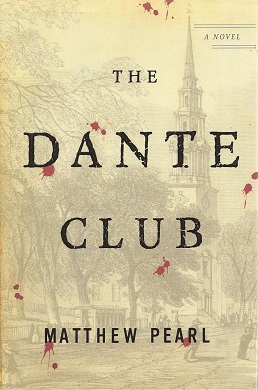
Book: The Dante Club

The Dante Club - WikipediaVictorian but American, The Dante Club was written by Matthew Pearl. I had previously read The Last Bookaneer, and wanted to see what the author did with a different subject.

Of the four or five real-life historical figures who help solve the crimes in 1865 Boston (U.S.), I knew something about only two: Oliver Wendell Holmes and Henry Wadsworth Longfellow. These two and other famous friends were part of the Harvard scene at the same time, and in this story they become amateur detectives as a killer seems to be imitating parts of the as-yet-untranslated Inferno by Dante. So it’s the story of the first American translation of Dante, and what Dante meant to the scholars, and how the work of scholars and poets was seen after the Civil War. Combined with a murder mystery.

Although written in an elevated style at the beginning, it settles into a real whodunnit, and although they aren’t played for laughs, I found authors of the likes of Longfellow and Holmes running around solving a mystery to be amusing as well as intriguing.

TV: Miss Scarlet and the Duke, Enola Holmes 2

Naturally drawn to things Victorian, I am watching Miss Scarlet and the Duke on public television and Enola Holmes 2 on Netflix. They are rather similar.

For Miss Scarlet, I first had to get past the name, since with Miss Scarlet I’m thinking either the board game Clue or Gone with the Wind; the Duke is supposedly a nickname for Inspector Wellington but his personality is such that I can’t imagine anyone using a nickname in his presence. Enola Holmes refers to the sister of Sherlock Holmes.

The women in both series are trying to make their way as detectives, which allows for stories that include sexism and the chance to prove themselves. Both women are “strong female protagonists”; they stay true to their own personalities even as they experience some growth as a result of their adventures. The historical accuracy is a bit better in Enola Holmes than in Miss Scarlet, where I’ve winced at a few verbal anachronisms and wondered at some flat painted walls. But from a writer’s perspective, Miss Scarlet has a side character that is worth the whole show: a Jamaican criminal named Moses. While other viewers are no doubt wishing that Miss Scarlet and Inspector Wellington would kiss and get a room, I keep hoping that Miss Scarlet and Moses will set up a business together.

Tidbits on Facebook and Instagram

If you like little tidbits of history, all Victorian, follow me on either Facebook or Instagram: I’ve been posting them there as I find ’em!

This, for example, is the Battersea trial pneumatic railway. It was tested above ground first, where people could see it, before being installed underground to carry mail parcels. It is in just such a mail car that the body is found in my novel.

Specials

Haven’t read the first Tommy Jones mystery when the third is being released? That’s OK! Starting today, March 15, Kobo is offering Murder at Old St. Thomas’s e-book at 30% off. Take advantage!

And don’t forget if you like certain genres of books that BookFunnel is having promotions:

Missed previous newsletters?

Weren’t on my newsletter mail list until recently? Previous editions of the newsletter are posted on my website — just click here!

And that’s it till April!

Grousable Books Newletter: 1 March 2023

In this edition, I present blog posts on writing, announce book promotions, and go off on design for films set in Victorian England.

Writing about Writing

Uppark, West Sussex

I’ve been composing blog posts that go further into my writing and research than a newsletter can.

In Late night with Mr. Wells I detail some of the historical research I did just to find out a few things. For a historian, research can lead to rabbit holes down which we jump without thinking, just like Alice, to get entangled in the facts of the past. Right now I’m working on a chapter about H. G. Wells, so these things happen.

In You’ve Got Romance I talk about how I came to write A Heart Purloined, how I chose the setting, and what I wanted to be different about its love story. In doing so, I realized a connection to the movie You’ve Got Mail.

In the Garden

Despite a few hot days, it’s been generally cold and a little rainy in SoCal, so my spring seeds are being started indoors. But outdoors, we’ve had some interesting visitors, including American Robins, who usually don’t come to this area at all.


Books and things

My e-books are part of several promotions this month, so have a look at the other books in these categories for some really good reads:

The Spring Into Spring Cozy Mystery Sale

The Historical Fiction Strong Female Leads Promotion

The “Back in Time” Historical Fiction and Romance Promotion

All of these are with BookFunnel, which lets you download your ebook in your preferred format, and provides customer support if you have any issues.

Victorian portrayals

I love when set design, costumes, and settings tell us more about a historical era than we knew before. Some films use the past as just a setting, as if the story could take place in any time. And many of them can. But my favorite stories are those that could take place in no other time. And some films go the extra mile to be as accurate as possible.

One of these is The Great Train Robbery from 1978. Fine attention was spent recreating not only the dress and manners of the era, but the feel of it. A highly experienced group of designers made this possible. This was production designer Maurice Carter’s penultimate film–he is known for other historically accurate movies like Becket (1964).  Art director Bert Davey was an action film specialist (Aliens, The Living Daylights) but also did art direction for period pieces like The Slipper and the Rose. Geoffrey Unsworth, unparalleled cinematographer, made it all come together in one of his last films–the movie is dedicated to him. See clips here. (If there is a heaven, cinematography is by Geoffrey Unsworth and Sven Nykvist.)

Another is Sherlock Holmes, the Robert Downey Jr. version from 2009. Long ago I was a designer in theatre, and I took a class from the American Film Institute in production design, so I love this stuff. This is a great article on the set decoration for Sherlock Holmes, not only because it talks about the actor interacting with the set, but because it shows the way that setting can represent character.

Upcoming Release

On March 22 the third Tommy Jones Mystery, Murder on the Pneumatic Railway, will be released. More on that in the next newsletter!

Don’t subscribe to my newsletter yet? Subscribe here!

Grousable Books Newsletter: February 2023

Events and a Bookshop

I have been somewhat loathe to attend in-person events in this time of plague, but I recently attended two. One was the Oceanside Sunset Market Authors’ Night, where I got to set up a table and sell books. It was a fun event, with many people and really nice organizers (a helper literally met me at my car with a handtruck!). I was asked all kinds of questions about where I get my ideas. Talking about going through sources, reading newspaper articles written in the 1860s, was a joy. Then the next night I attended the Local Authors Showcase at the San Diego Central Library, where my book Murder at Old St. Thomas’s was among the many others featured on display in the library for the month of February. Quite an honor.

Verbatim Books, located in North Park in San Diego, is my bookshop of the month. They have a fabulous consignment program, put my books on display right away, and were a great place to shop. Used books, new books, beautifully organized and at great prices. Yes, I bought a few!

Launch for A Heart Purloined

Valentine’s Day, February 14, is the “launch” day for A Heart Purloined, my new historical romance.

I was hoping to have an outdoor launch party here in San Diego, but the forecast for February 14 says it will be the only day it will rain, in between some very dry weeks. So it might be a very quiet (or wet) launch.

February in the Garden

Dry, dry, dry. In between unseasonable rain showers, we’re getting Santa Anas. This condition is supposedly when hot winds come down the hills from the northeast. Whatever they are, they mean your sinuses dry to a crisp and there isn’t enough hand lotion in all the world.

The Mr. Lincoln rose planted last month is doing fine anyway, and the sunny weather has fooled a lot of plants into thinking it might be spring. The apple tree has already got both flowers and tiny apples, a very odd thing while the camellias are in full bloom.

Oh, and about those camellias. I learned a trick: water them heavily in autumn and you get less blossom drop. I did it and it worked!

Books

This month I’ve been reading a book I bought at Verbatim, a Nancy Drew book. The Hidden Staircase is Book 2 of the old Nancy Drew series, which I haven’t read since I was a kid. I wanted to see how a children’s mystery reads as compared to an adult novel, and it’s a blast. It moves so quickly! There’s almost no description, and Nancy’s friend Helen is a foil–she encourages Nancy’s fearless adventurous streak. I had not remembered that Nancy was so brave as to jump into scary situations, in this case involving possible ghosts and definite bad guys.

TV and Movies

I was so excited when a friend told me that Remington Steele was on Amazon Prime, because I had just finished watching Seekers (I found the script somewhat disappointing) and didn’t know what to watch next.

Remington Steele ran five seasons starting in 1982, and I loved it. Laura Holt (Stephanie Zimbalist) has tried opening her own detective agency, but can’t get clients because she’s female. A man with an unknown past (Pierce Brosnan) appears and is mistaken for the pretend boss she’s created, Remington Steele. There is much humor in them solving mysteries sort of together, but what I really like is that Steele (or whatever his name is) is a serious classic movie buff.

This plays into the story. Some of the plots are based on old movies, but even when they aren’t he finds connections to old films. And so can the viewer. When one episode featured the disappearance of a man named George Kaplan, I knew before they did that the man never existed (see Hitchcock’s North by Northwest). The show is light but intelligent, a definite “cozy”. And the Henry Mancini theme song will keep running through your head.

And that’s it for this time!

Lisa M. Lane

20 January 2023

Announcing a romance!

A Heart Purloined, my first historical romance, will be released on Valentine’s Day, February 14.

It’s been quite the challenge, beginning with National Novel Writing Month last November/ I confess I was unable to keep mystery elements out of the story, so the characters have a few puzzles to solve!

But I am no stranger to romance novels. Back in the day, I was a huge fan of Johanna Lindsey and Amanda Quick, authors who feature heroines who go beyond plucky and are never passive. Thus it won’t surprise anyone that my “strong female protagonist” is Amanda Goodwin, a woman searching for a miniature of her grandmother that was lost in an investment swindle.

Amanda has a good heart and great confidence. She swears like a sailor, but is too truthful for her own good. The book is set, naturally, in Victorian England, but this time it’s 1880 and most of the action is in West Sussex rather than London.

A Heart Purloined is available for pre-order on Amazon now, but will be released widely as all my books are. A sweet treat for Valentines!

January in the Garden

The weather here in Southern California has been unusually stormy and wet, allowing for more days inside with the occasional foray to plant a six-pack of primroses before it rains again.

I’ve also planted a Mr. Lincoln rose, and looking around the garden, I realize I now tend sixteen roses. Some are there on purpose, and others just happened. One of my favorites is a hybrid rose where the hybrid top died off, and left the root stock below the graft. It sends up shoots and blooms all over like an old-fashioned rose.

So while some say we should dispose of the old for the New Year, and embrace the fresh, I’m not so sure. The root stock rose is so much lovelier than the hybrid it sported originally. Sometimes the older things are better, and the new things, however showy, are trendy but not lasting.

And in other books

This month I’ve been reading an old mystery, a work of general fiction, and something I’m not quite sure what to call although it says it’s a romance.

* The old mystery is The Floating Admiral, written in 1931 by a club of fiction writers, including Agatha Christie and GK Chesterton. Each wrote one chapter, and only read the chapters before, so it’s written (sort of) collaboratively. Although it was terrific fun to read, I admit I had trouble following it, since each author thought they knew who the killer was and emphasized something different.

* I’m also reading my first (!) Rhys Bowen novel, Above the Bay of Angels. To know that it’s about a woman who takes on the name of a dying woman is not as much fun as knowing that she becomes a cook in Queen Victoria’s kitchen. It’s one of the best-written popular novels I’ve read.

* The Wisteria Society of Lady Scoundrels by India Holton is a fantastic romp. When I started it, I was enchanted by the idea of a club of women pirates who steal and fight and try to kill each other but in the spirit of Victorian gentlewomen. Once the houses started flying around, I thought it was fantasy and put it down, but I came back and was glad I did. It’s listed as historical fiction but is more like steampunk comedy. The sense of humor never stops in this one – I don’t usually “lol” at books but I am, all the way through.

TV and Movies

If you follow my blog you’ll see I’ve been watching Whitechapel, and to be honest I’m glad I’m almost done!

My mystery books are semi-cozy. They aren’t thrillers and don’t contain a lot of violence or horror or explicit sex. That’s my taste, and it extends to TV and film. Whitechapel began well, with connections between a modern case and the Ripper killings, then moved on to parallel cases connected to the Kray killings.

Unfortunately, although the writing remained excellent and the historical connections fascinating, the editing began to feature more and more quick-edited shots of killings and gruesomeness, and the audio track more sounds designed to grate on the nerves. By season four those weird sounds were within scenes as well as between them.

But it’s still a good show, and without being set in the Victorian era, does a good job of making 2009 Whitechapel look like it’s Victorian, with each story connection to historic murders. It’s on BritBox.

And that’s it for January!

August 16 @ Grousable Books: events, Clerkenwell Gaol, and newsletters

Grousable Books Newsletter

In this issue: Upcoming events, mystery research, and a newsletter shift. 

Upcoming events

My books and I will be at two events this fall:

On October 26 the North Park Book Fair happens in San Diego. I love this one. North Park is a wonderfully mixed neighborhood blessed with many different types of people, and a lot of them read. It was my most successful sale last year.

North Park Book Fair 2023

This year, I am pleased to announce a collaboration with DMD Designs. David Daymude makes, among other fine wood art, distinctive pens that delight writers. The display should be beautiful!

Then on November 9, we’ll again be together at the Olivenhain Arts and Crafts Fair in Encinitas, California. This event features handmade everything, from food to quilts to jewelry. Everything has to be made by the person in the booth, so I consider that independently published books qualify. 10% of vendor proceeds go to help preserve the 19th century Olivenhain Town Meeting Hall.

Mystery Research: Where is the Clerkenwell House of Detention?

I know, you’ve been asking yourself this question! But sometimes authoring means a bit of detection about something others would find not only trivial but downright irrelevant.

For Murder on the Pneumatic Railway, I wanted Samson Light held in prison awaiting trial while his protégé Tommy Jones runs around London trying to clear him of the charge of murder. Having already set the first mystery in Southwark, and the second around Holborn, I was cruising around Clerkenwell because I wanted to get a little more East End-ish but not go all out Dickensonian. On a side note, in the late 19th century Clerkenwell was known for clock-making. Here’s a sample:

Gorgeous, huh?

I knew the infamous Coldbath Fields prison was in the area, because I have a previous character in prison there for debt, but I was seeking not a prison but a gaol, a place where they hold people until they go to trial.( I’ve seen too many Father Brown episodes to want my character rescued after he’s been convicted — it’s way too complicated.) And there seemed to be one in the area, but it took a lot of searching to get it all separated from Coldbath Fields and the other prison buildings that had been on the same property before. As one website tried to explain it:

Clerkenwell (old) Prison, also known as the Clerkenwell House of Detention or Middlesex House of Detention was a prison in Clerkenwell, London, opened in 1847. It held prisoners awaiting trial. It stood on Bowling Green Lane conveniently close to the Middlesex Sessions House, where prisoners would be tried, on Clerkenwell Green to the south.

Well that helped with location, anyway. Then it goes on:

The House of Detention was built on the site of two earlier prisons, the Clerkenwell Bridewell for convicted prisoners and the New Prison for those awaiting trial. The Bridewell closed in 1794 and its functions were taken over by the Coldbath Fields Prison at Mount Pleasant. The New Prison was rebuilt in 1818 and in 1847, at which time its name changed to the House of Detention.

Confused? Me too. Was it the Middlesex House of Corrections? No, I think that’s Coldbath Fields. House of Detention? Why isn’t anyone calling it a gaol (or even a jail)? So Dickens Junior, ever the tour guide, decided to help out, via this page:

House of Detention —affectionately termed by the “profession” the House of Distinction, or more familiarly “the Tench “—is designed primarily for untried prisoners, the discipline being less severe than elsewhere. Prisoners under short sentence of imprisonment without hard labour—technically first-class misdemeanants — are also confined here; being not required to wear any distinctive dress or to have their hair cropped. It stands between Woodbridge-street and Rosoman-street, Clerkenwell. NEAREST Railway Station, Farringdon-street; Omnibus Routes, Exmouth-street and Goswell-road; Cab Rank,Clerkenwell-green.

– Charles Dickens (Jr.), Dickens’s Dictionary of London, 1879

I also came across the floor plan, which made it easier to identify.

One ghost tour also calls it the House of Detention. By this point, I was pretty sure I had the right place. And look! It’s still kind of there, though it’s called Clerkenwell Prison.

The Old Sessions House was the Middlesex Sessions House, where the cases were taken for trial, so that helped too.

I even found some engineering information. (And this, friends, is why I abandoned studying medieval technology for Victorian England, where there are a fabulous number of sources, all in English and none of them copyrighted.)

This picture kept coming up as I worked, claiming to be visiting hours at Clerkenwell prison, but I was unable to verify that this was the place I wanted.

It looks so nice, all the visitors talking to their friends and loved ones in the door holes. But is this the place? I start looking, as one does, at the Illustrated London News, but no. After doing image search and finding the image on Wikipedia, which does occasionally cite sources, it appears it’s not from the Illustrated London News (or the “Chronicle” as noted on another page), but from Henry Mayhew’s The Criminal Prisons of London, and Scenes of Prison Life (1862). Stupidly, I go looking at Biblio.com and other vendors to buy it ($65!) only to find the whole book, downloadable for free, at Google Books. (Every time I start to yell at Google for being a monstrosity, they do something nice.)

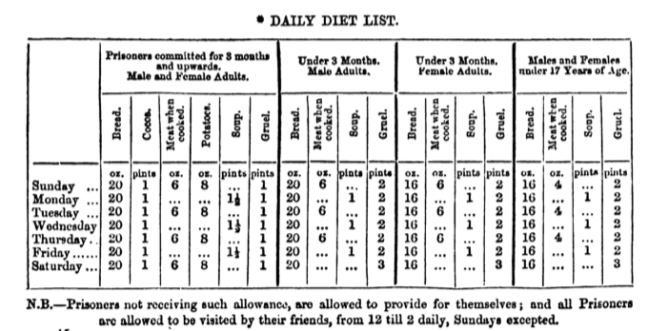
And in that book was everything: not just the image but what kind of prisoner went in what sort of cell, what furniture was in each cell, where the windows were, what sorts of crimes people were in for, and even a menu:

(BTW, I don’t think it’s right that if he’s there for three months he doesn’t get a pint of cocoa, but no one asked me. Or Mr Mayhew.)

So I had the place! And then something serendipitous happened. I was having trouble finding something to watch on the Roku during my exercises when BritBox conked out, so I started watching the film The Guernsey Literary and Potato Peel Pie Society (I have been waiting till it was long enough after reading it to see the movie). There’s a scene in a jazz club, and I’m thinking, that looks like Clerkenwell Prison. But of course I’ve got Clerkenwell Prison on the brain, and so I look it up and what do you know: that’s where it was filmed, in the cellar. You can go there and visit the cellar, which didn’t get destroyed in the Blitz, or even hire it for events.

A newsletter shift

Haven’t heard from me since the beginning of July? You’re not alone.

Before that, I was sending out newsletters twice monthly, on the 1st and 15th. But sometimes things get in the way. So I’ve decided to publish the newsletter once a month, around the middle of the month. Hope this works for you!

Want to read previous newsletters? They’re located here at my website, where you can also find information and buy links to all my books. 

Until next time, keep grousing!