Oh yes, an audiobook

I am delighted to report that yesterday my first audiobook, Bummer at Luna Beach, was released on Spotify and elsewhere. This is my SoCal eco-cozy beach mystery, the first featuring silver sleuth Rosie McMahon.

Audacity logoI recorded the audio myself, for several reasons. First, the writing adventure has cost me far more than I have earned doing it, and I refuse to use AI. Also, I really enjoy audiobooks read by the author, so why not me?

For those interested in the technology, I used Audacity, which is wonderful and free, for recording.

The microphone was worth ordering. It was a Tonor USB microphone, about $35.

My “studio” was a table with the computer, padded all around with blankets. While recording, I put a quilt over my head to block sound and prevent echo. I put foam around the microphone to prevent sibilance. (Decades ago, my first job in the theatre was sound board operator, so I enjoy this stuff.)

my recording studio

Between the scenes, I wanted a sound. At first I found some recorded seagulls at freesound, and contacted the person who created it for permission. But after the first two chapters, I found the sound squeaky and annoying. So I played a few notes on the piano into my phone, and used that instead.

Audacity let me smooth out the sound for even volume, using the Normalize feature. I was also able to edit out some unexpected noises, though it’s possible there’s a cuckoo clock in there somewhere!

Findaway Voices was my choice for distribution, although I did consider others. As it happened, Findaway Voices sunsetted on the same day of my release, and became Voices by INaudio. To get my audiobook on Spotify, which had been a distribution outlet for Findaway, I just had to click a permission.

Audible, although an option, wanted 7 years of distribution even in the non-exclusive contract. So for now, the book isn’t on ACX.

Spotify gives you free promo cards, which is nice but I can’t say I’m impressed by the design. I might jazz it up in Canva.

Wonderfully, however, the audiobook is already in libraries because of Overdrive. I am ridiculously pleased to see it listed at the Beverly Hills Library, where I once spent an afternoon writing.

Is it a super-smooth, professional, glitzy recording with a famous actor doing the narration? No. But I think it’s pretty good anyway.


Truth in fiction and the Brabant Court stairway

Like many authors, I enjoy visiting the sites used in my novels. London is a very big place, and its lesser known areas hold hidden treasure for the novelist.

Brabant Court is one of these treasures. It’s off Philpot Lane in The City, that legally defined section managed separately from the rest of London. It has its own government and its own police force, in the 1860s and now.

City of London shown on map

The City Police in the 1860s were required to live within The City rather than commute. Thus my protagonist, Sergeant Cuthbert Slaughter, has to live there, and I needed an inexpensive but comfortable flat for him and his lovely wife Ellie.*

I selected Brabant Court because, like many of the other sites I choose, it still exists in about the same form as during the Victorian era. Since I was writing in America at the time, I used Google Street View to explore it. Brabant Court is, as the name suggests, a courtyard accessed through a small carriageway, and throughout its history has featured both residential flats and businesses. I researched who owned what buildings, and what class of people occupied the site.

Several scenes of my Work in Progress take place in the Slaughters’ flat, which I situated overlooking the courtyard. Factually, a wine business was located at ground level in the court, so I added that to the story and had Ellie interact with them, and deal with what must have been the most awful smells.

In May I had the opportunity to physically go there. Murder at the Gasworks takes place at the City of London Gaslight and Coke Company, which is next to the river. I was exploring the City to see all the sites I feature so far in the novel. The carriageway was there, the court exactly as I imagined. The building actually faced Philpot Lane, and the nameplate said PFA Business School on that side. But I didn’t care about that side. The courtyard was the heart of my setting.

But as I stood in the courtyard looking up at the place where the Slaughters would live, I saw a horrible thing.

Not a monster, not an egregious assault on Victorian architecture, but a stairway. Through the windows. Instead of rooms with windows looking out on the courtyard, the stairway was on the courtyard side. The flats would have faced Philpot Lane in that building, as the business does now, not the courtyard.

Brabant Court building Brabant Court window
This was the building I’ve imagined for the Slaughters to live in. (Behind it, unfortunately, is the newest monstrosity, Skygarden). It’s hard to see because of the glare, but it’s a stairway to the flats behind the courtyard window.

So all my scenes with Ellie Slaughter looking out the window into the courtyard are factually, historically, WRONG. I corroborated this with a photo I found at the London Archive website of, yes, that exact stairwell.

Brabant Court stairs


As with most historically inaccurate things I find, others will say, “So what? No one will know. No one will care. It’s fiction!”

I know. I care. But I like what I’ve done with the courtyard in the novel. So the big question is: can I live with it? Or maybe: should I change it? I have a strong feeling I’ll be turning some things around, physically at least.


*If you are a fan of the Tommy Jones mysteries, you may be surprised at Slaughter being a sergeant and the couple being relatively down at heel. That’s because it’s a prequel to Murder at Old St. Thomas’s.

The unkilling of Mr Mortimer

What I wanted was a fight between two of my characters: Gareth (a gasworks stoker) and Mr Mortimer (the manager of the gasworks).

First (as always), the setting.

Thames River

It is the summer of 1860. The City of London Gaslight and Coke Company is on the north shore of the Thames River, next to Blackfriars Bridge. The gasworks supplies the City (London’s financial Square Mile) with gas for homes and businesses.

Gas is created by burning coal in large retorts. Stokers shovel the coal in. It’s a tough job, so Gareth is a big guy. It’s not a terribly skilled job, so Gareth is not a well-educated man. Mr Mortimer is a manager, so he’s got what we’d call a grade school education: he can read and do enough numbers to keep an eye on the company’s bookkeeper.

The by-products of gas production include chemicals like ammonia, coal tar, and coke. Ammonia could often be sold to farmers, since it supplies nitrogen. Coal tar is sticky and disgusting, although it has some folk use for skin conditions (until recently it was the prime ingredient in dandruff shampoo). Coke could be used to provide cleaner fuel than coal for household use, and cider ash was sold to brick makers. But none of these markets is enough to take up all the waste. There is always more than can be disposed of.

Dumping these by-products is common, despite laws passed to prevent it. In a way, dumping toxic waste into the Thames was a time-honored tradition. The river received runoff rain water from the filthy streets, untreated animal and human waste, and industrial waste products such as dye for cloth, tannin for leather, turpentine, and more, and had done since Roman times. The Thames is a tidal river, limiting its “flush it out to sea” capability.

Gareth and Mr Mortimer are engaged in illegally dumping the by-products of gas production into the river. It would obviously be best to do this under the cover of darkness, and as the tide was lowering.

Unfortunately, Thames tide records of the granularity I need didn’t start till 1870, so I have to use that year. In July, low tides are around 4am and 4pm. High tides are around 10am and 10pm. Since the sun doesn’t set until after 8:30pm that time of year, the two men only have a few hours after it gets dark before the tide turns. These tides in particular would be very high and very low, because it was a full moon the day before. There had been a solar eclipse.

Knowing that 1860 featured high levels of tide variance due to storms, and that the summer of 1860 was one of the coldest and wettest on record, the scene takes place in nasty, drizzling rain.

So they start a fight. Gareth is mad because a detective has been questioning his girl, thinking he is a murderer. Mr Mortimer is mad because he believes his wife has left him rather than just visiting her mother, and he’s sick of dumb oafs like Gareth. But Gareth is bigger, and even after he slips in the mud with Mr Mortimer pummeling him, he manages a full-on punch to Mr Mortimer’s jaw.

Mortimer is still, lying in the mud. He doesn’t move.

Oh no, oh no, I’ve killed him (this is both me and Gareth together – I am as surprised as he is). That would complicate the story, and not in a good way. Gareth’s been a good guy, friend of the victim. What would he do next? Dump Mortimer’s body in the river? Be a good man and notify the police? Claim it was an accident? Go home, leaving the body in the mud for someone else to find? Is he a murderer after all? Any of these would take the story in a whole other direction, a way I don’t want it to go.

I must revive him! Get up, Mr Mortimer. Gareth gives him a kick in the ribs. “Get up, you bastard!” And slowly Morrison turns on his hands and knees in the mud, and Gareth helps the poor sod to his feet.

Thus it was that I killed Mr Mortimer on accident and saved him, on a rainy night during high tide in 1860 London.

Could you see the eclipse?

On July 18, 1860, there was a total solar eclipse. It was the first eclipse to be photographed, by British astronomer Warren de la Rue, in Spain. (Being Victorian, he wrote a whole book about it.)

De la Rue's photo of the eclipse

I am writing a scene of bonding between two characters: the 10-year-old Tommy Jones and recently fired Sergeant Slaughter. Tommy is interested in all sorts of things, and the eclipse has caught his fancy. He has forced Slaughter to explain it many times before it happens. And now the day is here.

Because I am the author, the scene must be set with historical accuracy. We are in the City, in London. Checking the calendar, July 18 is a Wednesday, so most people are at work and the area would be fairly busy.

So would Tommy be able to see the eclipse at all in the UK? The newspapers report that all the European astronomers went to Spain to view it. In America they went to Oregon, Washington, and Alaska (apparently Secretary of State William Seward’s first trip to the place he would later make part of the U.S.).

What was its trajectory? Here’s a graphic by Fred Espenak of EclipseWise:

I am not an astronomer. How far away is that from London, in big sky terms? Harpers Weekly’s anticipatory map (Saturday, June 14) makes it look like it might be visible.

I go looking for latitude. London is 51.51 N. The eclipse at its height (about 2:30pm London time) was at 52.28 N. Is that close? Is it not? What would the partial look like from there?

Then there’s the weather. I know from here and many eyewitness reports that the summer of 1860 was one of the UK’s coldest and wettest on record. What if it was clouded over or raining and Tommy couldn’t see anything? Unfortunately, the Met Office didn’t keep daily records until September of that year. So that’s no help.

Often in desperation I turn to the Illustrated London News, a publication so fine I’ve had one of my characters work there. And there were all the answers. It reported this in its July 21 edition:

And pictures! They drew diagrams of how it looked from London.

Why didn’t I start my search here? Good heavens. Now I can write the scene.

Blogging and looking backward

Jim Groom, edtech guru, has been conducting interviews about writing at ReclaimTV. Many of the guests have been blogging for decades, and are very familiar to me from my years teaching at a distance, such as Bryan Alexander and Audrey Watters.

One of the most interesting interviews was Kate Bowles, who hasn’t blogged for years but influenced all of us when she did and now posts on Mastadon. In a broad ranging conversation, she discussed her own public writing, including her efforts to get back into it.  She and Jim talked about how things have changed, the conversations that no longer take place on blogs, the echo chambers created by closed communities, and what survives with the prevalence of AI.

Jim Groom and Kate Bowles


I am late to the term “fediverse”, and the more I learn about this idea of global, open, interconnected and independent sharing, the more it sounds like the World Wide Web when it was the Wild West. I wrote about that open web, and worried about losing it, in 2011 and 2012. Free, open, share — these are words from the late 1990s and early 2000s, when I became an online educator and participant.

Historians, of course, look backward all the time. The web became closed in the same way as the American frontier, through privileging commercialism and private gain. As we talk about writing publicly, we tend to want to go back to when blogging was long-form communication with call-and-response, a way to thoroughly hash through various subjects by learning about various viewponts, and writing about them. We groan about how this world has been taken over by places that are either closed (Discord) or plagued with bad actors and focused on selling things (Facebook, Instagram, X).

Taking a broader cultural perspective on the present, above and beyond the complaints of writers themselves, doesn’t help. We see long-form writing in general going out of fashion (just ask those of us who write and try to sell our novels), AI normalizing bad bland prose, and a strong desire for less junk and more meaning.

Perhaps it is best to celebrate the fact that intellectual and poetic writing is vintage. Many of the objects I value, such as record albums and landline phones, were once popular forms but are now niche. Blogging, and indeed long-form writing in general, may occupy such a place historically. We mourn this and rage, because without long-form writing it is impossible to posit a convincing argument, present evidence of an outlandish thesis, or tell a full and meaningful story.

It doesn’t really matter where we do it, and if the fediverse* is the place for it, I’m in.


(*NB: for the record, I think that term is awful – I much prefer open web)

WTF at the British Library

City of London gasworks etching
Current research interest: City of London Gasworks in 1860, shown here in, 1876.

I had an afternoon in London free, and my British Library Readers Card had expired last year. The common historian’s desire for a few hours of research, similar to the coffee drinkers desire for a latte, put me on a bus to the Library.

I hadn’t been there since 2021. My first card was issued in 2018. Back then, getting a Readers Card was a serious matter. To get my first, and its renewal, I was told to bring a letter signed by my dean, saying I was employed permanently at the college, teaching history.

What I had instead was a letter from Human Resources verifying that I was employed in the year I had requested the letter. I had to declare exactly what I had come to the library to research (at the time I was seeking out H. G. Wells’ science teaching writings). My photo was taken, and I was taught all about how to carefully handle historical documents: gloves, wedges to hold the book so there’s no strain on the spine, etc.

This time, I entered the registration office with even more trepidation. I am now retired, so I have no letter. And, would they consider looking up newspaper articles on the City Gasworks for my new mystery novel a sufficient need to use their resources? Perhaps my expired Readers Card would help

But the whole process has changed. A big sign announces that anyone can get a Readers Card, you just needed to bring identification with your address on it. The queue was notably longer, and I was taken aback by having to search for ID with my address before getting in the queue.

I didn’t want to be a snob (I’m all for the democratization of information), but I did ask the registrar if there had been any trouble with newbies not following the careful book rules? He said no, the trouble was that the reading rooms, restricted to those with Reader Cards, were now filled with students wanting study space. There hasn’t even been any additional burden on the librarians fetching materials, since there has been no increase in actual research requests.

I saw this for myself as I went upstairs with my shiny new card to the newsroom. The entire entry area, previously full of tables to look things up or lay them out, was full of students working on their laptops. It was like a day camp. I practically had to step over them to get to the  newsroom.

Once there, things got even more weird. There were only a few people in the room, most on the microfilm machines. The only sound was the whirring of the uptake wheels. I walked the entire room unable to find a single computer terminal where I could search the collection. Computers against the walls were unplugged with their cords tied up.

So I asked if they had a computer where I could look up what I wanted. Well, no, actually. Not in the entire library? No, because of the data breach. Apparently this breach happened over 18 months ago, but they hadn’t sorted it out and so no terminals were provided for searching. Later I saw this on their website, still there as of today:

notice of cyber breach

I asked how I was supposed to find articles I  might want to look at? You have to use your own device, your phone or tablet.

I have a cell phone. It’s very small. I was, at least, carrying my tiny foldable keyboard. I sat down and got onto the site, into the British Newspaper Archive. It’s the subscription to this entity that allows Readers to access these archives with unlimited searches. That can only be done from the British Library premises.

Search term: City Gasworks (later revised to City Gas-Works, which worked better).
Dates: Jan-Dec 1860.
Over a dozen articles appeared with each one linked. I opened one, and a huge broadsheet newspaper page appeared, squeezed into my little phone screen. I zoomed in. And zoomed in. And gradually developed my own technique for scanning for teeny-tiny headlines.

newspaper article
From The City Press 7 January 1860

Oh look! Here’s cool bit on a City Gas-Works inspector, found dead in his bed in January 1860. Apoplexy, the coroner said.  That just means they don’t really know – it’s the default for anything sudden. A murder, perhaps? I need a print out. The printer is sitting right next to me. Then I notice its cord is also wound up.

Back at the desk. Hi, I found something, how do I print? Um, you don’t. I almost said along with him, “not since the data breach”. The poor man was trying to be helpful, was appalled himself that this was the state of things, even offered to email me a page if I gave him the info.

Then he showed me on his tablet that I could try to download the page, but my phone didn’t have a link to do that until I used “Desktop view”. That was a very small link, pretty much a quarter the size of my fingertip. I kept missing it. But at least now I could download. The whole page, not the section. To be perused, and used, later at home.

I have had, as you can see in previous posts, and as detailed fictionally in Before the Time Machine, far more successful visits to the British Library. But now I’m wondering when the next one will be.

A revival

Lisa on busHello there! My Lisahistory blog has focused at various times on the study of history, pedagogy for college classes, educational technology, and more recently my work as a fiction author. Now, as I enter my later years, I am bringing all the threads back together (with links to those yarns I couldn’t weave in). 

Consider my Lisahistory blog revived. Not like Lazarus, or the Phoenix. More like Tabitha, the dead woman in Acts who did so many good works that Peter brought her back to life so she could work even more. 

Having just returned from a visit to England, I am inspired to keep working on my prequel to the Tommy Jones Victorian mysteries. Thus we begin again, with history, mystery, and a lot in between.  Subscription option coming soon!

December @ Grousable Books

Grousable Books Newsletter

December 2024

In this issue: A Boxing Day gift, book and events report, The Man Who Invented Christmas, what I’m reading, and a new possum visitor.

A Boxing Day gift

From December 26 through New Years Eve, Jolie Tunnell’s Advent Calendar features my story Murder Steampunk Style as a free download. All you have to do is sign up for her newsletter (you can cancel later, although I didn’t – it’s one of the few worth reading). I’ve mentioned Jolie before – her Loveda Brown historical mysteries are based in Idyllwild, California. She has more freebies for December, including her own prequel to the series. 

Book report

My literary novel, Before the Time Machine, is a dual-timeline story of H.G. Wells as a young man and a modern historian. The historian character is named Katherine. While she is only partly like me, her story is absorbing, as is her connection with her subject. People see “H.G. Wells” and think science fiction (which he called scientific romances), but mine is a literary novel, part Wells biography, part historical, part magical realism. And in its new cover, it’s particularly appealing in paperback.

Before the Time Machine cover

In other book news, I’m delighted to report that my edited book of Wells’s science education writings was accepted into the collection at Senate House, University of London. Even more than I enjoy people buying my books is having them available in libraries. And this one, dedicated to historical research, will give scholars access to articles that haven’t been republished since the 1890s. 

Event report

The North Park Book Fair in October was the fabulous event it always is, even though I was assigned a half-booth in blazing sun. I even went round fanning people who came in to look. I’d show you a picture of my booth, but I was so busy I forgot to take any! But the fair looked like this:

North Park Book Fair

Book fairs are wonderful places. Unlike a street fair, you don’t have to seek out who might be a reader of books. At a book fair, everyone there either loves to read or is accompanying someone who does. At street fairs, sometimes all people want is an interesting place to bring their dog. 

The Man Who Invented Christmas

No, it’s not a new movie, but I’ve intended to watch it since it came out in 2017. Charles Dickens, as I’ve said before, is a toughie for me. He wrote brilliant novels, but often in installments, so some of them read that way, with a cliffhanger at the end of each chapter. According to Judith Flanders’ The Victorian City, he walked miles each day around London. I’ve also visited his house, mostly to see what they’ve done with poor Catherine Dickens. She was his wife and bore him ten children, then he wanted to have actress Ellen Ternan as his mistress. So he not only abandoned Catherine, but filed charges that she was an unfit mother to avoid admitting his adultery as a cause of divorce. (Read the wonderful book by Lillian Nayder, The Other Dickens: A Life of Catherine Hogarth, the first major work to even consider her, or read this short interview.)

You know that I always try to separate an artist’s work from his/her life. Dickens was a master of narrative. This included not only his stories but his own life and public image. I’m always aware that what he hands out is designed to shape our ideas. But just when I get fed up with him, I recall this image:

Dickens's Dream by Buss

It’s the unfinished “Dickens’s Dream” by Robert W. Buss, 1875, and it shows the late Dickens in his study (based on a famous photograph) surrounded by images of his many characters. Even unfinished, it’s brilliant. Why? Because although he’s perfectly still, it shows his characters as active beings from his mind.

And that’s what I enjoyed about The Man Who Invented Christmas.  It weaves together Dickens’s writing of A Christmas Carol with his own life. The characters come to him, upset at where the story is going. Or they appear to tell him something.  The film shows the writing process better than anything else I’ve seen: the continual interruptions, the moments of inspiration, the writer’s block, the gathering of names and phrases from people he meets or overhears.

The Man Who Invented Christmas poster

Christopher Plummer is Scrooge. Simon Callow (who played the best Dickens ever in Dr Who: The Unquiet Dead) is the illustrator John Leech. And I try not to miss a film with Jonathan Pryce, who plays Charles’s father.

What I’m reading

I just finished Richard Osman’s The Last Devil to Die, the fourth book in his Thursday Murder Club series. The first one is being made into a movie with an all-star cast (Stephen Spielberg is in the picture because production is a combined effort of Netflix and Amblin, Spielberg’s company).

cast of The Thursday Murder Club

The Last Devil to Die was good, although I think the first and second books were better. You can see my review here. 

Now I’m in the middle of Arthur & George, by Julian Barnes, based on real events. I knew before I started that Arthur was Arthur Conan Doyle, the Victorian/Edwardian novelist and inventor of Sherlock Holmes. George, as it turns out, is George Edalji, a Staffordshire solicitor who was tried for animal mutilation crimes that took place in 1903. He served three years in prison, and Sir Arthur became a champion for the case being reviewed. Edalji was acquitted but awarded nothing for the three years lost. As with all Julian Barnes’s writing, the characters are finely drawn — you almost feel like you’re in Doyle’s mind. 

A new possum visitor

It’s hard to tell size in a photo, even more so online, but I’ve named him Pavarotti so that should give you an idea. He’s bigger than most cats.

Pavarotti the Possum

Pavarotti is the one facing the camera, but he also agreed to share food with his daughter, Mickey P. So he’s sweet, and slow, and hungry, and walks with great confidence, marching across the deck like it’s a stage. But he always leaves some food behind for the others. 

And more!

Want to read previous newsletters? They’re located here at my website, where you can also find information and buy links to all my books. 

Until next time, keep grousing!

October @ Grousable Books

Grousable Books Newsletter

October 2024

In this issue: An overview of my books, independent Victorian women, the right to vote, Kate Morton, and the North Park Book Fair.

Book overview

I’d like to welcome those new to the newsletter, many of whom will have read my short story, “The Dancing Colonel”. You may not know my books, so here’s an overview. I’ve published:

The Tommy Jones Mysteries – a trilogy of three novels, all set in Victorian England and with characters that cross over among the books. The first, Murder at Old St. Thomas’s, is a medical mystery. The second, Murder at an Exhibition, is an art mystery (some characters are in “The Dancing Colonel”), and the third, Murder on the Pneumatic Railway, is a technology mystery. They are chronologically in that order, but can be read in any order since none are dependent on the others.

book covers

(And I apologize, readers, that the prequel to these, Murder at the Gasworks, has been delayed by life circumstances, and may take another year to finish.)

My contemporary humorous beach mystery, Bummer at Luna Beach, was released last year. It features a 72-year-old amateur sleuth and her journalist sidekick, and is sent in a fictional California beach town.

I also have a romantic mystery: A Heart Purloined. It’s a rivals-to-lovers tale, Victorian-set and quite clean. No gratuitous anything, just likeable characters and quite a bit of humor.

My literary novel, Before the Time Machine, is a dual-timeline story of H.G. Wells as a young man and a modern historian.

Last is my professional work as a historian, a collection of H.G. Wells’s writings on science teaching. They’re actually quite readable, and I did the editing and annotations for all of the pieces.

A new history book

Writing novels or not, I am still a historian. A new book will be published in November that looks really good.

Deserted Wives and Economic Divorce in 19th-Century England and Wales: For Wives Alone, is written by historians Jennifer Aston and Olive Anderson.

Sort of. Olive Anderson died in 2016, leaving behind piles of research on a little-studied provision of the Marriage Act of 1857.

Section 21 provided that if a woman’s husband deserted her and didn’t provide support, a court could pronounce that woman a “femme sole”. This meant she was completely in charge of all the property that had been left behind, including bank accounts, the house, and all his belongings. Her own property would also belong to her, instead of the legal assumption that it was her husband’s.

Deserted Wives and Economic Divorce book cover

Aston got permission from Anderson’s daughter to use her research and create the book.

This kind of work is crucial to anyone studying the Victorian Era. For years Section 21, and the court cases filed under it, have been pretty much ignored. It’s tempting to see deserted women as merely victims. And yet quite a few were allowed to economically operate independently. I’ll know how many when I read the book.

As readers of this newsletter will be aware, I am always suspicious of absolutes. It’s commonly believed that Victorian women had no control over their property, and indeed little agency at all. My own research for the Tommy Jones mysteries shows that on the contrary, women of all classes were active participants, agents of change, and ignorers of stupid rules.

Since it’s an academic book, it will cost a lot. But what’s really cool is they’ve made the introduction available to read for free.

The right to vote

While we’re on the subject of legal rights, it’s voting time!

I know quite a few people who don’t intend to vote, which chokes me. We think of voting as a right, but in many ways it’s a privilege to live in a country where we can. Not all adult citizens have been able to vote for much of our history. And whenever people bring up the issue of women getting the vote in the U.S, there are always some myths to dispel.

First is that women’s suffrage emerged shortly before World War I with suffrage marches. Not so. In an informal sense, one could consider the smuggling of goods in the 17th century, and the boycotts on English tea in the 18th, a sort of voting. But in a literal sense, the formal women’s suffrage movement in America dates from 1848, the Seneca Falls convention.

Seneca Falls meeting 1848

The second myth is that the right to vote was granted to women in 1919. Quite a few states, primarily in the western U.S., already had women voters. What changed in 1919 was the right for women to vote for President. While that’s very important, of course, many women had been voting for local and state offices, and had held such offices themselves, for some time. 

Third is that American men always had the right to vote. Enslaved men didn’t, obviously. But even free men were often not eligible if they didn’t own property. It took the Revolutionary War for states to discuss universal male suffrage. 

And, the male franchise didn’t expand just to increase democracy. Read about the why here.

Anyway, be sure to vote. Lots of people fought so you could.

What I’m reading

Last month I told you I’m reading a book by Kate Atkinson, and this month it’s Kate Morton, so one would think I have a preference for authors named Kate!

Kate Morton is known for novels with multiple timelines and familial threads, and her writing style is almost unnoticeable since you get sucked into the story so fast. Secrets are her stock in trade, and in The Forgotten Garden there are mysteries.

Why was a four-year old girl found abandoned after getting off a ship from England to Australia? What secrets are held by a woman who lived in Australia her whole life even though she didn’t want to? And what will her granddaughter find when digging up the past?

Kate Morton books

It’s easy to feel like all of Morton’s books are one giant story even though they’re not. But I literally have to read something else in between reading her books. By that time, I’ve forgotten the previous book and can dive in anew. My favorite so far is The Lake House.

One upcoming event is . . . happening!

Despite getting turned down when I first applied, I have now been invited to the North Park Book Fair. I couldn’t be happier!

North Park Book Fair logo

So if you’re near San Diego, be sure to come. It’s all about books, not like an ordinary street fair, and North Park is a wonderful community in which to dine and shop. And yes, I’ll be in costume! And yes, you can bring your dog! (I have noticed that dogs enjoy a good book.)

And more!

Want to read previous newsletters? They’re located here at my website, where you can also find information and buy links to all my books. 

Until next time, keep grousing!

September @ Grousable Books

Grousable Books Newsletter

In this issue: Birthday wishes for Mr Wells, free mystery books, what I’m reading, upcoming events cancelled, a bit of publicity.

Happy birthday, H.G. Wells

Today, September 21, marks H.G. Wells’ birthday and as you know, I’m a fan. I know that’s not popular these days, but it’s true!

Did you know that although Wells is known for his futuristic work (and has even been credited with creating science fiction as a genre), he began his career writing articles on science? He was training to be a science teacher long before he wrote The Time Machine. 

Young H.G. Wells

I’ve been researching Wells for a number of years, and I often had to hunt down his articles on science teaching in various libraries and journals. So I thought I’d collect them myself, and the result is H.G. Wells on Science Education, 1886-1897. It’s part of an academic library promotion at the moment — that was always my intention, to get it in academic libraries. That way, other scholars wouldn’t have to spend the time trying to find them all.

My most literary book, Before the Time Machine, is also based on Wells.  It’s a novel about a historian with a secret. She researches H.G. Wells. The story of Wells as a young man (I’m a Victorianist, remember — he was born in 1866) is interspersed with her research trips. The two protagonists form an interesting bond, a woman out of time and a man ahead of his.

Looking for a free mystery or two?

Mystery Birthday Club banner

Get the party started! Check out the Mystery Birthday Club for some great reading fare (and yes, one of my stories is there too).

What I’m reading

I’m a recent fan of Kate Atkinson, and I just finished Started Early, Took My Dog. Jackson Brodie, Atkinson’s detective, is there but isn’t the main character. The central protagonist is Tracy, a retired police officer who makes an unexpected purchase that changes her life. I had never read any of the Jackson Brodie novels, and this was apparently the fourth, but it didn’t matter at all. I need to go back and start with Case Histories.

Started Early, Took My Dog cover

I think with authors like Kate Atkinson (and my other favorites like Rachel Cusk and Julian Barnes), you have to trust them to take you on the literary journey. There must be no second-guessing or frustration because the story isn’t clear at first or doesn’t seem to fit a known pattern. I have found trusting such authors to be a very rewarding pastime.

Ian McEwan is another trustworthy author. I also recently finished Amsterdam, the result of a used bookstore haul. It was a snarky tale of a composer struggling to finish a work, and his old friend, editor of a magazine. The story rotates around the deceased Molly, a lover they had in common. Although reviews talk a lot about it being a morality tale, I didn’t find it at all dull. McEwan writes beautifully, and the characters were interesting in their self-centeredness and the ways they justified what they did. 

Upcoming events are . . . cancelled.

Despite well-laid plans . . . well, you know how the saying goes. If you’re looking for me, I’ll be harder to find this fall.

I enthusiastically applied to the North Park Book Fair in San Diego, where I did well last year. Their reply to my application said they didn’t have room for me, and were emphasizing those who hadn’t had a table there before. And yet I have author friends I met there last year who got a table. There’s just no telling sometimes!

I also won’t be selling at the Olivenhain Craft Fair after all. But it’s still a good fair and if you’re in the area, do stop by. I’ll be the one lurking suspiciously around the homemade pastry booth.

A bit of publicity

A Warm Mug of Cozy has done a page featuring me, so I thought I’d share. 

The story I wrote for this anthology, “No Good Deed”, is a Rosie MacMahon story. If you don’t know Rosie, she’s my newest detective, a 70-something southern California woman with a mysterious past and a penchant for solving mysteries. Think Jessica Fletcher but the other coast. 

Bummer at Luna Beach colorful ad

She and her journalist friend Lou are featured in Bummer at Luna Beach, released earlier this year.

And more!

Want to read previous newsletters? They’re located here at my website, where you can also find information and buy links to all my books. 

Until next time, keep grousing!

August 15 @ Grousable Books

Grousable Books Newsletter

In this issue: Upcoming events, mystery research, and a newsletter shift. 

Upcoming events

My books and I will be at two events this fall:

On October 26 the North Park Book Fair happens in San Diego. I love this one. North Park is a wonderfully mixed neighborhood blessed with many different types of people, and a lot of them read. It was my most successful sale last year.

North Park Book Fair 2023

This year, I am pleased to announce a collaboration with DMD Designs. David Daymude makes, among other fine wood art, distinctive pens that delight writers. The display should be beautiful!

Then on November 9, we’ll again be together at the Olivenhain Arts and Crafts Fair in Encinitas, California. This event features handmade everything, from food to quilts to jewelry. Everything has to be made by the person in the booth, so I consider that independently published books qualify. 10% of vendor proceeds go to help preserve the 19th century Olivenhain Town Meeting Hall.

Mystery Research: Where is the Clerkenwell House of Detention?

I know, you’ve been asking yourself this question! But sometimes authoring means a bit of detection about something others would find not only trivial but downright irrelevant.

For Murder on the Pneumatic Railway, I wanted Samson Light held in prison awaiting trial while his protégé Tommy Jones runs around London trying to clear him of the charge of murder. Having already set the first mystery in Southwark, and the second around Holborn, I was cruising around Clerkenwell because I wanted to get a little more East End-ish but not go all out Dickensonian. On a side note, in the late 19th century Clerkenwell was known for clock-making. Here’s a sample:

Gorgeous, huh?

I knew the infamous Coldbath Fields prison was in the area, because I have a previous character in prison there for debt, but I was seeking not a prison but a gaol, a place where they hold people until they go to trial.( I’ve seen too many Father Brown episodes to want my character rescued after he’s been convicted — it’s way too complicated.) And there seemed to be one in the area, but it took a lot of searching to get it all separated from Coldbath Fields and the other prison buildings that had been on the same property before. As one website tried to explain it:

Clerkenwell (old) Prison, also known as the Clerkenwell House of Detention or Middlesex House of Detention was a prison in Clerkenwell, London, opened in 1847. It held prisoners awaiting trial. It stood on Bowling Green Lane conveniently close to the Middlesex Sessions House, where prisoners would be tried, on Clerkenwell Green to the south.

Well that helped with location, anyway. Then it goes on:

The House of Detention was built on the site of two earlier prisons, the Clerkenwell Bridewell for convicted prisoners and the New Prison for those awaiting trial. The Bridewell closed in 1794 and its functions were taken over by the Coldbath Fields Prison at Mount Pleasant. The New Prison was rebuilt in 1818 and in 1847, at which time its name changed to the House of Detention.

Confused? Me too. Was it the Middlesex House of Corrections? No, I think that’s Coldbath Fields. House of Detention? Why isn’t anyone calling it a gaol (or even a jail)? So Dickens Junior, ever the tour guide, decided to help out, via this page:

House of Detention —affectionately termed by the “profession” the House of Distinction, or more familiarly “the Tench “—is designed primarily for untried prisoners, the discipline being less severe than elsewhere. Prisoners under short sentence of imprisonment without hard labour—technically first-class misdemeanants — are also confined here; being not required to wear any distinctive dress or to have their hair cropped. It stands between Woodbridge-street and Rosoman-street, Clerkenwell. NEAREST Railway Station, Farringdon-street; Omnibus Routes, Exmouth-street and Goswell-road; Cab Rank,Clerkenwell-green.

– Charles Dickens (Jr.), Dickens’s Dictionary of London, 1879

I also came across the floor plan, which made it easier to identify.

One ghost tour also calls it the House of Detention. By this point, I was pretty sure I had the right place. And look! It’s still kind of there, though it’s called Clerkenwell Prison.

The Old Sessions House was the Middlesex Sessions House, where the cases were taken for trial, so that helped too.

I even found some engineering information. (And this, friends, is why I abandoned studying medieval technology for Victorian England, where there are a fabulous number of sources, all in English and none of them copyrighted.)

This picture kept coming up as I worked, claiming to be visiting hours at Clerkenwell prison, but I was unable to verify that this was the place I wanted.

It looks so nice, all the visitors talking to their friends and loved ones in the door holes. But is this the place? I start looking, as one does, at the Illustrated London News, but no. After doing image search and finding the image on Wikipedia, which does occasionally cite sources, it appears it’s not from the Illustrated London News (or the “Chronicle” as noted on another page), but from Henry Mayhew’s The Criminal Prisons of London, and Scenes of Prison Life (1862). Stupidly, I go looking at Biblio.com and other vendors to buy it ($65!) only to find the whole book, downloadable for free, at Google Books. (Every time I start to yell at Google for being a monstrosity, they do something nice.)

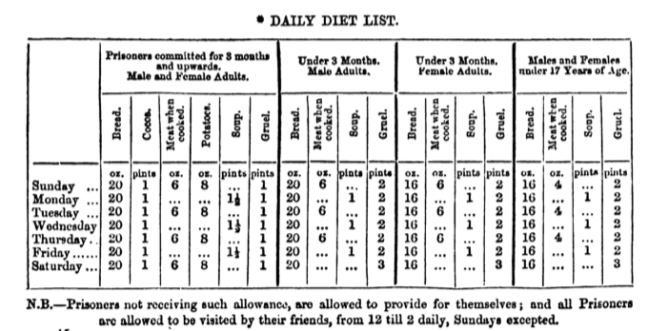
And in that book was everything: not just the image but what kind of prisoner went in what sort of cell, what furniture was in each cell, where the windows were, what sorts of crimes people were in for, and even a menu:

(BTW, I don’t think it’s right that if he’s there for three months he doesn’t get a pint of cocoa, but no one asked me. Or Mr Mayhew.)

So I had the place! And then something serendipitous happened. I was having trouble finding something to watch on the Roku during my exercises when BritBox conked out, so I started watching the film The Guernsey Literary and Potato Peel Pie Society (I have been waiting till it was long enough after reading it to see the movie). There’s a scene in a jazz club, and I’m thinking, that looks like Clerkenwell Prison. But of course I’ve got Clerkenwell Prison on the brain, and so I look it up and what do you know: that’s where it was filmed, in the cellar. You can go there and visit the cellar, which didn’t get destroyed in the Blitz, or even hire it for events.

A newsletter shift

Haven’t heard from me since the beginning of July? You’re not alone.

Before that, I was sending out newsletters twice monthly, on the 1st and 15th. But sometimes things get in the way. So I’ve decided to publish the newsletter once a month, around the middle of the month. Hope this works for you!

Want to read previous newsletters? They’re located here at my website, where you can also find information and buy links to all my books. 

Until next time, keep grousing!


1 July @ Grousable Books: Victorians, Murder by Death, visitors and visits

Grousable Books Newsletter


In this issue: A special promo for fans of the 19th century,  Murder by Death, garden visitors, the Bowl, and the Fair.

It’s true – I’ve actually written two more scenes in Murder at the Gasworks, the Tommy Jones prequel I’ve been stuck on for almost a year. Maybe it’s not writer’s block after all. But I don’t want to talk about it too much or I might jinx it, so later, later. 

Special promo for Regency/Victorian readers

I’ve never seen such a specific book promotion before, but naturally I joined it: the 19th c Historical Fiction BookFunnel promo. Great stuff available!

The 19th century (that’s the 1800s, because there is no year 0) is comprised of the Regency and Victorian eras in the UK. So what’s Regency and what’s Victorian?

Regency and Victorian dress

The Regency era, until recently dominated by the books of Jane Austen, is considered to be 1795-1837. This is true although the actual regency (when George III was mad and his son governed in his place) was only 1811-1820. 

The popularity of the TV show Bridgerton, which is actually fantasy rather than historical fiction of any kind, attests to our interest in the Regency years. Unfortunately, Bridgerton contains little that is factual about the era.

My books, or at least the Tommy Jones Mysteries, are all set after 1850, and Queen Victoria ruled from 1837-1901. The prequel I’m writing begins in 1860.  Murder at Old St. Thomas’s is 1862, Murder at an Exhibition is 1863, and Murder on the Pneumatic Railway is 1865. These would be considered mid-Victorian. My other great interest, the young H. G. Wells, would be late Victorian and Edwardian. Edwardian is a whole other story.

Murder by Death

Mystery movies often contain in-jokes about other mysteries, but none went as far as this one. Famous fictional detectives with only slightly changed names (Sam Diamond, Jessica Marples, Dick and Dora Charleston, etc.) are invited to the haunted-style house of the rich Lionel Twain for a murder. 

Murder by Death movie still

The script is by Neil Simon, and the cast is amazing: David Niven, Maggie Smith, James Coco, Elsa Lanchester, even Alec Guinness as the blind butler. 

Is it dated? Oh, yes. It was made in 1976.  There are cultural stereotypes, set-ups now considered inappropriate, and gag jokes. If you can overlook these, it’s hysterically funny, and a real tribute to all those Agatha Christie style mysteries. Lives are threatened, the detectives are conceited and competitive, and the host is not what he appears. He has dirt on all the detectives, and grievances against them. 

The movie Clue (1985) was practically plagiarized from Murder by Death, so if you liked that, you’ll like this.

Garden visitors

My garden is quite busy in summer, and we’ve had quite a few guests.

Usually there are only one or two rabbits competing with me for the strawberries; this year there are four so far plus a baby bunny. Given their reputation, I have often wondered why only one or two come graze in summer; with two you’d think there’d be more, and this year there are.

Bunnies

In other news, I believe Petunia the possum has a pouchful of joeys again, so I’m looking forward to seeing new babies. Three from her first litter are still hanging around.

But there are also some predators. A hawk landed in the tree by my desk window and ate his lunch on right there on the branch. A coyote has visited during the day lately, jumping the fence and checking out my yard. Drives my cat crazy. 

The grapes haven’t yet ripened so there are no fig beetles or raccoons yet, but I’m sure they’re next!

The Bowl 

It may be unusual to discuss a composer in a writer newsletter, but I went to the opening night at the Hollywood Bowl, and they featured Henry Mancini’s music. I’ve been a fan for a long time, ever since I first saw The Pink Panther on TV as a kid (which, now that I think about it, was a mystery movie). I can hum the tunes to the theme music of Charade, The Great Race, and The Days of Wine and Roses. 

Hollywood Bowl fireworks

How was the concert? A little too lyrical on the playing, I thought. Yes, Moon River and Crazy World sound beautiful with violins, but the themes from Hatari and Peter Gunn need a jazzier, more rhythmic feel. (I will say I thought I was there to hear the L.A. Philharmonic, but instead it was the Hollywood Bowl Orchestra. Apparently the L.A. Phil merely “manages” that orchestra.) And I have no idea what was up with Michael Bublé coming on for only the last two songs. 

The Fair

Last weekend I went to what we all called The Del Mar Fair, now renamed as the San Diego County Fair. I go for one day usually, but I haven’t been for the last few years. The baking and cooking competition foods had been moved from the large Grandstand Building to an Exhibit Hall that is usually full of vendors. I saw few people buying anything. With online shopping, the days of going to the fair and buying a Vitamix machine, aluminum siding, or a massage chair seem to be gone.

This year’s theme was “Let’s Go Retro”, which apparently meant from the 1950s through the 1990s. The exhibit had recreated rooms from the different decades, and I was reminded of my old furniture, computer, and toys. 

Antenna balls exhibit

Do I remember antenna balls? I have one on my car right now! Not everyone has a new antenna-free car, you know. 

And more!

Want to read previous newsletters? They’re located here at my website, where you can also find information and buy links to all my books. You can post comments there too.

Until next time, keep grousing!

AI in assignments

While all professors and teachers must deal with Artificial Intelligence, I have never thought it a good idea to forbid students from using it. I also don’t think it’s a good idea to ignore it.

Whenever a new technological challenge to traditional teaching has arisen, the initial response (usually either enthusiasm or despair) has eventually quieted down to a norm. The question is how to accomplish this with AI.

AI illustration
Photo by Steve Johnson on Unsplash

First, we must be clear what AI actually is. It’s been in use for years, but I’ll just give one example: spell checking. At first, some were aghast at spell checking. How would students ever learn how to spell? A decade later, profs were insisting that all papers be spell-checked before being submitted. Grammar checkers weren’t far behind. Professors were tired of reading/correcting/mourning spelling problems, since their job was to focus on content.

Now the content itself is being created by computers — it’s generative AI. But instead of producing better content, it’s sometimes worse. Human error, as with all errors, are magnified. (Remember the old meme “to err is human — to really mess things up requires a computer”?) And it’s impossible to tell what a student is learning about the subject when they didn’t write the paper, so how do we grade work?

Why do we use AI?

At the most basic level, student use of AI for written assignments is plagiarism, with all the problems that entails. It is harder to tell whether a student has used AI, since unlike the old practice of lifting passages that were better written than a student could manage, the content comes out with errors and problems. We just don’t know who made them.

Students use AI for the same reasons they plagiarize generally: laziness, perceived lack of time, lack of confidence in their own understanding, lack of English skills. All of these are affective disorders, and all of them have causes often related to previous academic experience.

Of course, professors also plagiarize, or at the very least may rely on test banks, textbooks, and other resources not created by them. They do this for similar reasons: laziness, perceived lack of time, lack of confidence in their own understanding, and lack of English skills.

Changing the focus from product (the paper, assignment, or post) to process might help.

Maps
Photo by Andrew Neel on Unsplash

An example

I give an assignment asking students to use primary sources to construct their own historical argument in a short paper. I am aware that they may work with friends, buy a paper online, or use AI. The latter has become most common so the question is how to work with that process rather than against it.

(You’ll notice the assignment is designed to make students choose their topic. I don’t ask a question that can be typed into Google. And they have to use sources from the class, not just anything they find online. I don’t use “prompts”, but we practice the thesis/evidence thing a lot in class, and I model it.)

After crafting the assignment to minimize boilerplate responses, one could assume students will use AI. Instead of punishment, and spending hours trying to use AI to figure out whether the student has used AI, one could require documentation.

Instructions could go like this:

Write a three-page paper on what three of the assigned historical documents have in common, creating a historical thesis that’s proven with those documents. You are welcome to use AI at any stage, documenting your work by creating footnotes. These footnotes must contain which AI generator was used and list all search term/phrase/question efforts in order.

For example:

President Abraham Lincoln developed the Emancipation Proclamation in an effort to cause slave rebellion in the Confederacy.3

3. ChatGPT: Emancipation Proclamation, Emancipation Proclamation and slavery, Why did Lincoln write the Emancipation Proclamation?, Was Lincoln trying to cause slave rebellion with the Emancipation Proclamation?, Lincoln and Emancipation Proclamation, Emancipation Proclamation goals.

Skill sets

Those of us who mourn the loss of the card catalog and shelf browsing are aware that one cannot really browse anymore. Search is the new browse. Search terms are crucial; knowing which ones to use is an important skill for finding information. You can’t find the answers without asking the generative AI program the right questions.

Documenting process is meta. The student becomes more aware of how they’re searching. If we agree in class that AI is sometimes wrong, those who care may even fact check what AI tells them. Since what’s important to me is the skill in developing a thesis/evidence argument, I can then grade the product as I did before, on accuracy and writing and fulfilling the assignment (or whatever is on my rubric).

Is AI a horrible thing?

Sure it is. The magnification and popularization of inaccuracies, the pressure to work “smarter” and more superficially, the lack of deep thought and analysis — all of these are horrible.  When society values these things, a teacher can focus on ways of training the mind to counter them, rather than opposing them directly.

That’s natural intelligence in action.


June 15 @ Grousable Books: a nutty musical number, Andrea Kress, The Lady Vanishes, and more

Grousable Books Newsletter

View on the web

In this issue: A nutty musical number, Andrea Kress, The Lady Vanishes, from pantser to plotter, and Thomas Jefferson cukes.

I Think I’d Better Think it Out Again

Yes, it’s the song that Fagin sings in the musical Oliver! But I changed the lyrics to reflect my frustration with the marketing aspects of my career as a writer.

So if you want to see, and hear, something pretty nutty: 

Or watch on YouTube here

No applause, please. I know, I’m no singer. But it had to be done.

Author of the month: Andrea Kress

This month my author focus is on Andrea Kress, who writes historical cozies. This is the first of the Berkshires Cozy Mystery series, set in the 1930s. 

Murder at Highfields cover

In Murder at Highfield, nurse Aggie Burnside leaves New York to join a friend who lives in the Berkshire Mountains. She’s drawn into a case where a judge is murdered, and supplants the bumbling police inspector in solving the mystery. Take a look!

Mystery Movie: The Lady Vanishes

The Lady Vanishes (1938), with Margaret Lockwood and Michael Redgrave, opens with a miniature train set, then takes you live into the hotel where a number of people are stuck overnight due to an avalanche. This way all the main characters (the two British men traveling together, the wealthily afianced young woman, the illicit couple, the roguish scholar, the dottering old lady) are introduced.

Still from The Lady Vanishes
The brain patient, the nun (Estelle Winwood), and the couple trying to solve the mystery of the vanished lady.

Dame May Whitty’s character (the dottering old lady) is on the train and disappears, but the afianced young woman (Margaret Lockwood) is the only one who admits to having seen her. The roguish scholar (Redgrave) helps her as a lark.

This was the film that got Alfred Hitchcock appreciated, and it contains a number of his signature tropes: playful sexuality, humor, an enemies to lovers relationship, one person believing what others don’t, shadowy hints of foreboding, random murder, and imminent dangers to characters one has come to like. There’s also a head injury that makes the main character question what she sees. Even the chugging of the steam train seems to go from reassuring to sinister. …. And yes, the fact that it’s made in 1938 does play a role in the story.  

From pantser to plotter

There’s an old saying that writers are either plotters, carefully planning out and outlining their book before they write, or pantsers, those who write “by the seat of their pants” without a plan. Most, of course, do a bit of both. 

Having done years of historical research and lecture outlines where I had to be a plotter, I was so happy to be a pantser as a novelist. And yet…

pants

If you follow my newsletter you might get the feeling I’m stuck on the prequel to the Tommy Jones Mysteries. It’s not “writer’s block” but I’ll admit I’m in a bind. I set the Murder at the Gasworks aside to do other things, including publish my cozy Bummer at Luna Beach. And when I came back to my draft, I realized I’d literally lost the thread. I think I know who done it and why (which is a first for me!), but I’m at the half-way point and don’t know what comes next.

Taking a look again, writing summaries of all the scenes, what jumped out at me were the “doubles”. Two bodies, two detectives, two women working to help, two gasworks, and one boy: Tommy Jones. Perhaps this larger idea might get me back on track!

Thomas Jefferson cukes

I’ve tried and tried to grow cucumbers, but we get a lot of gray, overcast, semi-coastal days and they don’t do well. I’ve tried different locations and different cultivars: Japanese, gherkin, lemon, English, burpless.

But last year I was given a packet straight from Monticello of Long Green Improved Cucumber (Cucumis sativus).

cucumber plant

I love Thomas Jefferson. I do. I’ve read, in additional to his political writings, his garden notebook and his love letters. Yes, I know the Louisiana Purchase was an abuse of presidential power, but I wrote a paper in college on his Embargo of 1807 and I think it did great things for American industry. He walked up Pennsylvania Avenue to get inaugurated instead of taking a carriage. I’m a fan.

Now I confess that these particular cucumbers were not grown by Jefferson. The cultivar wasn’t around until the mid-nineteenth century. But they come jumping out of the potting soil, every single blessed seed, and grow and grow. The cucumbers are delicious. The fact that they’re somehow connected to TJ’s favorite place to be just makes them better.

And more!

Want to read previous newsletters? They’re located here at my website, where you can also find information and buy links to all my books. You can post comments there too.

Until next time, keep grousing!

June 1st @ Grousable Books: 20% off, Ellery Queen, SS Great Eastern

Grousable Books Newsletter


In this issue: 20% off all my books, Ellery Queen, A Warm Mug of Cozy, June author event cancelled, and the SS Great Eastern.

Subscriber special!

Starting today and continuing for a fortnight, readers can save 20% on all my books by ordering direct at Grousable Bookshop. Use the code NEWS20. You can even get an autographed copy if you’re in the U.S.

my books

But shhhhh, for now it’s just for newsletter subscribers.

Ellery Queen

I was watching a mystery show the other day: Death in Paradise. They usually have four suspects, but this time only had two, and the murderer was one of them. I still couldn’t figure it out.

When I can’t figure it out, I always hear Truman Capote saying to the roomful of detectives in Murder by Death (1976): 

You’ve tricked and fooled your readers for years. You’ve tortured us all with surprise endings that made no sense. You’ve introduced characters in the last five pages that were never in the book before. You’ve withheld clues and information that made it impossible for us to guess who did it.

And it was one of those. The vital clue was at the very end. (More on Murder by Death another time!)

I miss the tv show Ellery Queen.

At the end, Jim Hutton as Ellery would turn to the camera and ask whether you, the audience, had figured it out. He’d remind you of all the clues, and then there’d be a commercial for you to think/discuss at home and come to your conclusion. After the commercial, Ellery would tell you (and the other characters) the answer.

Jim Hutton and David Wayne on Ellery Queen tv show

And yes, that’s David Wayne (whom I’ll always see in my mind playing the song Farewell, Amanda in the Tracy-Hepburn classic film Adam’s Rib) playing his dad.

My short story was accepted!

“No Good Deed”, a story featuring as Rosie and Lou from Bummer at Luna Beach, was accepted for the A Warm Mug of Cozy second anthology of cozy mystery stories. It’s a detective story. I can’t call Rosie and Lou detectives, though, since they’re amateurs and police detective Rory Gallardo is totally involved.

This is a major distinction in mysteries: is it “amateur sleuth” or “police detective”? Sherlock Holmes, arguably, was neither, so he seems to come under the moniker “private investigator” (which these days sounds pretty noir). Sticking to one of these categories is expected. 

Tom Barnaby (Police Detective), Jessica Fletcher (Amateur Sleuth), Sherlock Holmes (Private Detective)

So when was the last time I did what was expected? My first Victorian mystery, Murder at Old St. Thomas’s, features Inspector Slaughter (“police detective”). But Murder at an Exhibition has an “amateur female sleuth”. And how do I categorize Murder on the Pneumatic Railway? It’s more of a detective ensemble – everyone has a role to play in solving it.

In my “No Good Deed” short story, Rosie and Lou are looking for a deed that will reveal who owns property on an island off the coast of California. They find much more than they bargained for, and must hunt for a murderer. I don’t know the publication date yet, but the last A Warm Mug of Cozy anthology came out in fall. I’ll let you know!

Change of plans

You may recall that I was excited about being a local author at Beach Town Books in San Clemente on June 23. Unfortunately, the event has been cancelled. They are considering a July reschedule, so I’ll let you know.

While I’m thinking about bookstores, I want to shout out to local bookshops in the San Diego area: Artifact Books in Encinitas, which hosts fantasy and thriller authors out on the sidewalk because the shop is so small. Mysterious Galaxy, whose eclectic collection of fantasy and mysteries leads to unexpected discoveries.

Mysterious Galaxy bookstore

And The Book Catapult, which has its own book club.

Did you know that when want a new book and you order through Bookshop.org, you can choose which bookstore to purchase from? You can set it to order from these, or your local indie bookstore. If they don’t have it in stock, they order from the publisher and it’s shipped to you. It’s a great way to support independent shops.

Historical research notes

Thanks to the bright-eyed readers who reported the incorrect link to my research process posts, I’ve added a second installment on the possible New Orleans short story and you can see both here.

In another change of plans, I will be setting aside the New Orleans story for now. Instead the focus is on the Tommy Jones Mysteries prequel, which has been half-written for many months. I’d love to publish Murder at the Gasworks later this year. So the research posts will now return to Victorian England, and here’s a new note.

William Samuel Parrott, Building the “Great Leviathan” (1858)

When Murder at Old St. Thomas’s begins, Inspector Slaughter greets his new sergeant. It’s 1862, and the sergeant has come over from Baltimore on the “Great Eastern”, also known in the painting above as the “Great Leviathan”. Designed by Isambard Kingdom Brunel, it was 692 feet long and was the largest passenger ship in the world, and could carry 4,000 people. It featured paddlewheel, sails, and a screw propeller. (Yes, all three.)

Like other extravagant technologies, the SS Great Eastern would not fulfill the dream. There wasn’t demand for the amount of cargo it could carry, and at various times in its history the boiler exploded, there were pounding noises from the hull, and it struck a rock off Long Island that ripped a hole in the ship. Although it would help lay the transAtlantic cable, it was defunct by 1874. 

By the way, I love researching good technologies that get abandoned. My favorite airplane, the Airbus A380, also got off to a rocky start in 2000, going far over budget, requiring nations to chip in to build it, and developing cracks after ten years. Production was ended in 2021 because it was too large for the airport system.

I promise more parallels to contemporary life as I continue research for Gasworks.

And more!

Want to read previous newsletters? They’re located here at my website, where you can also find information and buy links to all my books. You can post comments there too.

Until next time, keep grousing!

Historical fiction research report 2

As research continues into New Orleans 1910, I begin to look for who the movers and shakers were, and what was happening in the Big Easy.

Through surfing websites on Domino’s sugar (I wanted to know whether it was cane or beet, and it’s cane still, most of it from Louisiana) I found the website of Edward Branley. He’s a NOLA (that’s New Orleans, Louisiana) teacher and author who has written books on the history. Through is site, I rabbit-holed to a master’s thesis on Albert Baldwin Wood. I read that he had created the drainage systems that carried away flood water and eventually sewage, and helped provide fresh water. It was because of him the city expanded. And during Hurricane Katrina, his pumps kept working, even when all the newer ones failed.

A. Baldwin Wood and others, 1915

According to Wikipedia, Wood began working for the Sewerage and Water Board of New Orleans in 1899, and began patenting his inventions in 1913. So that means that in between he was inventing cool things. This picture is on Wikipedia. It says he’s in the center, but I don’t trust that necessarily, so I look up other pictures of him. That leads me to the Biloxi Historical Society…

If you’ve read any of my Victorian mysteries, you know how much I love technology. Victrolas, stereoscopes, cool wagon parts. And sewage systems. The best sign of an advanced civilization is a good sewage system!

So now I have a sugar factory, a 9-year-old Louis Armstrong, and a hydraulics engineer. 

May 15th @ Grousable Books: Research and art

Grousable Books Newsletter


In this issue: follow my research, quick possum pic, author spotlight on Jolie Tunnell, Beach Town Books, and a bit of art.

A unique chance to watch me work

No, I don’t mean I get on Zoom and you watch me type, frown, and shuffle papers.

For my newsletter subscribers, and because I do love documenting history, I plan to blog my process of research for both a New Orleans-based short story and Murder at the Gasworks, a prequel to my Tommy Jones Victorian mysteries.

people at a bank
George Elgar Hicks, Dividend Day (1850)

The inspiration for the short story is Bouchercon 2025‘s anthology competition, which I plan to enter. The territory is new. Since the conference is in New Orleans, that’s where they’ve asked the stories to be set. All my fiction work so far has been set in England or southern California, so this will be a challenge. 

I’ll also be diverting into my WIP (Work in Progress). The Tommy Jones prequel is half-drafted already, but there is still much research to do, starting with understanding Dividend Day at the Bank of England, pictured above, when stockholders collected their quarterly dividend. (And no, I don’t know how this fits into the story – yet – but there’s been some sneaky goings-on at the Bank . . . )

You can come with me (to the research posts, not the Bank). The first installment is in a secret category on my blog. 

Author recommendation: Jolie Tunnell

This month my hearty recommendation is for the novels of Jolie Tunnell, who’s a wonderful person in addition to being a wonderful author of cozy historical mysteries. I became acquainted with her sleuth Loveda Brown in her first outing, The Great Loveda Brown.

Jolie writes the Idyllwild Mystery Series. Idyllwild is located in southern California, like my Bummer at Luna Beach, but it’s up in the San Jacinto Mountains, on the way to Palm Springs. Idyllwild has long been an artists’ colony, but the town also has a very interesting history, as it turns out. 

Here’s the latest tale. Go ahead and download it. It’s FREE!

Cover of Loveda Brown: The Boston Burglar


Loveda Brown is a governess for a wealthy 1911 Boston family, but things are about to get complicated.

The August heat could be blamed for short tempers and frizzy curls, but only Loveda Brown would know how a dead man landed in her third-floor bedroom unannounced. Or would she? The clock ticks down as Loveda and her best friend Bea try to untangle the mystery while her future becomes dimmer than a sixteen-watt lightbulb.

Can she take the heat? Or will the truth shock her world?

Download at:  https://dl.bookfunnel.com/l55do1hfrm

Quick possum pic

I’ll make this quick because not everyone is enchanted with the species Didelphis virginiana. But surely babies are ok?

baby possums

These two joeys are two of three siblings, and they do like munching, though they are careful not to be seen by the owl. They also hide when the adult possums come by.

Coming in June

If you’re in or near San Clemente, California, come on by. I will be one of a few authors at Beach Town Books for their June Author Pop-Up on Sunday, June 23. 

Beach Town Books sign

More information as I have it! But let me give the shop a shout-out, too, and not just because they’re hosting li’l ole me. Beach Town Books has lots of used books and some new in a friendly shop with knowledgeable staff. Really a special place. 

And a bit of art

I love museums, and this year I’ve had the privilege of visiting the Smithsonian in D.C., the National Gallery of Art, the San Diego Museum of Art (free every third Tuesday if you’re a local!), the Oceanside Museum of Art, and the Skirball Cultural Center and Museum in Los Angeles.

Of course, when I go I’m attracted to Victorian-era art. From a historian’s point of view, works of art are primary sources (things created during the era you’re studying). But I’m also an art history buff, interested in artistic styles and what topics are shown in the works. I take photos of both the paintings and the tags so I don’t forget.

Brook's A Pastoral Visit
Richard Norris Brooke, A Pastoral Visit (1888), National Gallery

It’s not easy to take photos of paintings in museums. The lights tend to reflect off the varnish, so I often have to photograph from the side. That’s not ideal, but at least it’s my photo.

I like A Pastoral Visit because as I get older I appreciate genre paintings, like people at home, more and more. A family together in a comfortable room, 1888 gender roles intact, food, strong adults, children, and a cat. I tend to sit and look at paintings like this for a long time.

And more!

Want to read previous newsletters? They’re located here at my website, where you can also find information and buy links to all my books. You can post comments there too.

Until next time, keep grousing!

Subscribe here to receive newsletters by email

Historical fiction research report 1

I recently received an email from Bouchercon 2025, the big mystery convention being held in November 2025 in New Orleans. They are putting together an anthology. I entered last year’s anthology for San Diego, and wrote a special story for it: Murder Steampunk Style. It didn’t get accepted.

So I’m trying again, but I live in San Diego, not New Orleans. The instructions say the story should have something to do with the Big Easy. I’ve been there three times, I know some history, I’ve done some reading (history, of course, but also fiction such as Tennessee Williams, Anne Rice, Ellen Byron, Alexandra Ripley). One of my strongest memories from visiting was seeing the Domino Sugar factory on the banks of the Mississippi River. I do like me some technology. I look on Google Maps and it’s Domino Sugar Chalmette. I found their website, but it occurred to me that if I write about a body buried in Domino Sugar, people working there might be offended, or the company might. 

I love writing historical novels, so what if I made it historical? Yes, people in the South know their family history, but perhaps it would be distant enough that it would be ok. I look at the brief history timeline on the Domino website, and it looks like the earliest possible would be 1909. On May 17, the refinery commenced operation. So give it a chance to get rolling – I’ll do 1910.

First picture searching “New Orleans 1910” cinches it for me, an uploaded photograph “by” Mark Savad on a fine art commercial site. Did he colorize it? Create it with AI? I don’t know, but later I find the black and white version.

1910 image of New Orleans

But the source doesn’t matter because it’s evocative and this is the inspiration stage. I kept looking for images from New Orleans in 1910 and decided to start a Pinterest board to stow them. Then I added the Pinterest extension to my Chrome browser, so I can add pictures as I come upon them. I add the one of the Domino plant.

Somehow I stumble on Louis Armstrong (serendipity!), who I know is from New Orleans, and I wonder how old he would be in 1910 so I check the Wikipedia page and he would be 9 years old. This would be that early part of his life when he worked for and had dinner with a Jewish family. I remember that was why he wore a Star of David in later life.

Much later in his life, Armstrong wrote about his very young life in “Louis Armstrong + the Jewish Family in New Orleans, La, the Year of 1907”, and it’s been studied. I searched but couldn’t find the entire document transcribed online (looks like his house museum archive may have the original). The Wikipedia article found their info from his booklet in a collection book, which I find online used for $10 so I ordered it.

I will now continue gathering more pics and info about the city in 1910, and thinking about Louis Armstrong as the possible character.  

May 1 @ Grousable Books: Possums, books, and Sisi

Grousable Books Newletter banner

In this issue: Freebies, li’l possums, Bummer release news, Sisi, a big change book cover, and a cozy anthology contest.

First, welcome to all new subscribers to the newsletter! It’s a little different from other author newsletters, so I hope you enjoy it. 

Freebies

Head on over to this Fun in the Sun BookFunnel promo page to find free book downloads (and be sure to get yourself The Dancing Colonel for free if you haven’t already). Genres include mystery, fantasy, short stories, and more!

Li’l possums

Yes, this little guy (and I think he’s a guy because his face is wider than the females) is fresh off the hillside and ready for some apple pieces.

little possum

For those keeping track of our possum geneaology, he is one of three so far, son of Bold Petunia, who is daughter of Cassie, who is daughter of Nobbie and (possibly) Panda2. Yes, it’s the Possum Begats.

How do I know who’s who? I take photos, and watch for them almost every night, and try to tell them apart using facial markings and body shapes. I can tell who’s living in the garden by how fast they arrive for food. Plus I’m a trained historian (which doesn’t help in the slightest).

Bummer release news

For my newly released book Bummer at Luna Beach, I tried to get some publicity out more widely. Early reviews are coming in at Amazon and elsewhere, and all outlets should now have the book. My huge thanks to those readers who are posting reviews!

Bummer at Luna Beach colorful ad

It’s now available in paperback, hardback, or ebook. I’m still working on the audiobook!

If you’re not in the know, Bummer at Luna Beach is what I’m calling an “eco-cozy” mystery with a beachy location. Since it’s a cozy, there’s no gore or horror, just a busybody Miss Marple-ish sleuth, a newbie police detective, a teenage environmentalist, and a grumpy newspaperman. It’s light and fun, but with recognizable underlying themes about keeping beach towns funky.

Sisi

Some day I hope to visit Vienna, so I like to watch movies and TV shows that are set there. And because I’m a historian, I like historical stories. 

Exactly one year ago (!) I reported to you on Vienna Blood, the TV show. Now I’ve just finished watching the first and second seasons of Sisi, on PBS.

Photo of actors playing Sisi and Franz Joseph

I know a little bit about the rein of Franz Joseph, the Emperor of Austria-Hungary in the 19th century (I vaguely recall writing a chapter on 19th century European politics for a textbook a couple of decades ago). Franz Joseph’s wife Elisabeth (Sisi) was a popular but tragic monarch who may have suffered from depression. That’s not an issue in the first two seasons, where she captures Franz Joseph’s heart with a free personality much at odds with the norms of the time, and becomes a political asset. 

The costumes, though! We are at the height of the crinoline era, where skirts were held out in a huge bell shape by hoops. These were, in fact, a revelation and a relief for upper-class women, since the previous era had featured heavy petticoats. With a crinoline, you could do amazing things (like pee, and sit down) much more comfortably. The only possible historical inaccuracy I’ve caught so far is that Sisi’s maids wear them. Indeed, the costumed maids seem to be there primarily for comic effect.

It’s violent in the war scenes (lots of war in the 19th century, especially if you’re Austrian – those nasty Lombards and Hungarians are everywhere) but they saved money using slo-mo camerawork. Otherwise it’s a delight. Yes, it’s in German (and even a little bit of Hungarian), but with expert and evocative subtitles.

Big change book cover

My literary novel, Before the Time Machine, has had a generic book cover since it was published. Although literary fiction readers like the cover (they enjoy discovering what’s inside), general fiction readers can’t tell whether they want to read it. 

Before the Time Machine old cover

So I’ve worked on a new cover. Unfortunately, I lost access to the Adobe suite when I retired from the college, so I’ve created it with a combination of Canva and GIMP (the open source graphics program). The new one looks like this:

Before the Time Machine new cover

At a glance we can see that it’s about a historian and H.G. Wells, and time. We’ll see how it goes!

Cozy anthology contest

Writing contests make me crazy (not that I have far to go!). Some of them are just money makers, frankly. Folks set up a contest, charge everyone $100 to enter, give some of the entry fees as prize money, and keep the rest. Really, anyone can do this. 

But far better than an ordinary contest is an anthology entry contest. Anthologies are published as books, and are a good way to read several stories of the same genre together. Last year, A Warm Mug of Cozy was published as a collection of stories by wonderful cozy mystery authors.

A Warm Mug of Cozy Anthology cover

So this year for Volume 2, I’m entering a story. It features Rosie McMahon and Lou the newspaperman from Bummer at Luna Beach. They find a body while snooping where they shouldn’t be. The clues lead them to Koko Island to find the killer, along with police detective Rory Gallardo, a forensic technician, and a few members of the Koko Island Club. 

As you can imagine if you’re an Agatha Christie fan, Koko Island is isolated and the cast of characters very limited. I hope the tale gets accepted!

And more!

  • Want to read previous newsletters? They’re located here at my website, where you can also find information and buy links to all my books. You can post comments there too.
  • Want to read blog posts on history and writing, or even teaching online? See my Lisahistory blog.

Until next time, keep grousing!

Subscribe here to receive newsletters by email


Amazon barcodes

I want my book to look just right, so I’m working with my covers and placing that barcode in just the right place. Barcodes are already an intrusive thing, their white background shocking when nothing else has white. The books came out fine at Ingram.

But now I want to publish the paperbacks at Amazon also. Why? Because although Amazon can get my book from Ingram, and shows it on their site, it’s sometimes shown as unavailable because it’s Print on Demand. Even when it’s available, it takes weeks to get there. They say that on the book pages, discouraging purchases. So it’s no wonder my paperback sales on Amazon have been low.

When I order proof copies, however, they look like this:

ugly Amazon bar codes

Ugly, huh? I knew about the “not for resale” stripe (which I don’t mind, actually – on the shelf I can tell it’s a proof). But that barcode is the size of a small European country. It cuts through my Victorian frame, and partly overlaps my own barcode. I’m confused because during setup, it asks whether you have your own barcode. I assumed that clicking Yes means they use yours.

When I research in Amazon support, it goes on about barcode sizes and requirements if you use your own, but I’d done all that. And it says they might add a “Transparent” QR-looking thing. I google and see that some people are saying this horrid bar code isn’t printed on the real copies, only proof copies and maybe author copies.

Amazon support chat was there for me, and after I sent them this photo they confirmed that this is the case. These big-as-a-Buick barcodes won’t appear on author copies (thank goodness, since I sell some myself) or actual purchased books.

The curly quotes trick

When I worked in Scrivener and in Word, I had trouble with curly quotes. They look like this:

“curly quotation marks”

The default for most systems is the more modern straight quotes:

"straight quotation marks"

Most of my work is historical, and I use fonts that look a little more like printing or typeset, so I want curly.

In Word, there is a setting to do curly quotes, but it’s inside the settings for autocorrect. 

autocorrect setting

Many of us find it doesn’t work. We set it but it still does straight quotes, and it doesn’t change straight quotes that are there anyway.. Sometimes a curly one jumps in. We don’t know why, and spend hours changing the quotation marks.

A simple trick: replace them all. I know it won’t look right, but select your whole book, then do Find and Replace with your double quotation marks.

find and replace

I know it seems weird, since it looks like you’re replacing straight quotes with straight quotes. So:

  1. Use Word – Preferences – Autocorrect to set the curly quotes
  2. Use Edit – Find – Replace and put double quotes in both

Caveat: For single quotation marks, this doesn’t work as easily, and with good reason.  Sometimes we use a closing mark (’) for contractions, apostrophes, or even leaving off letters at the beginning of a word:

My country ’tis of thee
That was Gretchen’s streudel 
You don’t know who he is

Word can’t always tell the difference. So we do need to go back and look at all those individual (using Find can help, though!)


April 15 @ Grousable Books: Snafus and Saints

Grousable Books Newletter banner

In this issue: Newsletter snafus, The Saint, Astrid, the garden in spring, and author M. Culler.

Newsletter news and snafus

A big thanks to the readers who contact me when the newsletter touches them. I got lots of mail about my poor bees from good-hearted folks who lauded my efforts. Made me feel better about the whole thing!

Now for the snafu. 

Old newsletter design with backgrounds

I’ve also received unhappy notes about the formatting of the newsletter, especially how it looks on phones, or in dark mode, or other viewports where strange things happen: white text on beige background, dark text on the red brocade, etc. I can’t account for it, so I’ve eliminated all the backgrounds.

Yup, we’ve got a plain white newsletter now. I like decoration, but it’s no good if we can’t read it!

Yes, it’s The Saint

Awhile back I was at Footnote Books in San Diego, and picked up an old paperback of The Saint in Europe by Leslie Charteris. Why? Because I like the TV show with Roger Moore, which I watch on occasion. But I’d never read the books.

The Saint books

As you can see here, I’m kinda hooked now. No reason to go elsewhere (it’s one of those fabulous old-fashioned shops with used books piled to the ceiling), so I returned to Footnote and got three more. The first two covers match The Saint in Europe. I could have gotten all matching covers, but that 25 cent Avon paperback was too cool not to buy.

Very few things are “dated”, to my mind, and these stories certainly aren’t. I found surprisingly few anti-female passages (which are common in spy books from this era). In one story I was a bit shocked at The Saint killing someone as coolly as he might order dinner, but overall the stories were varied and interesting. Just when I thought there was a formula, Charteris would break it. 

It’s not surprising, I suppose, that the Saint, a man trying to help people out while he has some fun (and profit) for himself, would still work in our times.

For those who like author notes: Leslie Charteris was half British and half Chinese, so couldn’t establish residency in the U.S. due to the Chinese Exclusion Act. It took an act of Congress to give him and his daughter permission in 1942, one year before the appeal of the Act. Charteris became a U.S. citizen after World War II.

Neurodivergent mystery TV

While fiction and media have always featured neurodivergent characters (Sherlock Holmes counts!), the past decade or so has brought more differently-abled mystery characters to our attention. The most popular literary example might be Nita Prose’s The Maid (which to me seemed to come rather late to the party).

On PBS, there’s Astrid. She’s an adult who’s been dealing with severe social anxiety forever, and her job is designed to keep her from having too much human contact. She knows she’s on the autism spectrum, but has special abilities. She can remember most of the case files she copies in Criminal Records, finding parallels and connections.

Still from Astrid TV show

Her counterpart is a creative and disorganized police detective, and the story is as much about how they work together as it is the mysteries they solve. In French with great subtitles that capture the essence of phrasing, not just the words. Highly recommended. 

The garden in spring

Of course, I don’t have to watch TV, because I can just look out the window. I saw one rabbit jump over another rabbit’s head. They did it three times just for fun. We seem to have a dove ménage-à-trois after a hawk attack took out one of a pair, we have more wrens than usual, and one sparrow spends all day, every day, trying to attract a mate by screaming bloody murder from a nearby tree.

the garden in april

Between the sparrow and my cat, it’s taking a very long time to record the audiobook for Bummer at Luna Beach. Even with my best efforts, those animal sounds sneak in. And some animal sounds I’m putting in on purpose–I’m thinking of having the sound of seagulls between the scenes. They’re French seagulls, so pretend you don’t notice. 

Author of the month: M. Culler

In the middle of each month, I like to share an author whose work I’ve gotten to know or who writes in genres similar to my own. Writers who write well, and whose work I like to read, are highest on my list.

This month I’d like to introduce you to M. Culler, writer of cozy mysteries that are bright and intelligent. Take a look.

M. Culler and her book

Her A New Year’s Cat-aclysm features a feline, of course. The main character is the new owner of an animal shelter, and the biggest donation goes missing. As with many of M. Culler’s books, there’s a bit of romance there, too.

M. also runs the Book Dragons readers group on Facebook. Like me, she writes in several genres. If you like cozy mystery or romance or fantasy, I think you’ll enjoy her books.

And more!

  • Want to read previous newsletters? They’re located here at my website, where you can also find information and buy links to all my books. You can post comments there too.
  • Want to read blog posts on history and writing, or even teaching online? See my Lisahistory blog.

Until next time, keep grousing!

Subscribe here to receive newsletters by email


1 April @ Grousable Books: Bodies and Bees

Grousable Books Newletter banner


In this issue: Bodies, grouse news, and The Story of the Bees.

Bodies

There was a time when I didn’t review any shows from pay services, but now it’s almost impossible to watch anything without using one. Pay channels are the new studios, and many have the resources to engage in deep levels of historical research to create high production values. 

Bodies is a Netflix production, the story of a body that appears, naked and with an eye missing, in four different timeframes. The first of these, chronologically, is Victorian, which is why I watched. 

Victorian detective leaning over a body
Copyright Netflix

The narratives set in 1890 and 1941 feature brilliant production design by Richard Bullock, who also did Peaky Blinders (set in the 1920s). Each of the four eras was filmed in a way that indicate the time. So there’s more sepia for 1890, more flat grays and blacks for 1941,  natural color for the present, and blue for the future. This is cinematic time design–photographs and movies have made us think of these eras in these colors.

Grouse news

Yes, there is grouse news, a first! The US is proposing plans to protect the sage grouse. Some say it’s too little, too late to save their habitat–it is nevertheless a good step. 

sage grouse

Although this is not the Grousable Books breed (that’s a Black Grouse), the bird is extremely similar. Rarely employed as a hunted game bird to be frightened by beaters, it is nevertheless an important species for the health of nearly 70 million acres of land in the western United States. 

The Story of the Bees

First, the neighbor texted, worried about a swarm of bees on our common fence. By the time I got out there, the bees had made a beard on the underside of the compost bin lid, and were busily creating a comb. I assured the neighbor (who has a small child) that I could get them to leave by the next day. It was a small group so calling in someone was silly.

Late that night, I went out and opened the lid, tipping it back against the fence. They would be cold, I thought, and when the sun rose they would fly away. Exposing the group usually does the trick (if they’re out of the sun, I’ve used a halogen light at night to the same effect).

bees clustered on compost bin lid

But they didn’t leave. In the morning, they simply all moved to the underside of the lid, bearding and building. I went out and had a word with them. They were the gentlest bees ever, and while they listened patiently it was clear they would not acquiesce to my request. I’d become fond of them and kind of wanted them to stay, just not right there. We created a “bee box” with cardboards and three hastily purchased comb frames, put it up against the bin, and waited. They ignored it.

So as the sun was setting on the second day, I came up with the clever idea of removing the whole lid and moving it to the other side of the garden.  If you have read my novel Before the Time Machine, and think I may have things in common with the character Katherine, I do: clumsiness. I dropped the lid.

Beekeeping enthusiasts may be worried at this point about what I was wearing. No, I am not a beekeeper. In fact, I’ve been afraid of them most of my life. (I grew up in the era of films like Killer Bees and The Swarm–do you remember the ending with the Volkswagen and the Superdome?) I wore long sweatpants, a long-sleeved flannel shirt, my Dodgers baseball cap, rose gloves, and an over head/under arm strapped netting thing I bought for mosquitos.

Frantically Googling how to make bee smoke as they flew around in confusion, I ran inside and got my stainless steel kettle, filled it with pine needles and toilet paper roll, lit it, and used the smoke to manually move the bees. They were all trying to recreate their bunch on the bin lid. I talked quietly to them, and tried to scoop some off the uneven surface into an orange Home Depot bucket and put the lid on fast. I caught about half, and the others flew up–not at me, just up.

It took me two hours to move about 95% of them to the other side of the yard. By the end I was using yogurt containers to get barely a dozen at a time. And if they ever do make honey, it will taste like burnt pine needles.

aI didn’t get stung. Not once.

They all found their way back into a bunch on the lid, now safely across the yard, as the sun set. When I went out early next morning, they were asleep. I set up our faux bee box and put a little cardboard ramp so they could walk the plank. I saw them check it out later that day, then I left the house for two hours. When I came back, they were gone. There was one bee left sitting on the box, looking dazed.

Is there a moral? Well, I should probably have waited one more day instead of feeling pressured by the neighbor’s concern. Terrified someone would start bringing out poison spray or something, I moved them further than they could safely move (the limit is three feet), and when I dropped the lid I had to move them all manually. There were fatalities, but not as many as I feared. I hope they don’t let their bee friends know what I did, because I want my garden to be a welcoming home to living critters. 

I miss them. 

And more!

  • Want to read previous newsletters? They’re located here at my website, where you can also find information and buy links to all my books. You can post comments there too.
  • Want to read blog posts on history and writing, or even teaching online? See my Lisahistory blog.

Until next time, keep grousing!

Subscribe here to receive newsletters by email

March 15 @ Grousable Books

Grousable Books Newletter banner

View on the web

In this issue: Gosford Park, The Alewives, 30% off pre-orders for Bummer at Luna Beach, a new revision of the Wells book, and flowers.

Gosford Park

As readers may recall, I’m not a huge fan of current movies. Too much detailed violence, characters in pain, angst and dark psychology for me. I like the bodies to be dead when I get there.

So I recently had the pleasure of rewatching Gosford Park (2001), a film that had trouble getting funded (two of the participating actors contributed) but is one of the best Agatha Christie-style films of all time.

Scene from Gosford Park

It takes place, naturally, at a manor house shooting party. Not only is it directed by Robert Altman and written by up-and-comer Julian Fellowes, but the cast is nothing short of astonishing: Maggie Smith, Eileen Atkins, Helen Mirren, Michael Gambon, Clive Owen, and more. Using the “Upstairs, Downstairs” motif that would later feature in Downton Abbey, the cinematography is gorgeous, the acting sublime.

And the story? The murder doesn’t happen till significantly into the film, which I love. (Avid readers may have noticed that my mysteries work that way, too!)

Book recommendation: The Alewives

It’s not easy to write a believable novel set in the 14th century, but Elizabeth R. Anderson has done it with The Alewives: take a look!

Cover of The Alewives

Particularly appropriate for Women’s History Month, three women in dire financial straights after the Black Death set out to make their way as alewives. It’s a charming medieval murder mystery (bet you didn’t know I was a medievalist before I became a Victorianist) and timely—they are trying to reconstruct their lives after the plague. 

Writing stuff

Wondering what I’ve been up to, author-wise? Gearing up for the April 20 release of Bummer at Luna Beach! I’m even creating flyers and mailers for this one, since I expect it to be popular in coastal California. You may have already seen my virtual “billboard” for the fictitious town of San Benno.

Welcome to beautiful San Benno for the most on the coast

And yes, a few versions of this cozy mystery are available for pre-order now: Amazon (Kindle e-book) and Barnes & Noble (hardcover).  The paperback will be available everywhere soon.

OR you can pre-order the e-book or or signed paperback nwo directly from Grousable Bookshop and it will ship April 20. (For newsletter readers only, use the code NEWS30 for 30% off when you pre-order from Grousable Bookshop!)

In other writing news, I just finished re-editing my academic reference work, H.G. Wells on Science Education, 1886-1897. The revised edition will be released well before the man’s birthday in September. Those interested in reading work Wells wrote before The Time Machine (actually quite delightful even though it’s all about science teaching) should wait for the new release. Revised editions take a while to propagate through the system.

Flowers

After all the rains, the flowers in my garden went crazy. The little apple tree in the middle has never been this covered in blossoms. (For SoCal low-chill gardeners, those are Anna and Dorsett Golden types.)

So left to right, sparaxis, apples, Dutch iris. If you’re not familiar with sparaxis, it’s one of those South African bulbs that does really well in the alkaline soil and sunny conditions in southern California. Plus they take care of themselves, and come up every year. Can’t ask for more than that.

And more!

  • Want to read previous newsletters? They’re located here at my website, where you can also find information and buy links to all my books. You can post comments there too.
  • Want to read blog posts on history and writing, or even teaching online? See my Lisahistory blog.

Until next time, keep grousing!

Subscribe here to receive newsletters by email

1 March

Grousable Books Newletter banner

Seeing Stars

In this issue: Poor Tommy Jones, production design awards, early spring in the garden, seeing stars.

Poor Tommy Jones

It’s not enough that he’s a nice kid on mean streets, but he’s being ignored by his author (that’s me). And here he is supposed to be the star!

Tommy was a curious kid in Murder at Old St. Thomas’s, a source in Murder at an Exhibition, and the main detective in Murder on the Pneumatic Railway. But Murder at the Gasworks will be a prequel, showing how he became the ward of Inspector Slaughter and his wife, Ellie. There’s a murder (possibly two) and two Sergeants and a feud between the City of London Police and the Met. 

Drawing the Retorts at the Great Gas Establishment, Brick Lane (1821)
W. Reed, Drawing the Retorts at the Great Gas Establishment, Brick Lane (1821)

These characters have been set aside for months as I prepare for the release of Bummer at Luna Beach, a contemporary SoCal cozy that has nothing to do with Tommy or Victorian England. The prequel was half-drafted when I got into this cozy craziness. 

Then there’s always the question: are the Tommy Jones Mysteries cozies? or are they more Traditional mysteries? I don’t think Tommy will care. He sits on the hard stone floor at the gasworks waiting for his story to be told. 

Production design awards

As you know, I love movies, and in particular I’m a fan of good production design. That’s where the look and mood of the movie comes through, in the set decoration (what objects are in the shot and how they’re arranged), scenic design, costuming — pretty much anything visual that isn’t cinematography. I’m afraid I don’t care as much about the movie stars.

Set of Maestro
Set of Maestro

I follow the Set Decorators Society of America, which gives awards. See the full list of nominees and winners for 2023.

Early spring in the garden

You have no doubt heard about the storms that have flooded parts of SoCal over the last couple of months. It wasn’t that much water, just a lot for here, and in some ways we just aren’t prepared for it. I don’t even have a rain barrel to collect it. I used a trash can. And a trug. And a bucket. 

Animals arrived waterlogged at the food bowl I set up under an umbrella near the back door. They came spiky, especially the punk possums, and were grateful for dry food. This is my star possum at the moment, Shy Petunia (it turns out there were two Petunias, one bold and one shy).

possum
Possum in the rain

As the days lengthen, those previously waterlogged bulbs and trees have also recovered. Once again, I’m working on creating some English Country Garden in my chapparal scrub suburb. Wish me luck!

Seeing stars

Quite a few people have read my novels, and hundreds have downloaded my short stories, “The Dancing Colonel”and “Murder Steampunk Style”. That’s great!

5 stars

Indie authors love reviews, but I’m also delighted with stars. Please consider giving my work some love on GoodReads, Amazon, or wherever you shop? It helps other readers, and me too!

Love e-books?

All my e-books are half off at Smashwords March 3-9. Enjoy!

And more!

  • Want to read previous newsletters? They’re located here at my website, where you can also find information and buy links to all my books. You can post comments there too.
  • Want to read blog posts on history and writing, or even teaching onlien? See my Lisahistory blog.

Until next time, keep grousing!

Subscribe here to receive newsletters by email

15 February

Grousable Books Newletter banner

View on the web

In this issue: Lessons in History, helping a katydid, Black Orchid Blues, panning Belgravia, and promo time for e-books.

Lessons in History

I am currently reading (later than many others, I know) Lessons in Chemistry by Bonnie Garmus.

Lessons in Chemistry book cover

In portraying the challenges of being a female scientist before second-wave feminism really got going, the book is teaching readers about history. Readers and movie viewers are continually surprised by what is revealed to them in a story set in the past. Often they go look things up to find out what really happened.

After 30 years of teaching history to college students, I can tell you that one can teach historical themes and events, but that doesn’t mean they’re being learned. 

Fiction books and films can play a huge role in teaching people. Narrative is a great way to learn, because following a story is natural (following an argument, like in a history book, is not). Movies like The Imitation Game, The Help, and Hidden Figures, and books like Lessons in Chemistry, help us understand the past even if they’re just one modern-day interpretation. It’s our doorway to learning some history.

Helping a katydid

I was sitting out in front on a cold night, looking up above the door. There was something up there, something ugly dragging a leg and what looked like a wing. A cricket? cockroach?

It was a katydid, missing its back leg. Digging out a box with holes in the lid, I took him in for the night. He rapidly ate a piece of apple, then went to sleep. I read up on injured katydids (as one does) and discovered they can survive missing a big back leg. Though they don’t grow them back, they learn to rebalance in a couple of days. 

Katydid on a flower

Next day, he was climbing up to the top of the box and clearly ready to leave my comfy accommodation. And sure enough, three days later, he stood on a tall flower to show me he was ok.

Recommended book

Allow me to introduce you to author Persia Walker. Her book, Black Orchid Blues, is a complex historical thriller with a completely different pace than my books, but great historical detail.

Persia Walker, Black Orchid Blues cover

If you’re looking for a book that grabs you into the story right away, I’d recommend it! Described by Publishers Weekly as a “dark, sexy novel”, it takes the reader on a fast-paced ride through the underbelly of 1920s Harlem.

Panning Belgravia

I don’t usually pan movies and TV shows, but I confess being disappointed by the first episode of Belgravia. It has fans, I know. I should be one, since it’s written by Julian Fellowes, creator of Downton Abbey and other good stuff. Plus it’s set in the 19th century.

Belgravia cast

Look at those costumes! There’s Harriet Walter, one of my favorite actors (on the left with the parasol)! It’s got to be fabulous.

Unfortunately, Belgravia is too soap-opera-ish for me. The first episode begins in 1815 in Brussels, so if you know your history it’s clear what’s coming. Napoleon is about to meet his Waterloo, so all the British troops are off to confront him. Luckily, we are not subjected to the battle itself (if you’ve seen Waterloo with Christopher Plummer as Wellington and Rod Steiger as Napoleon you’ve seen the best already). 

I’m glad not to view the dying up close, and I appreciate the focus on women left at home, but very quickly we’re into who was in love and shouldn’t be (due to class, of course), who got pregnant, who acted inappropriately, and who shouldn’t have been invited to the Duchess’s tea party. Plus a tiny historical tidbit of the Duchess of Bedford inventing afternoon tea (which may well be a manorial legend). It’s like Downton Abbey speeded up, where we’re supposed to mourn the dead before we even know who they are.

But the performances were excellent considering a rather thin script, and the costumes and sets simply gorgeous. 

Promo time for e-books

FREEBIE: From February 7-March 10 my short story “Murder Steampunk Style” is free at BookFunnel’s Dark Night/Bright Light cozy mystery giveaway. And oh yes, there are books there written by other authors too!

Only a few days left for Kobo’s Great Reads Under $5 e-book promo for Murder on the Pneumatic Railway. That’s the one where Tommy Jones must help get his old biology tutor, Samson Light, out from under the charge of murdering a railway clerk. Victorian London and Durham at their finest. You can get it here. This one is for readers from Canada, USA, United Kingdom, Australia, and New Zealand.

BOGO at Kobo is still going on for Romance books through the end of the month, so that means A Heart Purloined and many others. Here’s the list for historical romance. 

And more!

  • Want to read previous newsletters? They’re located here at my website, where you can also find information and buy links to all my books. You can post comments there too.
  • Want to read blog posts on history and writing, or even teaching onlien? See my Lisahistory blog.

Until next time, keep grousing!